


Linking Joint Impairment and Gait Biomechanics in Patients with Juvenile Idiopathic Arthritis
- PMID: 31111329
- PMCID: PMC6838035
- DOI: 10.1007/s10439-019-02287-0
Linking Joint Impairment and Gait Biomechanics in Patients with Juvenile Idiopathic Arthritis
Abstract
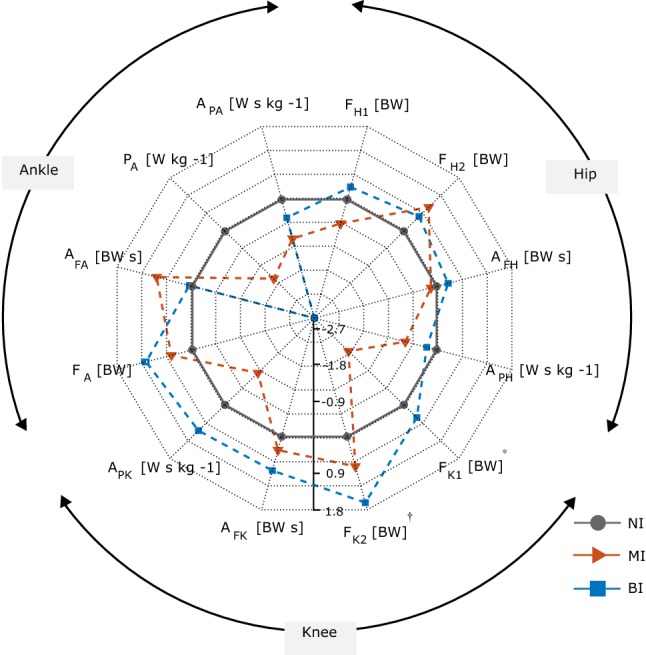
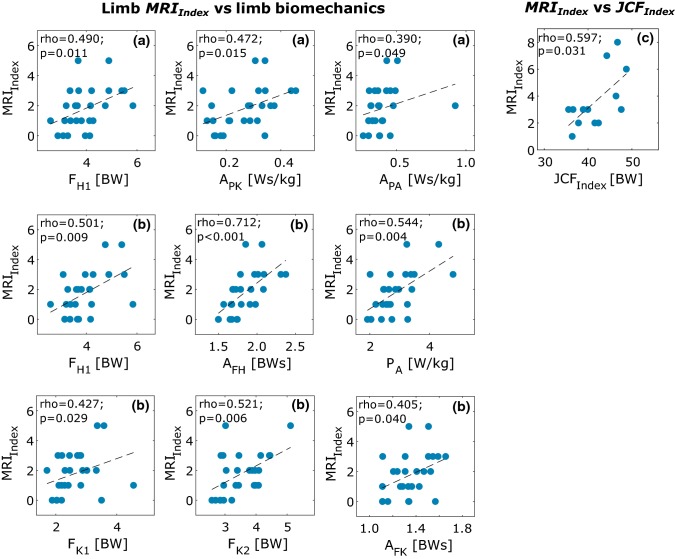
Juvenile Idiopathic Arthritis (JIA) is a paediatric musculoskeletal disease of unknown aetiology, leading to walking alterations when the lower-limb joints are involved. Diagnosis of JIA is mostly clinical. Imaging can quantify impairments associated to inflammation and joint damage. However, treatment planning could be better supported using dynamic information, such as joint contact forces (JCFs). To this purpose, we used a musculoskeletal model to predict JCFs and investigate how JCFs varied as a result of joint impairment in eighteen children with JIA. Gait analysis data and magnetic resonance images (MRI) were used to develop patient-specific lower-limb musculoskeletal models, which were evaluated for operator-dependent variability (< 3.6°, 0.05 N kg-1 and 0.5 BW for joint angles, moments, and JCFs, respectively). Gait alterations and JCF patterns showed high between-subjects variability reflecting the pathology heterogeneity in the cohort. Higher joint impairment, assessed with MRI-based evaluation, was weakly associated to overall joint overloading. A stronger correlation was observed between impairment of one limb and overload of the contralateral limb, suggesting risky compensatory strategies being adopted, especially at the knee level. This suggests that knee overloading during gait might be a good predictor of disease progression and gait biomechanics should be used to inform treatment planning.
Keywords: Biomechanics; Gait analysis; Juvenile arthritis; Lower-limb; MRI; Musculoskeletal; Musculoskeletal modelling; Opensim.
Figures
References
-
- Arnold AS, Blemker SS, Delp SL. Evaluation of a deformable musculoskeletal model for estimating muscle–tendon lengths during crouch gait. Ann. Biomed. Eng. 2001;29(3):263–274. - PubMed
-
- Arnold AS, Salinas S, Hakawa DJ, Delp SL. Accuracy of muscle moment arms estimated from MRI-based musculoskeletal models of the lower extremity. Comput. Aided Surg. 2000;5(2):108–119. - PubMed
-
- Broström E, Hagelberg S, Haglund-Åkerlind Y. Effect of joint injections in children with Juvenile Idiopathic Arthritis: evaluation by 3D-gait analysis. Acta Paediatr. 2004;93(7):906–910. - PubMed
-
- Cardillo G. Dunn’s test: a procedure for multiple, not parametric, comparisons. Natick: MATLAB Central, MathWorks; 2006.
-
- Cignoni P, Callieri M, Corsini M, Dellepiane M, Ganovelli F, Ranzuglia G. Meshlab: an open-source mesh processing tool. Eurographics Ital. Chap. Conf. 2008;2008:129–136.
MeSH terms
Grants and funding
LinkOut - more resources
Full Text Sources
Medical
