


Validity and reliability of the 9-item Shared Decision Making Questionnaire (SDM-Q-9) in a national survey in Hungary
- PMID: 31111402
- PMCID: PMC6544590
- DOI: 10.1007/s10198-019-01061-2
Validity and reliability of the 9-item Shared Decision Making Questionnaire (SDM-Q-9) in a national survey in Hungary
Abstract
Background: The nine-item Shared Decision Making Questionnaire (SDM-Q-9) is one of the most frequently applied instruments for assessing patients' involvement in medical decision-making. Our objectives were to develop a Hungarian version of SDM-Q-9, to evaluate its psychometric properties and to compare its performance between primary and specialised care settings.
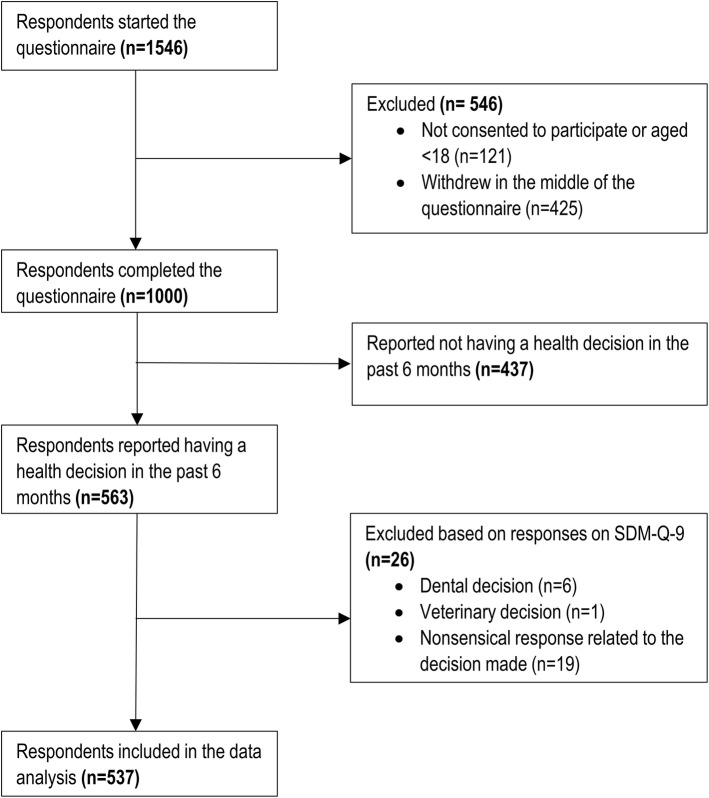
Methods: In 2019, a sample of adults (n = 537) representative of the Hungarian general population in terms of age, gender and geographic region completed an online survey with respect to a recent health-related decision. Outcome measures included SDM-Q-9 and Control Preferences Scale-post (CPSpost). Item characteristics, internal consistency reliability and the factor structure of SDM-Q-9 were determined.
Results: The overall ceiling and floor effects for SDM-Q-9 total scores were 12.3% and 2.2%, respectively. An excellent internal consistency reliability (Cronbach's alpha 0.925) was demonstrated. Exploratory factor analysis resulted in a one-factor model explaining 63.5% of the variance of SDM-Q-9. A confirmatory factor analysis supported the acceptability of this model. Known-groups validity was confirmed with CPSpost categories; mean SDM-Q-9 total scores were higher in the 'Shared decision' category (72.6) compared to both 'Physician decided' (55.1, p = 0.0002) and 'Patient decided' (57.2, p = 0.0086) categories. In most aspects of validity and reliability, there was no statistically significant difference between primary and specialised care.
Conclusions: The overall good measurement properties of the Hungarian SDM-Q-9 make the questionnaire suitable for use in both primary and specialised care settings. SDM-Q-9 may be useful for health policies targeting the implementation of shared decision-making and aiming to improve efficiency and quality of care in Hungary.
Keywords: Primary care; Psychometrics; SDM-Q-9; Shared decision-making; Specialised care.
Conflict of interest statement
In connection with writing this article, FR has received grant support from the Higher Education Institutional Excellence Program of the Ministry of Human Capacities in the framework of the ‘Financial and Public Services’ research project (20764-3/2018/FEKUTSTRAT) at Corvinus University of Budapest. The other authors declare that they have no conflict of interest.
Figures


References
-
- Langberg EM, Dyhr L, Davidsen AS. Development of the concept of patient-centredness—a systematic review. Patient Educ. Couns. 2019;5:6. - PubMed
-
- Djulbegovic B, Guyatt GH. Progress in evidence-based medicine: a quarter century on. Lancet (London, England) 2017;390(10092):415–423. - PubMed
-
- Fried TR. Shared decision making-finding the sweet spot. N. Engl. J. Med. 2016;374(2):104–106. - PubMed
-
- Oshima Lee E, Emanuel EJ. Shared decision making to improve care and reduce costs. N. Engl. J. Med. 2013;368(1):6–8. - PubMed
MeSH terms
LinkOut - more resources
Full Text Sources
