


A 44-Week Open-Label Study Evaluating Safety and Efficacy of Topical Glycopyrronium Tosylate in Patients with Primary Axillary Hyperhidrosis
- PMID: 31111409
- PMCID: PMC6687675
- DOI: 10.1007/s40257-019-00446-6
A 44-Week Open-Label Study Evaluating Safety and Efficacy of Topical Glycopyrronium Tosylate in Patients with Primary Axillary Hyperhidrosis
Abstract
Background: Glycopyrronium tosylate is a topical anticholinergic approved in the USA for primary axillary hyperhidrosis in patients aged ≥ 9 years (Qbrexza™ [glycopyrronium] cloth, 2.4%).
Objective: This 44-week open-label extension study assessed glycopyrronium tosylate safety and descriptive efficacy in patients completing one of two, phase III, double-blind, vehicle-controlled, 4-week trials (NCT02530281; NCT02530294).
Methods: Patients aged ≥ 9 years with primary axillary hyperhidrosis were randomized 2:1 (glycopyrronium tosylate: vehicle, once daily) in the double-blind trials. Completers could receive open-label glycopyrronium tosylate for up to an additional 44 weeks. Treatment-emergent adverse events and local skin reactions were assessed. Descriptive efficacy assessments were gravimetrically measured sweat production, Hyperhidrosis Disease Severity Scale responder rate (≥ 2 grade improvement), and Dermatology Life Quality Index/children's Dermatology Life Quality Index.
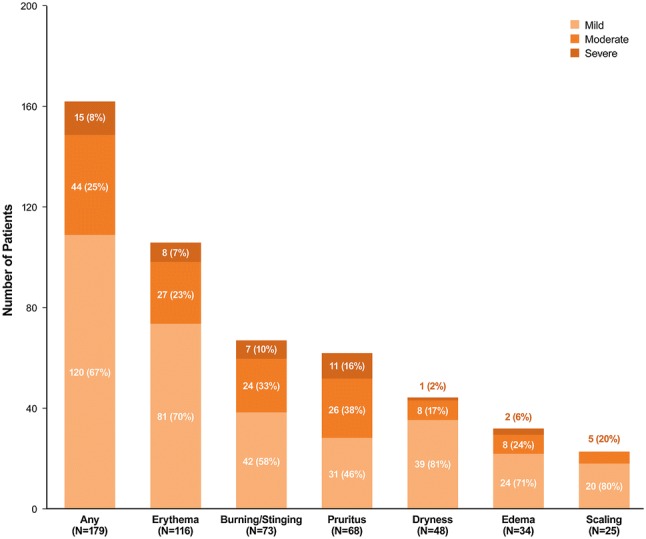
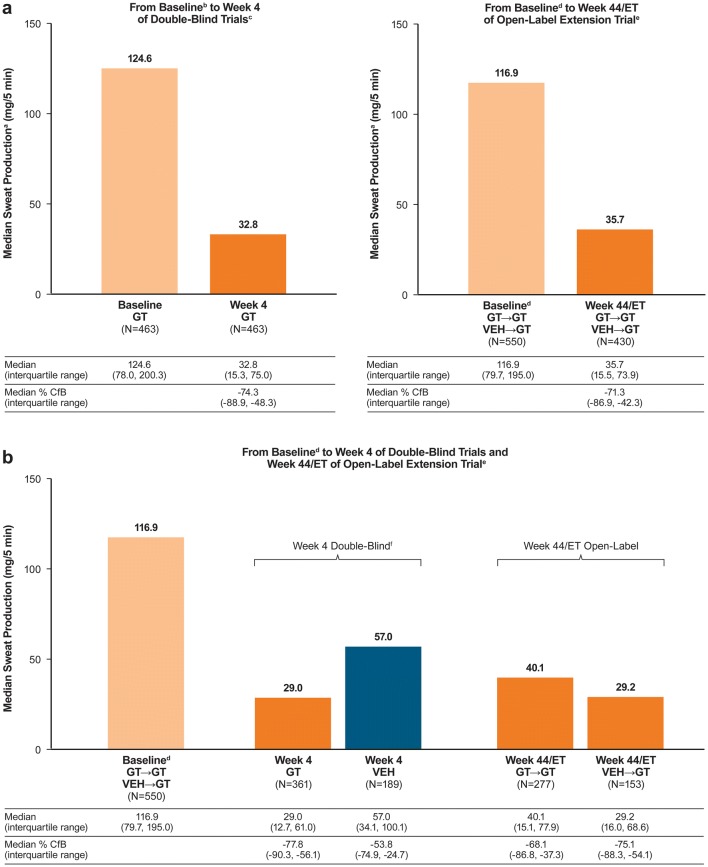
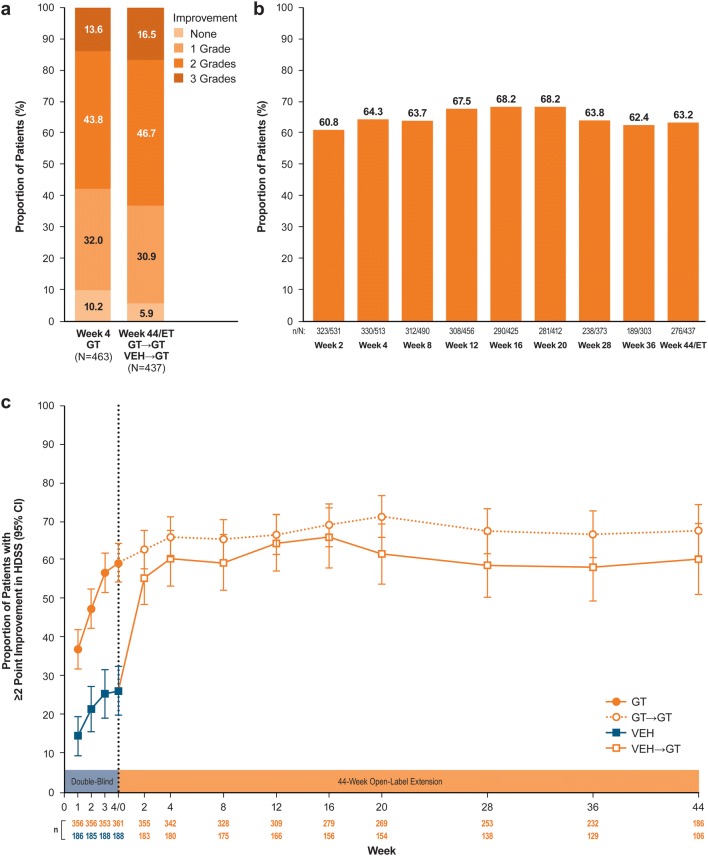
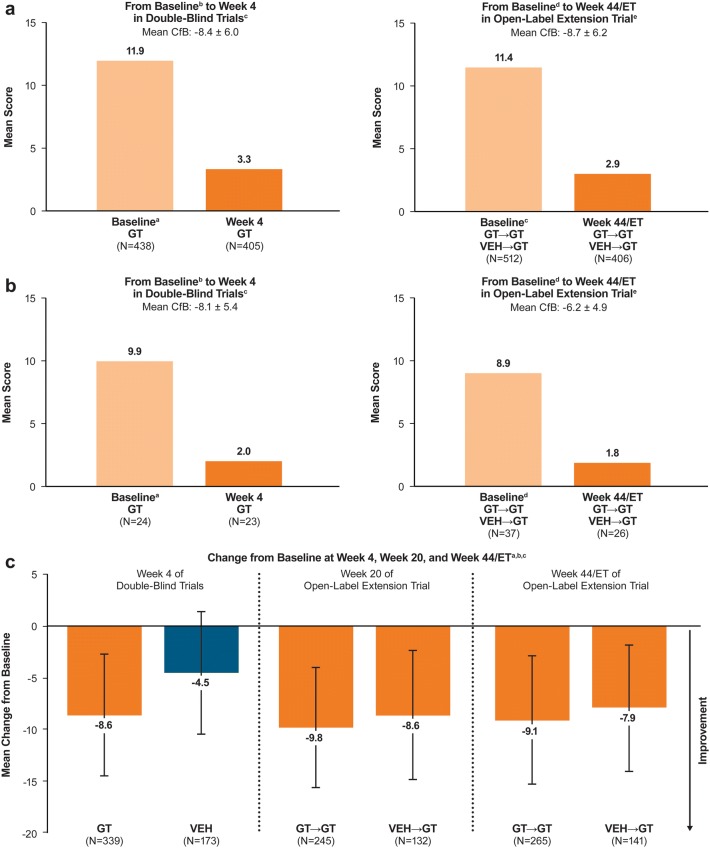
Results: Of 651 patients completing the double-blind trials, 564 (86.6%) entered the open-label extension; 550 were analyzed. Most patients experiencing treatment-emergent adverse events had mild or moderate events (> 90%). Discontinuation because of treatment-emergent adverse events remained low and relatively stable, with a cumulative rate of 8.0% (44/550) over 44 weeks. Common treatment-emergent adverse events (> 5%) were dry mouth (16.9%), vision blurred (6.7%), application-site pain (6.4%), nasopharyngitis (5.8%), and mydriasis (5.3%). Most patients (67.5%) had no local skin reactions; those occurring were predominantly mild/moderate. Glycopyrronium tosylate efficacy was maintained throughout the trial; at week 44, the Hyperhidrosis Disease Severity Scale responder rate was 63.2%, and improvements from baseline (double blind) in sweat production were - 71.3% and 8.7 ± 6.2/6.2 ± 4.9 for Dermatology Life Quality Index/children's Dermatology Life Quality Index.
Conclusions: Daily long-term application of glycopyrronium tosylate for up to 48 weeks (double blind plus open label) was generally well tolerated and efficacy was maintained. No new safety signals emerged.
Trial registry: Clinicaltrials.gov NCT02553798.
Conflict of interest statement
Dee Anna Glaser is an investigator for Allergan, Galderma, ATACAMA, Brickell Biotech, Inc., Dermira, Inc., Evolus, and Sienna Biopharmaceuticals, Inc. and a consultant for Dermira, Inc. William P. Werschler is a consultant and investigator for Dermira, Inc. Adelaide A. Herbert is a consultant for Dermira, Inc. and an employee of the UTHealth McGovern Medical School, which received compensation from Dermira, Inc. for study participation. Alexander Nast is an employee of Charité – Universitätsmedizin Berlin, which received compensation from Dermira, Inc. for study participation; he was an advisory board member for Boehringer Ingelheim, carried out educational activities for Bayer and Novartis, and received research grants from Eli Lilly and Company, Pfizer, GSK, Plc., and MEDA. Lawrence Green is an investigator for Brickell Biotech, Inc. and an advisory board member and investigator for Dermira, Inc. Richard D. Mamelok is a consultant for Dermira, Inc. John Quiring is an employee of QST Consultations. Janice Drew is an employee of Dermira, Inc. David M. Pariser is a consultant and investigator for Brickell Biotech, Inc., Celgene Corporation, Dermira, Inc., LEO Pharma US, Novartis Pharmaceuticals, Promius Pharmaceuticals, Regeneron, and Valeant Pharmaceuticals International, a consultant for ATACAMA, Biofrontera AG, DUSA Pharmaceuticals, Inc., Sonofi, TDM SurgiTech, Inc., and TheraVida, and an investigator for Abbott Laboratories, Amgen, Asana Biosciences, Dermavant Sciences, Eli Lilly and Company, Merck & Co., Inc., Novo Nordisk A/S, Ortho Dermatologics, Peplin Inc., Pfizer Inc., Photocure ASA, and Stiefel (as GSK company).
Figures

References
-
- Naumann M, Hamm H, Spalding JR, Kowalski J, Lee J. Comparing the quality of life effects of primary focal hyperhidrosis to other dermatological conditions as assessed by the Dermatology Life Quality Index (DLQI) Value Health. 2003;6:242. doi: 10.1016/S1098-3015(10)63957-5. - DOI
-
- Alvarez MA, Ruano J, Gomez FJ, Casas E, Baamonde C, Salvatierra A, et al. Differences between objective efficacy and perceived efficacy in patients with palmar hyperhidrosis treated with either botulinum toxin or endoscopic thoracic sympathectomy. J Eur Acad Dermatol Venereol. 2013;27:e282–e288. doi: 10.1111/j.1468-3083.2012.04630.x. - DOI - PubMed
Publication types
MeSH terms
Substances
Associated data
LinkOut - more resources
Full Text Sources
Other Literature Sources
Medical
