Review
. 2019 Apr:55:46-51.
doi: 10.1016/j.gde.2019.04.014. Epub 2019 May 18.

Epigenetic gene regulation, chromatin structure, and force-induced chromatin remodelling in epidermal development and homeostasis

Affiliations
Review

Epigenetic gene regulation, chromatin structure, and force-induced chromatin remodelling in epidermal development and homeostasis

Yekaterina A Miroshnikova et al. Curr Opin Genet Dev. 2019 Apr.

Abstract

The skin epidermis is a constantly renewing stratified epithelium that provides essential protective barrier functions throughout life. Epidermal stratification is governed by a step-wise differentiation program that requires precise spatiotemporal control of gene expression. How epidermal self-renewal and differentiation are regulated remains a fundamental open question. Cell-intrinsic and cell-extrinsic mechanisms that modify chromatin structure and interactions have been identified as key regulators of epidermal differentiation and stratification. Here, we will review the recent advances in our understanding of how chromatin modifiers, tissue-specific transcription factors, and force-induced nuclear remodeling processes function to shape chromatin and to control epidermal tissue development and homeostasis.


Conflict of interest statement

Conflict of interest

The authors declare no conflict of interest.

Figures
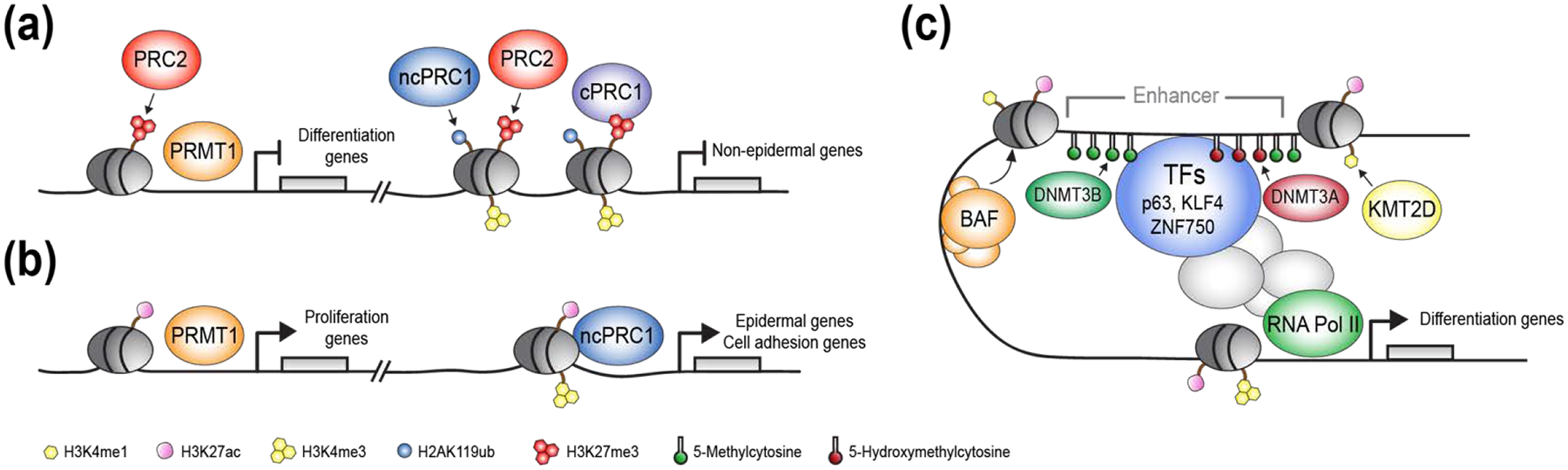
Figure 1.
Figure 1.. Epidermal transcriptional regulation by chromatin modifiers and transcription factors.
(a, right) Promoters of non-epidermal and epidermal differentiation genes are repressed by Polycomb repressive complex 2 (PRC2)-dependent histone H3 lysine 27 trimethylation (H3K27me3) and PRC1-depenendent histone H2A lysine 119 monoubiquitination (H2AK119ub) histone marks. (a, left) PRC2 and PRMT1 repress expression of epidermal differentiation genes and prevents premature epidermal differentiation. (b, right) Non-canonical PRC1 (ncPRC1) binds to promoters of epidermal lineage and cell adhesion genes and promotes gene expression, independently of PRC2 or canonical-PRC1 (cPRC1). (b, left) PRMT1 promotes expression of proliferation genes and sustains epidermal progenitor self-renewal. (c) Schematic illustration of the diverse mechanisms in which lineage-specific epidermal transcription factors work in-concert with chromatin modifiers to establish an open chromatin state and facilitate enhancer-promoter interactions, leading to activation of gene expression.
Figure 2.
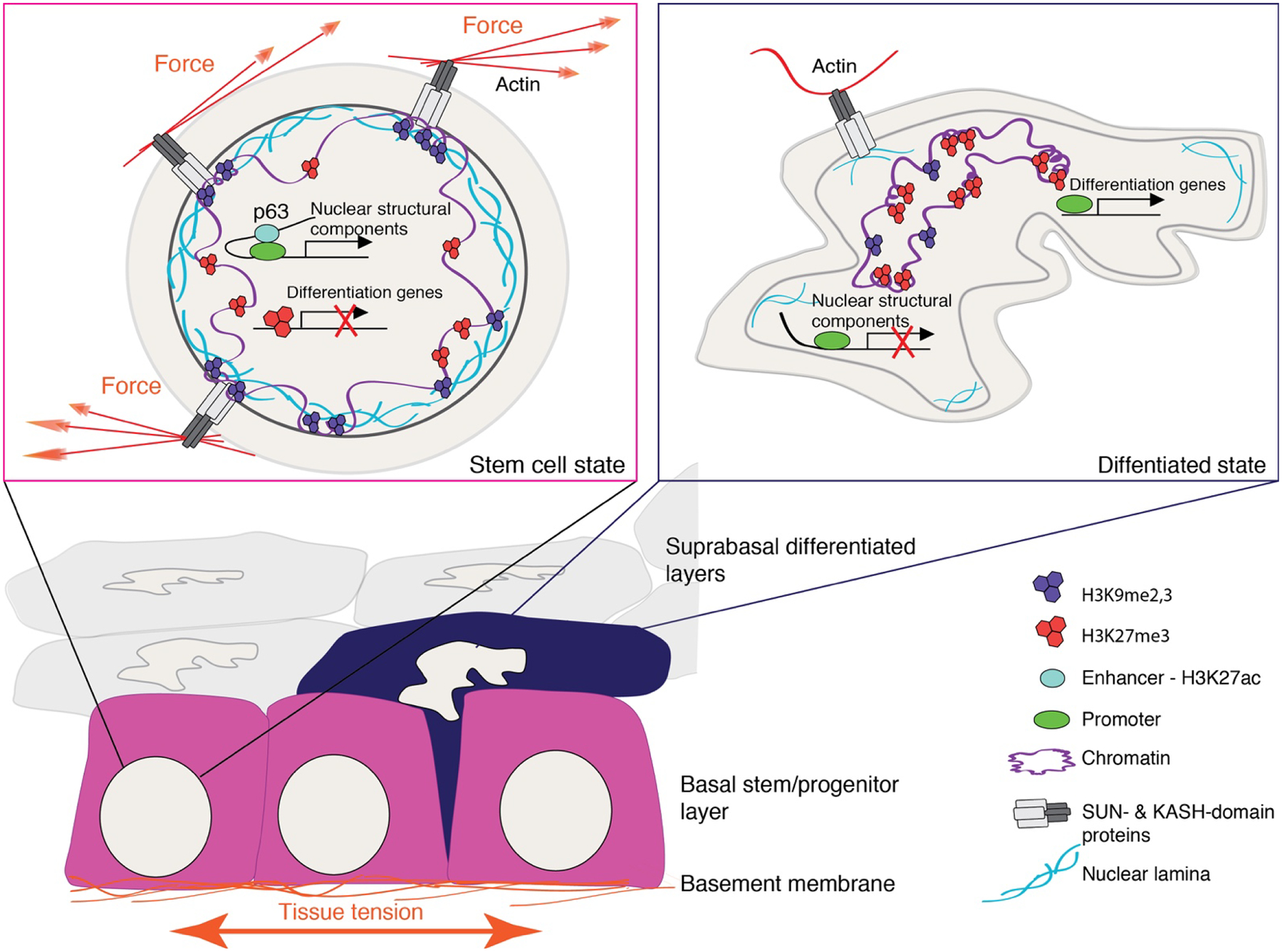
Figure 2.. A model describing changes in the nuclear and chromatin architecture during epidermal stratification.
Extrinsic mechanical forces from the epidermal basement are transduced to the nucleus of basal stem/progenitor cells via members of the linker of nucleoskeleton and cytoskeleton, SUN- and KASH- domain proteins. Stem cells thus exhibit a mechanically stiff nucleus with p63-driven enhancer-promoter interactions driving expression of nuclear structural components such as A-type lamins and nesprins and anchoring of H3K9me2,3-marked heterochromatin to the nuclear lamina. Precautious differentiation is prevented by H3K27me3-mediated suppression of differentiation genes that can be reinforced by mechanical force. As cells commit to differentiation, they withdraw from the cell cycle, delaminate from the basement membrane and move upward to the suprabasal layers. During delamination, epidermal cells decrease their cell-intrinsic tension and nuclear volume, lose p63 expression, and their H3K9me2,3-and H3K27me3-marked heterochromatin transitions to the nuclear interior. These changes are likely to elevate nuclear deformability and thus facilitate the upward movement of cells within the tightly packed cell layers.

References

    1. Gonzales KAU and Fuchs E (2017) Skin and Its Regenerative Powers: An Alliance between Stem Cells and Their Niche. Dev. Cell 43, 387–401 - PMC - PubMed
    1. Chacón‐Martínez CA et al. (2017) Hair follicle stem cell cultures reveal self‐organizing plasticity of stem cells and their progeny. EMBO J 36, 151–164 - PMC - PubMed
    1. Bickmore WA and Van Steensel B (2013) Genome architecture: Domain organization of interphase chromosomes. Cell 152, 1270–1284. - PubMed
    1. Le HQ et al. (2016) Mechanical regulation of transcription controls Polycomb-mediated gene silencing during lineage commitment. Nat. Cell Biol 18, 864–75 - PubMed
    2. ** This paper demonstrates how extrinsic mechanical strain impacts chromatin structure and epigenetic gene regulation. The authors show that while strain induces general chromatin decompaction in epidermal progenitor cells, transcriptional repression leads to accumulation of H3K27me3 at terminal differentiation genes, preventing their expression.

    1. Samuel MS et al. (2011) Actomyosin-mediated cellular tension drives increased tissue stiffness and β-catenin activation to induce epidermal hyperplasia and tumor growth. Cancer Cell 19, 776–91 - PMC - PubMed

Publication types