Fraction of Inspired Oxygen as a Predictor of CPAP Failure in Preterm Infants with Respiratory Distress Syndrome: A Prospective Multicenter Study
- PMID: 31112987
- PMCID: PMC6878744
- DOI: 10.1159/000499674
Fraction of Inspired Oxygen as a Predictor of CPAP Failure in Preterm Infants with Respiratory Distress Syndrome: A Prospective Multicenter Study
Abstract
Introduction: There are limited data available regarding the fraction of inspired oxygen (FiO2) predictive of the failure of continuous positive airway pressure (CPAP) in preterm infants with respiratory distress syndrome (RDS). Therefore, we investigated factors predictive of CPAP failure in the first 72 h of life, with special attention to the prognostic role of FiO2.
Methods: This multicenter, prospective study enrolled infants <30 weeks gestation in whom CPAP was initiated within the first 15 min after birth. In the univariate and multivariate logistic regression models, demographic, perinatal, and respiratory parameters were analyzed. The FiO2 threshold was determined with ROC curve analysis.
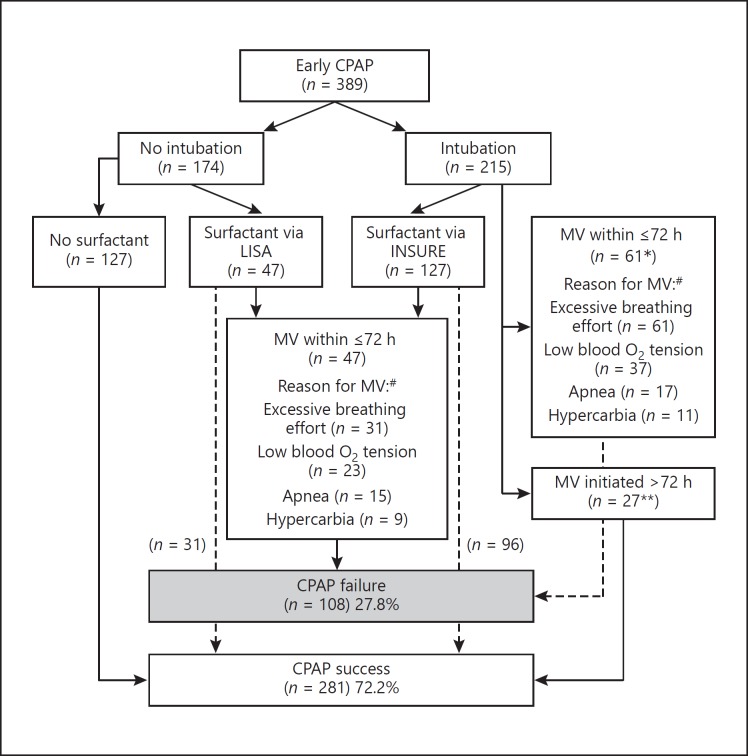
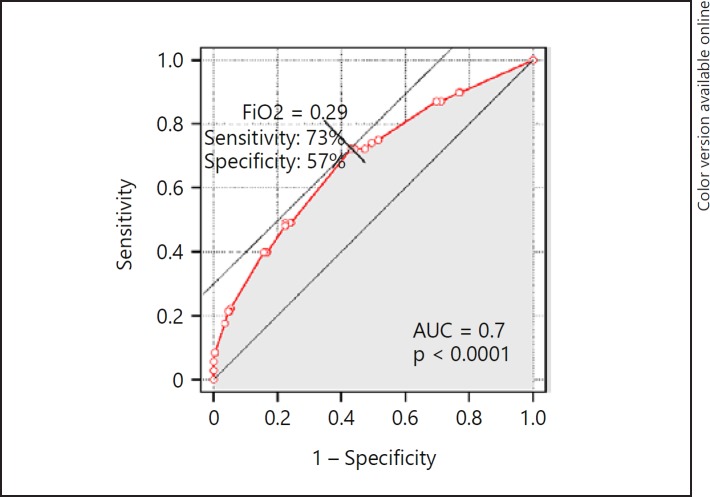
Results: Of 389 recruited newborns, CPAP failure occurred in 108 infants (27.8%). In the univariate model, each gestational week reduced the odds of CPAP failure by 19%, and each 100 g of birth weight reduced the odds by 16% (both p < 0.05). The risk was increased by 4.2 and 7.5% for each 0.01 increase in FiO2in the first and second hours of life, respectively. In the final multivariate model, birth weight and FiO2 in the second hour of life were the predictive measures. The prognostic threshold was FiO2 = 0.29 in the second hour of life (AUC 0.7; p < 0.0001), with a sensitivity of 73% and a specificity of 57%. CPAP failure implied a more than 20-fold higher risk of death and pneumothorax and a 2- to 5-fold higher risk of typical complications of prematurity, including bronchopulmonary dysplasia and severe intraventricular hemorrhage.
Conclusion: FiO2 in the second hour of life is a significantpredictor of CPAP failure. The threshold of 0.29 best discriminates the CPAP outcome. Nonresponders to CPAP have a remarkably higher incidence of complications and a higher mortality rate.
Keywords: Continuous positive airway pressure; Fraction of inspired oxygen; Mechanical ventilation; Preterm infant; Respiratory distress syndrome; Treatment failure.
The Author(s). Published by S. Karger AG, Basel.
Conflict of interest statement
R.H. is employed by Chiesi Poland, the sponsor of the study. E.G., M.R., and M.K.B.-K. received honoraria from Chiesi Poland for scientific presentations and participation on advisory boards. T.S. received honoraria for lectures from Chiesi Poland.
Figures
References
-
- Parat S, Mhanna MJ. Respiratory management of extremely low birth weight infants: survey of neonatal specialists. World J Pediatr. 2016 Aug;12((3)):314–9. - PubMed
-
- Trevisanuto D, Satariano I, Doglioni N, Criscoli G, Cavallin F, Gizzi C, et al. Neonatal Resuscitation Study Group, Italian Society of Neonatology Changes over time in delivery room management of extremely low birth weight infants in Italy. Resuscitation. 2014 Aug;85((8)):1072–6. - PubMed
-
- Sweet DG, Carnielli V, Greisen G, Hallman M, Ozek E, Plavka R, et al. European Consensus Guidelines on the Management of Respiratory Distress Syndrome - 2016 Update. Neonatology. 2017;111((2)):107–25. - PubMed
-
- Subramaniam P, Ho JJ, Davis PG. Prophylactic nasal continuous positive airway pressure for preventing morbidity and mortality in very preterm infants. Cochrane Database Syst Rev. 2016 Jun;14((6)):CD001243. - PubMed
-
- Dargaville PA, Aiyappan A, De Paoli AG, Dalton RG, Kuschel CA, Kamlin CO, et al. Continuous positive airway pressure failure in preterm infants: incidence, predictors and consequences. Neonatology. 2013;104((1)):8–14. - PubMed
Publication types
MeSH terms
Substances
Supplementary concepts
LinkOut - more resources
Full Text Sources
Medical