


Women have lower chances than men to be resuscitated and survive out-of-hospital cardiac arrest
- PMID: 31112998
- PMCID: PMC6911168
- DOI: 10.1093/eurheartj/ehz297
Women have lower chances than men to be resuscitated and survive out-of-hospital cardiac arrest
Abstract
Aims: Previous studies on sex differences in out-of-hospital cardiac arrest (OHCA) had limited scope and yielded conflicting results. We aimed to provide a comprehensive overall view on sex differences in care utilization, and outcome of OHCA.
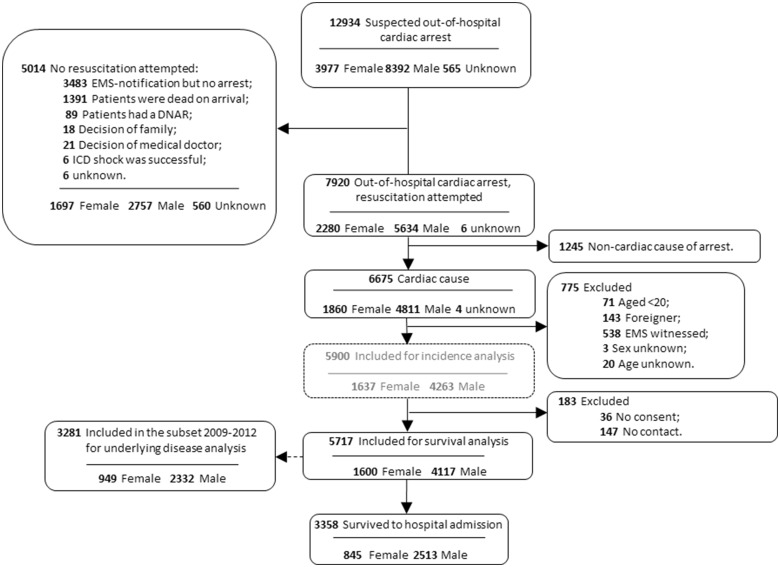
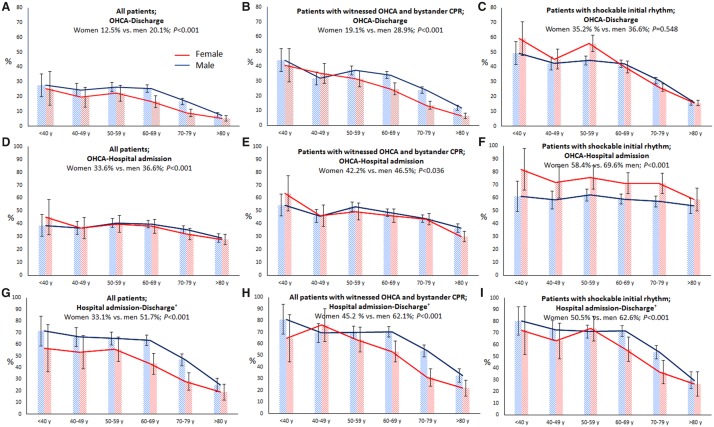
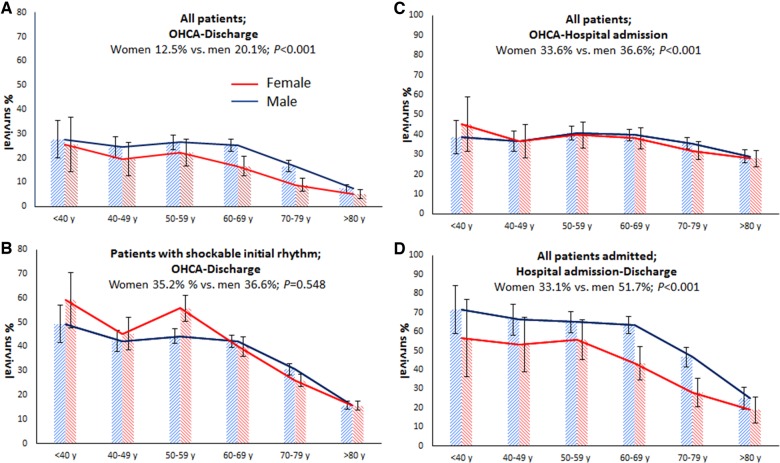
Methods and results: We performed a population-based cohort-study, analysing all emergency medical service (EMS) treated resuscitation attempts in one province of the Netherlands (2006-2012). We calculated odds ratios (ORs) for the association of sex and chance of a resuscitation attempt by EMS, shockable initial rhythm (SIR), and in-hospital treatment using logistic regression analysis. Additionally, we provided an overview of sex differences in overall survival and survival at successive stages of care, in the entire study population and in patients with SIR. We identified 5717 EMS-treated OHCAs (28.0% female). Women with OHCA were less likely than men to receive a resuscitation attempt by a bystander (67.9% vs. 72.7%; P < 0.001), even when OHCA was witnessed (69.2% vs. 73.9%; P < 0.001). Women who were resuscitated had lower odds than men for overall survival to hospital discharge [OR 0.57; 95% confidence interval (CI) 0.48-0.67; 12.5% vs. 20.1%; P < 0.001], survival from OHCA to hospital admission (OR 0.88; 95% CI 0.78-0.99; 33.6% vs. 36.6%; P = 0.033), and survival from hospital admission to discharge (OR 0.49, 95% CI 0.40-0.60; 33.1% vs. 51.7%). This was explained by a lower rate of SIR in women (33.7% vs. 52.7%; P < 0.001). After adjustment for resuscitation parameters, female sex remained independently associated with lower SIR rate.
Conclusion: In case of OHCA, women are less often resuscitated by bystanders than men. When resuscitation is attempted, women have lower survival rates at each successive stage of care. These sex gaps are likely explained by lower rate of SIR in women, which can only partly be explained by resuscitation characteristics.
Keywords: Cardiopulmonary resuscitation; ESCAPE-NET; Epidemiology; Out-of-hospital cardiac arrest; Sex differences.
© The Author(s) 2019. Published by Oxford University Press on behalf of the European Society of Cardiology.
Figures
Comment in
-
Post-cardiac arrest evaluation: understanding non-shockable rhythms.Eur Heart J. 2019 Dec 14;40(47):3835-3837. doi: 10.1093/eurheartj/ehz504. Eur Heart J. 2019. PMID: 31408103 Free PMC article. No abstract available.
References
-
- Orth-Gomér K, Deter HC.. Sex and gender issues in Cardiovascular Research. Psychosom Med 2015;77:1067–1068. - PubMed
-
- Bairey Merz CN, Ramineni T, Leong D.. Sex-specific risk factors for cardiovascular disease in women-making cardiovascular disease real. Curr Opin Cardiol 2018;33:500–505. - PubMed
-
- Appelman Y, van Rijn BB, Ten Haaf ME, Boersma E, Peters SA.. Sex differences in cardiovascular risk factors and disease prevention. Atherosclerosis 2015;241:211–218. - PubMed
-
- O'Neil A, Scovelle AJ, Milner AJ, Kavanagh A.. Gender/sex as a social determinant of cardiovascular risk. Circulation 2018;137:854–864. - PubMed
-
- Timmis A, Townsend N, Gale C, Grobbee R, Maniadakis N, Flather M, Wilkins E, Wright L, Vos R, Bax J, Blum M, Pinto F, Vardas P.. European Society of Cardiology: cardiovascular Disease Statistics 2017. Eur Heart J 2018;39:508–579. - PubMed
Publication types
MeSH terms
LinkOut - more resources
Full Text Sources
Medical
