


PubTator central: automated concept annotation for biomedical full text articles
- PMID: 31114887
- PMCID: PMC6602571
- DOI: 10.1093/nar/gkz389
PubTator central: automated concept annotation for biomedical full text articles
Abstract
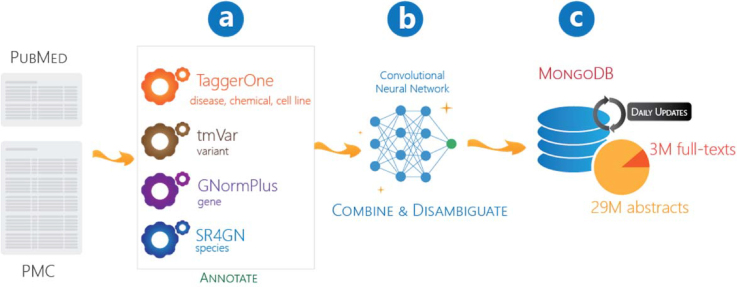
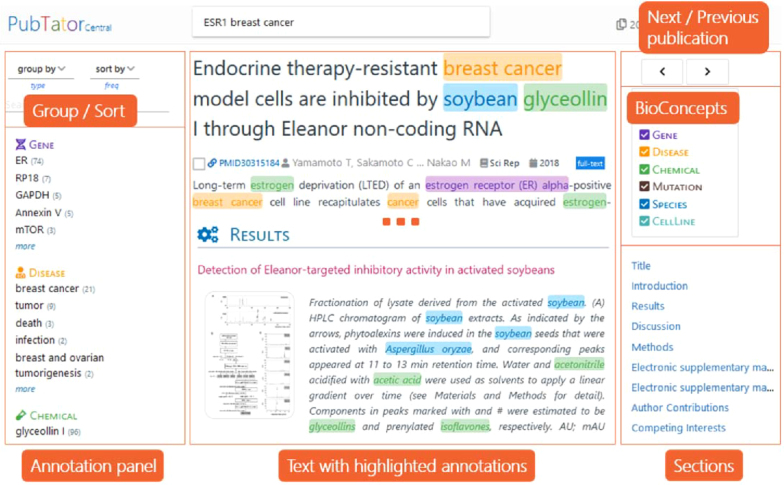
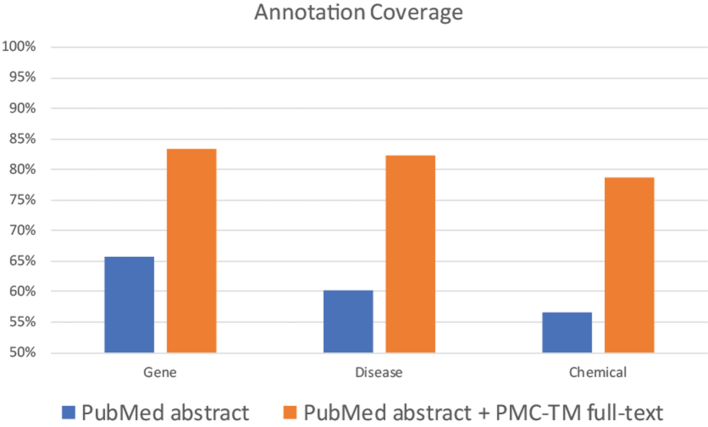
PubTator Central (https://www.ncbi.nlm.nih.gov/research/pubtator/) is a web service for viewing and retrieving bioconcept annotations in full text biomedical articles. PubTator Central (PTC) provides automated annotations from state-of-the-art text mining systems for genes/proteins, genetic variants, diseases, chemicals, species and cell lines, all available for immediate download. PTC annotates PubMed (29 million abstracts) and the PMC Text Mining subset (3 million full text articles). The new PTC web interface allows users to build full text document collections and visualize concept annotations in each document. Annotations are downloadable in multiple formats (XML, JSON and tab delimited) via the online interface, a RESTful web service and bulk FTP. Improved concept identification systems and a new disambiguation module based on deep learning increase annotation accuracy, and the new server-side architecture is significantly faster. PTC is synchronized with PubMed and PubMed Central, with new articles added daily. The original PubTator service has served annotated abstracts for ∼300 million requests, enabling third-party research in use cases such as biocuration support, gene prioritization, genetic disease analysis, and literature-based knowledge discovery. We demonstrate the full text results in PTC significantly increase biomedical concept coverage and anticipate this expansion will both enhance existing downstream applications and enable new use cases.
Published by Oxford University Press on behalf of Nucleic Acids Research 2019.
Figures
References
Publication types
MeSH terms
Substances
LinkOut - more resources
Full Text Sources
Molecular Biology Databases
