. 2019 Sep 1;76(9):924-932.
doi: 10.1001/jamapsychiatry.2019.1119.

Genetic Variants Associated With Anxiety and Stress-Related Disorders: A Genome-Wide Association Study and Mouse-Model Study

Affiliations

Genetic Variants Associated With Anxiety and Stress-Related Disorders: A Genome-Wide Association Study and Mouse-Model Study

Sandra M Meier et al. JAMA Psychiatry. .

Abstract

Importance: Anxiety and stress-related disorders are among the most common mental disorders. Although family and twin studies indicate that both genetic and environmental factors play an important role underlying their etiology, the genetic underpinnings of anxiety and stress-related disorders are poorly understood.

Objectives: To estimate the single-nucleotide polymorphism-based heritability of anxiety and stress-related disorders; to identify novel genetic risk variants, genes, or biological pathways; to test for pleiotropic associations with other psychiatric traits; and to evaluate the association of psychiatric comorbidities with genetic findings.

Design, setting, participants: This genome-wide association study included individuals with various anxiety and stress-related diagnoses and controls derived from the population-based Lundbeck Foundation Initiative for Integrative Psychiatric Research (iPSYCH) study. Lifetime diagnoses of anxiety and stress-related disorders were obtained through the national Danish registers. Genes of interest were further evaluated in mice exposed to chronic social defeat. The study was conducted between June 2016 and November 2018.

Main outcomes and measures: Diagnoses of a relatively broad diagnostic spectrum of anxiety and stress-related disorders.

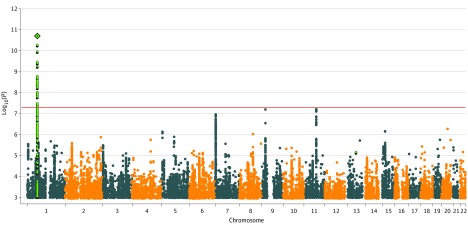
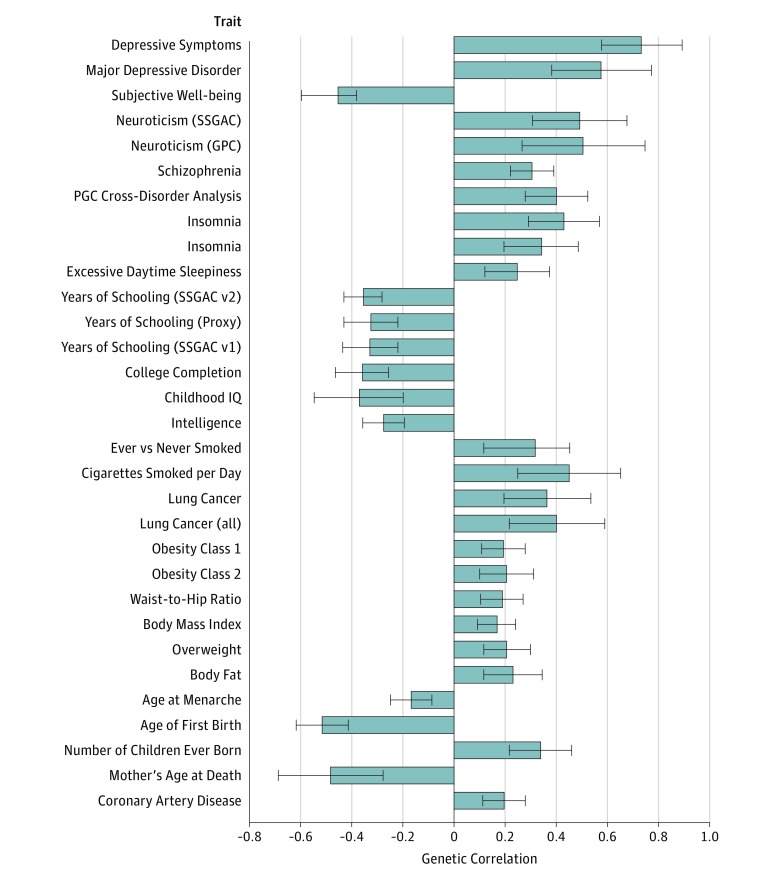
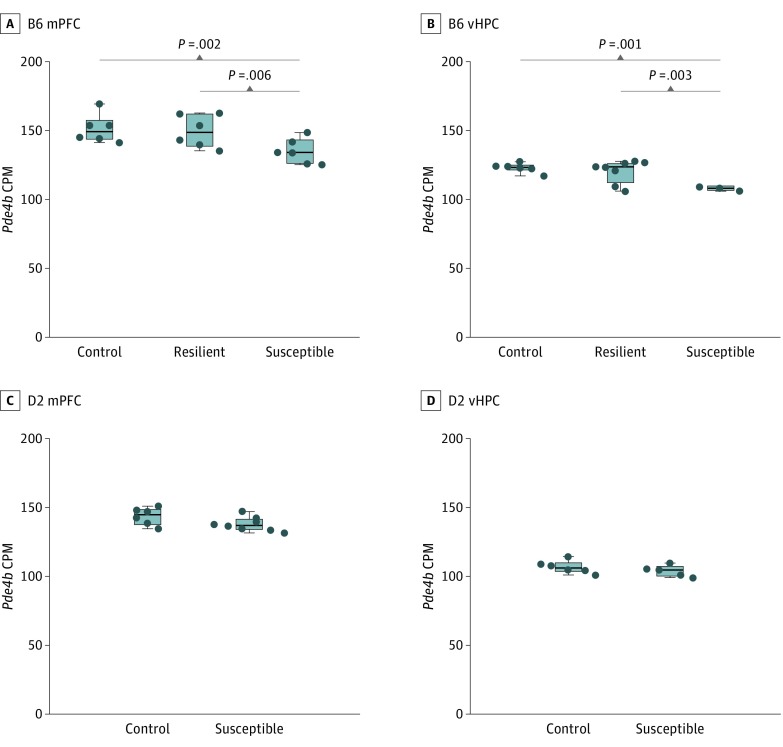
Results: The study sample included 12 655 individuals with various anxiety and stress-related diagnoses and 19 225 controls. Overall, 17 740 study participants (55.6%) were women. A total of 7308 participants (22.9%) were born between 1981-1985, 8840 (27.7%) between 1986-1990, 8157 (25.6%) between 1991-1995, 5918 (18.6%) between 1996-2000, and 1657 (5.2%) between 2001-2005. Standard association analysis revealed variants in PDE4B to be associated with anxiety and stress-related disorder (rs7528604; P = 5.39 × 10⁻¹¹; odds ratio = 0.89; 95% CI, 0.86-0.92). A framework of sensitivity analyses adjusting for mental comorbidity supported this result showing consistent association of PDE4B variants with anxiety and stress-related disorder across analytical scenarios. In mouse models, alterations in Pde4b expression were observed in those mice displaying anxiety-like behavior after exposure to chronic stress in the prefrontal cortex (P = .002; t = -3.33) and the hippocampus (P = .001; t = -3.72). We also found a single-nucleotide polymorphism heritability of 28% (standard error = 0.027) and that the genetic signature of anxiety and stress-related overlapped with psychiatric traits, educational outcomes, obesity-related phenotypes, smoking, and reproductive success.

Conclusions and relevance: This study highlights anxiety and stress-related disorders as complex heritable phenotypes with intriguing genetic correlations not only with psychiatric traits, but also with educational outcomes and multiple obesity-related phenotypes. Furthermore, we highlight the candidate gene PDE4B as a robust risk locus pointing to the potential of PDE4B inhibitors in treatment of these disorders.


Conflict of interest statement

Conflict of Interest Disclosures: Dr Mortensen reports grants from the Lundbeck Foundation during the conduct of the study and outside the submitted work. Dr Hougaard reports grants from the Lundbeck Foundation during the conduct of the study and personal fees from the Statens Serum Institut outside the submitted work. Dr Nordentoft reports grants from the Lundbeck Foundation during the conduct of the study. Dr Breen reports grants from the UK National Institute for Health Research during the conduct of the study. Dr Børglum reports grants from the Lundbeck Foundation during the conduct of the study and outside the submitted work. Dr Eley reports grants from the UK Medical Research Council, UK National Institute for Health Research, and Fondation Peters during the conduct of the study. Dr Hovatta reports grants from European Research Council, Sigrid Juselius Foundation, and University of Helsinki during the conduct of the study. Dr Mattheisen reports grants from the Lundbeck Foundation during the conduct of the study. Dr Mors reports grants from the Lundbeck Foundation during the conduct of the study. No other disclosures were reported.

Figures

Figure 1.
Figure 1.. Manhattan Plot of the Results From the Genome-Wide Association Study of Anxiety and Stress-Related Disorders
This plot displays 12 665 individuals and 19 225 controls. Single-nucleotide polymorphisms in green are in linkage disequilibrium with the index single-nucleotide polymorphisms (diamonds) and have a P value less than .001. Index variants located with a distance less than 400 kilobase are considered as 1 locus.
Figure 2.
Figure 2.. Significant Genetic Correlations Between Anxiety and Stress-Related Disorders and Other Heritable Traits
Bonferroni correction P < 2.19 × 10−4. In total, 228 traits were tested, including psychiatric traits, educational outcomes, obesity-related phenotypes, smoking, and reproductive success (eTable 4 in the Supplement). Error bars indicate 95% confidence limits. GPC indicates Genetics of Personality Consortium; PGC, Psychiatric Genomics Consortium; SSGAC, Social Science Genetic Association Consortium.
Figure 3.
Figure 3.. Differential Pde4b Gene Expression Levels in Mice Exposed to Chronic Psychosocial Stress
Each sample is represented by a dot superimposed on the box plot. Number of mice per group: B6 strain controls = 6 (mPFC and vHPC), resilient = 6 (mPFC) and 8 (vHPC), susceptible = 6 (mPFC) and 3 (vHPC); D2 strain controls = 6 (mPFC and vHPC), resilient = 0, susceptible = 8 (mPFC) and 5 (vHPC). CPM indicates log counts per million; mPFC, medial prefrontal cortex; vHPC, ventral hippocampus.

Comment in

References

    1. Kessler RC, Avenevoli S, Costello EJ, et al. . Prevalence, persistence, and sociodemographic correlates of DSM-IV disorders in the National Comorbidity Survey Replication Adolescent Supplement. Arch Gen Psychiatry. 2012;69(4):372-380. doi:10.1001/archgenpsychiatry.2011.160 - DOI - PMC - PubMed
    1. Wittchen HU, Jacobi F, Rehm J, et al. . The size and burden of mental disorders and other disorders of the brain in Europe 2010. Eur Neuropsychopharmacol. 2011;21(9):655-679. doi:10.1016/j.euroneuro.2011.07.018 - DOI - PubMed
    1. Hettema JM, Neale MC, Kendler KS. A review and meta-analysis of the genetic epidemiology of anxiety disorders. Am J Psychiatry. 2001;158(10):1568-1578. doi:10.1176/appi.ajp.158.10.1568 - DOI - PubMed
    1. Tambs K, Czajkowsky N, Røysamb E, et al. . Structure of genetic and environmental risk factors for dimensional representations of DSM-IV anxiety disorders. Br J Psychiatry. 2009;195(4):301-307. doi:10.1192/bjp.bp.108.059485 - DOI - PMC - PubMed
    1. Erhardt A, Czibere L, Roeske D, et al. . TMEM132D, a new candidate for anxiety phenotypes: evidence from human and mouse studies. Mol Psychiatry. 2011;16(6):647-663. doi:10.1038/mp.2010.41 - DOI - PubMed

Publication types

MeSH terms

Substances