Clinical Trial
. 2019 May 22;7(1):136.
doi: 10.1186/s40425-019-0599-8.

Safety and enhanced immunostimulatory activity of the DRD2 antagonist ONC201 in advanced solid tumor patients with weekly oral administration

Affiliations
Clinical Trial

Safety and enhanced immunostimulatory activity of the DRD2 antagonist ONC201 in advanced solid tumor patients with weekly oral administration

Mark N Stein et al. J Immunother Cancer. .

Abstract

Background: ONC201 is a small molecule antagonist of DRD2, a G protein-coupled receptor overexpressed in several malignancies, that has prolonged antitumor efficacy and immunomodulatory properties in preclinical models. The first-in-human trial of ONC201 previously established a recommended phase II dose (RP2D) of 625 mg once every three weeks. Here, we report the results of a phase I study that evaluated the safety, pharmacokinetics (PK), and pharmacodynamics (PD) of weekly ONC201.

Methods: Patients ≥ 18 years old with an advanced solid tumor refractory to standard treatment were enrolled. Dose escalation proceeded with a 3 + 3 design from 375 mg to 625 mg of ONC201. One cycle, also the dose-limiting toxicity (DLT) window, was 21 days. The primary endpoint was to determine the RP2D of weekly ONC201, which was confirmed in an 11-patient dose expansion cohort.

Results: Twenty patients were enrolled: three at 375 mg and 17 at 625 mg of ONC201. The RP2D was defined as 625 mg with no DLT, treatment discontinuation, or dose modifications due to drug-related toxicity. PK profiles were consistent with every-three-week dosing and similar between the first and fourth dose. Serum prolactin and caspase-cleaved cytokeratin-18 induction were detected, along with intratumoral integrated stress response activation and infiltration of granzyme B+ Natural Killer cells. Induction of immune cytokines and effectors was higher in patients who received ONC201 once weekly versus once every three weeks. Stable disease of > 6 months was observed in several prostate and endometrial cancer patients.

Conclusions: Weekly, oral ONC201 is well-tolerated and results in enhanced immunostimulatory activity that warrants further investigation.

Trial registration: NCT02250781 (Oral ONC201 in Treating Patients With Advanced Solid Tumors), NCT02324621 (Continuation of Oral ONC201 in Treating Patients With Advanced Solid Tumors).

Keywords: Cancer; Dopamine; Immuno-oncology; Immunotherapy; ONC201; Solid tumors.


Conflict of interest statement

Rohinton S. Tarapore, Varun V. Prabhu, Joshua E. Allen, Martin Stogniew, and Wolfgang Oster are employees and shareholders of Oncoceutics. Joseph Bertino is a shareholder of Oncoceutics. Wafik S. El-Deiry is the Scientific Founder of Oncoceutics and a shareholder and is compliant with institutional and NIH guidelines for disclosure of conflict of interest.

Figures
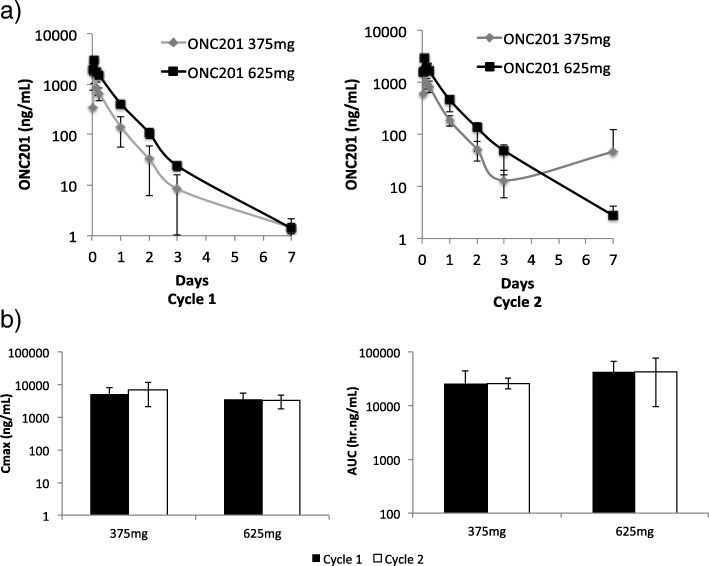
Fig. 1
Fig. 1
Pharmacokinetic analysis of ONC201. a ONC201 plasma concentrations following the first dose of cycle 1 and cycle 2. Concentrations are shown as the mean for each dose cohort in dose escalation (375 mg and 625 mg). b Cmax and AUC for 375 mg (n = 3) and 625 mg (n = 17) dose cohorts for cycle 1 and cycle 2. Each error bar indicates SEM
Fig. 2
Fig. 2
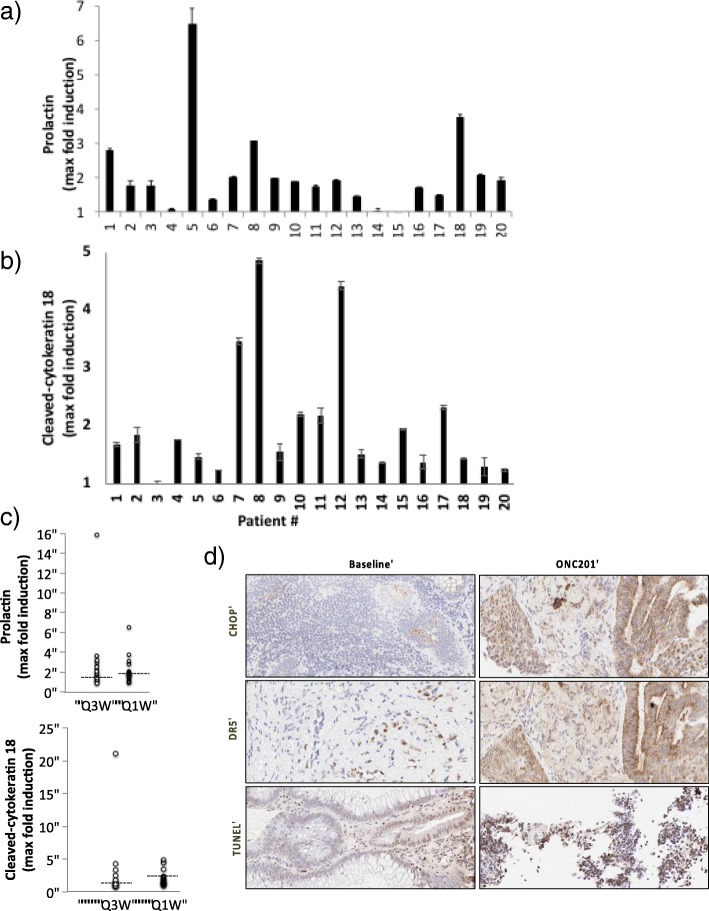
Pharmacodynamic assays for ONC201. Maximum fold induction of serum prolactin levels (a) and cleaved cytokeratin 18 (b) in patients relative to baseline levels. c Max fold induction of prolactin and cleaved cytokeratin 18 in patients treated at once every three weeks (Q3W) and on the weekly (Q1W) schedule relative to baseline levels. Median prolactin levels: 1.79 and 1.84 for Q3W and Q1W cohorts, respectively. Median cleaved cytokeratin levels: 1.25 and 1.61 for Q3W and Q1W cohorts, respectively. d IHC analyses of CHOP, DR5, and double-stranded DNA breaks (TUNEL) in baseline and ONC201-treated biopsies for an endometrial cancer patient. The biopsy was done 9.8 months after starting ONC201 treatment (7 days after the most recent ONC201 dose). Each error bar indicates SEM
Fig. 3
Fig. 3
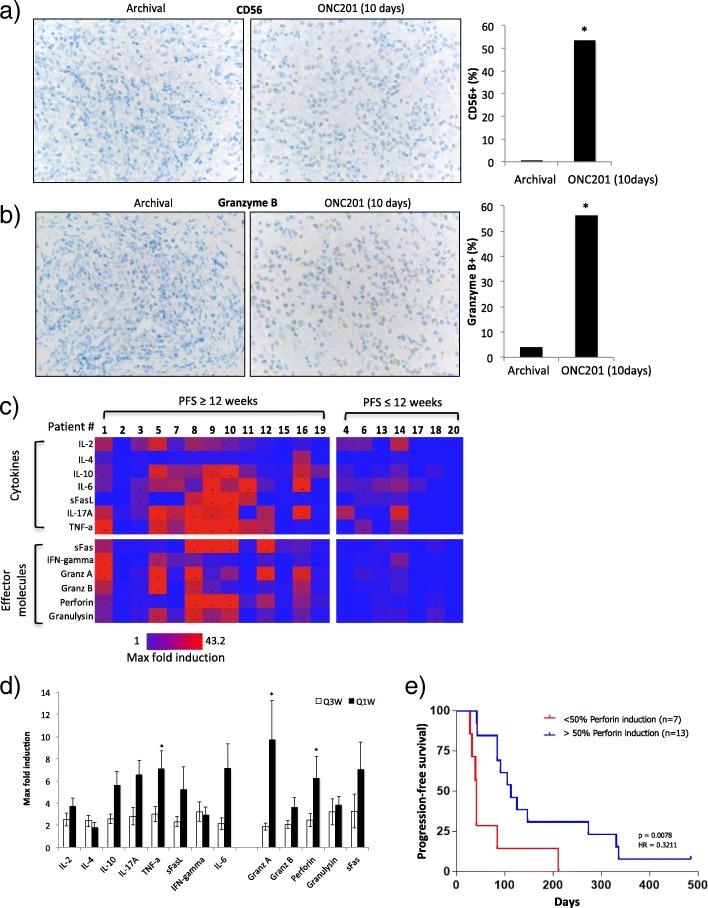
Immunostimulatory activity of ONC201. Immunohistochemical analysis of CD56+ (a) and granzyme B+ (b) cells in archival and post-ONC201 biopsy tumor tissue of an enzalutamide-refractory prostate cancer patient. Positive staining is depicted in gray color (P < 0.05). * denotes P < 0.05 by student’s two-tailed t test comparing the on-treatment tissue staining to archival tissue staining. c Heat map depicting maximum fold induction relative to baseline of immune cytokines and effector molecules in patients with PFS ≥ 12 weeks versus PFS < 12 weeks. * denotes P < 0.05 by student’s two-tailed t test comparing the on-treatment tissue staining to archival tissue staining. d Maximum fold change over baseline of immune cytokines and effector molecules in patients with PFS > =12 weeks by RECIST who received ONC201 at various dose levels once every three weeks or once weekly. Each error bar indicates SEM. * denotes P < 0.05 by student’s two-tailed t test comparing the maximum values to the baseline value. e PFS in patients who had at least a 50% induction in perforin following ONC201 once every three weeks or once weekly (P = 0.0078; HR 0.3211)
Fig. 4
Fig. 4
Clinical outcome of ONC201-treated patients. a Swimmer plot of ONC201-treated patients showing progression-free survival, as defined by RECIST version 1.1. Each bar represents one patient on the study who has been treated on a weekly schedule with ONC201. Arrowhead indicates that the patient was still on treatment at the time of writing this manuscript. b Primary tumor and bone metastasis measurements from a patient with prostate cancer at baseline and after two doses of weekly 625 mg ONC201

References

    1. Li J, Zhu S, Kozono D, Ng K, Futalan D, Shen Y, et al. Genome-wide shRNA screen revealed integrated mitogenic signaling between dopamine receptor D2 (DRD2) and epidermal growth factor receptor (EGFR) in glioblastoma. Oncotarget. 2014;5(4):882–893. doi: 10.18632/oncotarget.1801. - DOI - PMC - PubMed
    1. Li L, Miyamoto M, Ebihara Y, Mega S, Takahashi R, Hase R, et al. DRD2/DARPP-32 expression correlates with lymph node metastasis and tumor progression in patients with esophageal squamous cell carcinoma. World J Surg. 2006;30(9):1672–1679. doi: 10.1007/s00268-006-0035-3. - DOI - PubMed
    1. Mu J, Huang W, Tan Z, Li M, Zhang L, Ding Q, et al. Dopamine receptor D2 is correlated with gastric cancer prognosis. Oncol Lett. 2017;13(3):1223–1227. doi: 10.3892/ol.2017.5573. - DOI - PMC - PubMed
    1. Sachlos E, Risueno RM, Laronde S, Shapovalova Z, Lee JH, Russell J, et al. Identification of drugs including a dopamine receptor antagonist that selectively target cancer stem cells. Cell. 2012;149(6):1284–1297. doi: 10.1016/j.cell.2012.03.049. - DOI - PubMed
    1. Meredith EJ, Holder MJ, Rosen A, Lee AD, Dyer MJ, Barnes NM, et al. Dopamine targets cycling B cells independent of receptors/transporter for oxidative attack: implications for non-Hodgkin's lymphoma. Proc Natl Acad Sci U S A. 2006;103(36):13485–13490. doi: 10.1073/pnas.0605993103. - DOI - PMC - PubMed

Publication types

Associated data

LinkOut - more resources