Review
. 2019 Sep 24;18(5):314-328.
doi: 10.1093/bfgp/elz008.

The genomic architecture of antimalarial drug resistance

Affiliations
Review

The genomic architecture of antimalarial drug resistance

Annie N Cowell et al. Brief Funct Genomics. .

Abstract

Plasmodium falciparum and Plasmodium vivax, the two protozoan parasite species that cause the majority of cases of human malaria, have developed resistance to nearly all known antimalarials. The ability of malaria parasites to develop resistance is primarily due to the high numbers of parasites in the infected person's bloodstream during the asexual blood stage of infection in conjunction with the mutability of their genomes. Identifying the genetic mutations that mediate antimalarial resistance has deepened our understanding of how the parasites evade our treatments and reveals molecular markers that can be used to track the emergence of resistance in clinical samples. In this review, we examine known genetic mutations that lead to resistance to the major classes of antimalarial medications: the 4-aminoquinolines (chloroquine, amodiaquine and piperaquine), antifolate drugs, aryl amino-alcohols (quinine, lumefantrine and mefloquine), artemisinin compounds, antibiotics (clindamycin and doxycycline) and a napthoquinone (atovaquone). We discuss how the evolution of antimalarial resistance informs strategies to design the next generation of antimalarial therapies.

Keywords: Plasmodium falciparum; Plasmodium vivax; artemisinin; drug resistance; malaria.


Figures

Figure 1
Figure 1
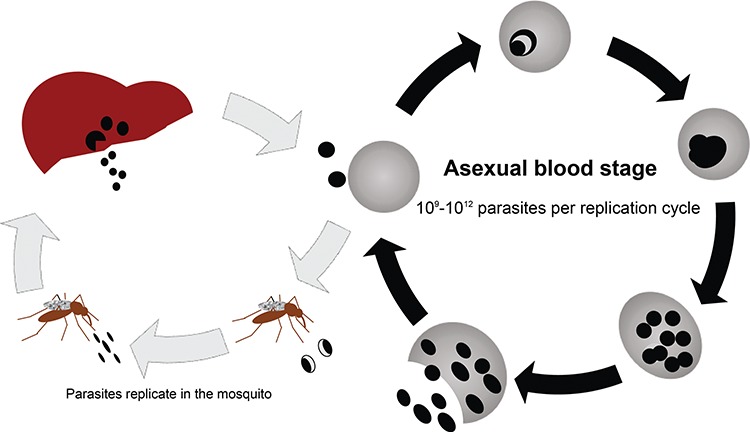
The P. falciparum life cycle highlighting the asexual blood stage of infection where antimalarial resistance mutations arise. Infection begins with inoculation of sporozoites by an infected mosquito. Sporozoites infect liver cells, and merozoites are released into the bloodstream, which invade red blood cells (RBCs). During the asexual blood stage of infection, which is responsible for the clinical manifestations of disease, the parasites undergo maturation and replication with an average of 109–1012 parasites per replication cycle. The infected RBCs rupture, releasing new merozoites into the bloodstream to begin another cycle of replication. A subset of parasites becomes gametocytes which can be ingested by another mosquito to continue malaria transmission.
Figure 2
Figure 2
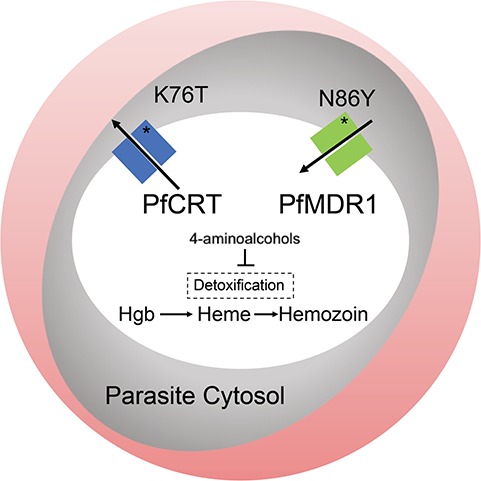
The parasite DV and the role of the P. falciparum CQ resistance transporter (PfCRT) and the P. falciparum multidrug resistance protein 1 (PfMDR1). The parasite (gray oval) is shown within an RBC. The DV (white oval) is a compartment within the parasite where the catabolism of hemoglobin (Hgb) from the host RBC occurs. The breakdown of Hgb results in reactive heme which undergoes detoxification to hemozoin. Medications from the 4-aminoquinoline class bind heme and interfere with detoxification. PfCRT and PfMDR1 are DV membrane proteins. It is thought that PfCRT transports drugs out of the DV while PfMDR1 transports them into the DV [19, 36]. The T mutation in pfcrt is essential to CQ resistance, while the N86Y mutations in pfmdr1 augment CQ resistance. Mutations in these transporters have also been found to mediate resistance to the aryl-amino alcohols and artemisinin.
Figure 3
Figure 3
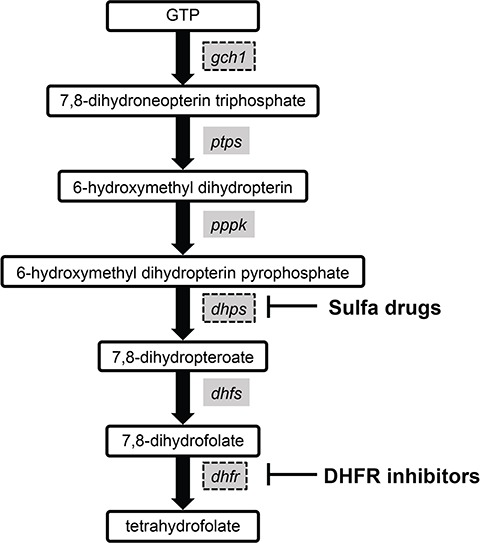
The P. falciparum folate biosynthesis pathway. Enzymes inhibited by the antifolate drugs are shown. Point mutations in the dhps and dhfr mediate resistance to sulfa drugs and DHFR inhibitors, respectively. Increased copy number of the gch1 gene has been detected in clinical isolates from Southeast Asia and likely represents an adaptive evolutionary response to antifolate pressure [95]. Other abbreviations: pyruvoyltetrahydropterin synthase (ptps), hydroxymethyldihydropterin pyrophospholkinase (pppk) and dihydrofolate synthase (dhfs). Adapted from [94].

References

    1. Korenromp EL, Williams BG, Gouws E, et al. Measurement of trends in childhood malaria mortality in Africa: an assessment of progress toward targets based on verbal autopsy. Lancet Infect Dis 2003;3:349–358. - PubMed
    1. World Health Organization Artemisinin and Artemisinin-Based Combination Therapy Resistance. Geneva, Switzerland, 2017.
    1. Maxmen A. How to defuse malaria’s ticking time bomb. Nature 2018;559:458–465. - PubMed
    1. White NJ. Antimalarial drug resistance. J Clin Invest 2004;113:1084–1092. - PMC - PubMed
    1. World Health Organization Guidelines for the Treatment of Malaria, 3rd edn Geneva, Switzerland, 2015.

Publication types

MeSH terms