


Indoor residual spraying for preventing malaria in communities using insecticide-treated nets
- PMID: 31120132
- PMCID: PMC6532761
- DOI: 10.1002/14651858.CD012688.pub2
Indoor residual spraying for preventing malaria in communities using insecticide-treated nets
Update in
-
Indoor residual spraying for preventing malaria in communities using insecticide-treated nets.Cochrane Database Syst Rev. 2022 Jan 17;1(1):CD012688. doi: 10.1002/14651858.CD012688.pub3. Cochrane Database Syst Rev. 2022. PMID: 35038163 Free PMC article.
Abstract
Background: Insecticide-treated nets (ITNs) and indoor residual spraying (IRS) are used to control malaria vectors. Both strategies use insecticides to kill mosquitoes that bite and rest indoors. For ITNs, the World Health Organization (WHO) only recommended pyrethroids until 2018, but mosquito vectors are becoming resistant to this insecticide. For IRS, a range of insecticides are recommended. Adding IRS to ITNs may improve control, simply because two interventions may be better than one; it may improve malaria control where ITNs are failing due to pyrethroid resistance; and it may slow the emergence and spread of pyrethroid resistance.
Objectives: To summarize the effect on malaria of additionally implementing IRS, using non-pyrethroid-like or pyrethroid-like insecticides, in communities currently using ITNs.
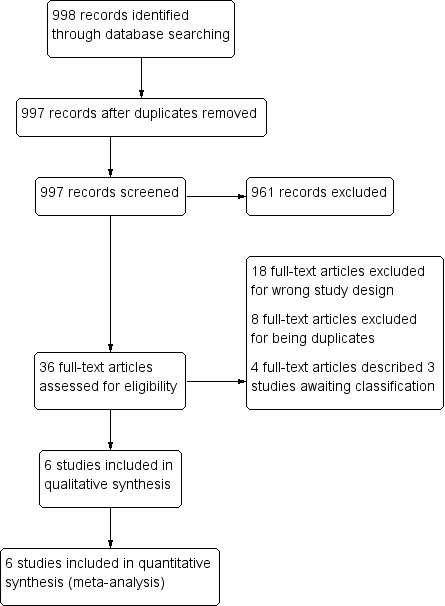
Search methods: We searched the Cochrane Infectious Diseases Group Specialized Register; the Cochrane Central Register of Controlled Trials (CENTRAL); MEDLINE; Embase; LILACS; the WHO International Clinical Trials Registry Platform; ClinicalTrials.gov; and the ISRCTN registry up to 18 March 2019.
Selection criteria: Cluster-randomized controlled trials (cRCTs), interrupted time series (ITS), or controlled before-and-after studies (CBAs) comparing IRS plus ITNs with ITNs alone.
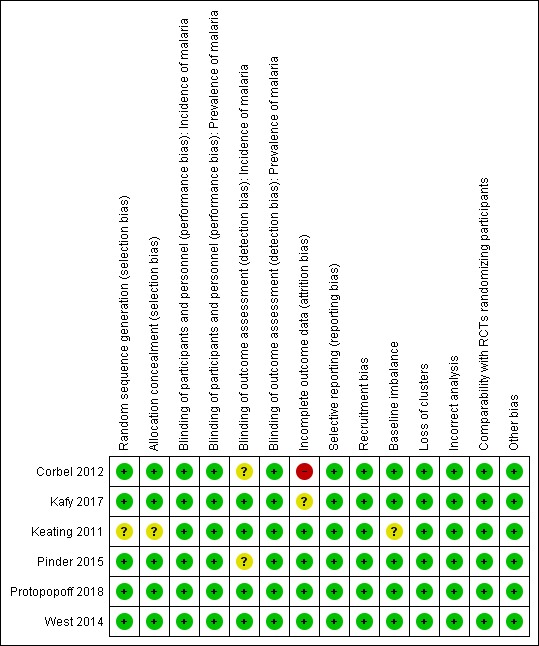
Data collection and analysis: Two review authors independently assessed trials for eligibility, analyzed risk of bias, and extracted data. We used risk ratio (RR) and 95% confidence intervals (CI). We stratified by type of insecticide: 'non-pyrethroid-like', as this could improve malaria control better than adding IRS insecticides that have the same way of working as the insecticide on ITNs ('pyrethroid-like'). We used subgroup analysis of ITN usage in the trials to explore heterogeneity. We assessed the certainty of evidence using the GRADE approach.
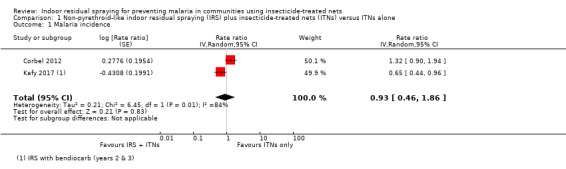
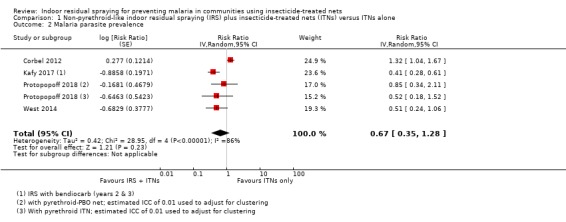
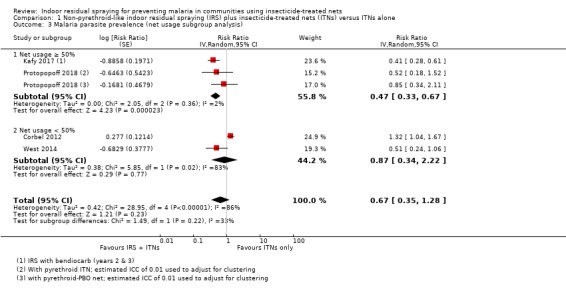
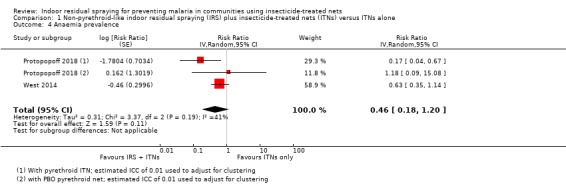
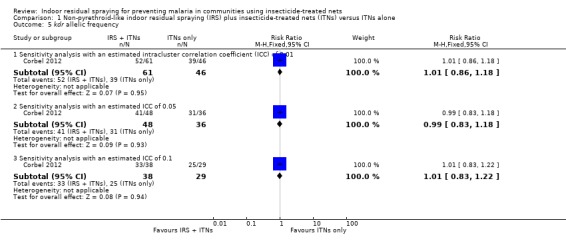
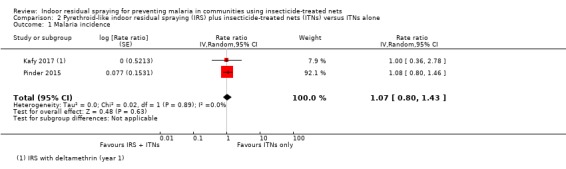
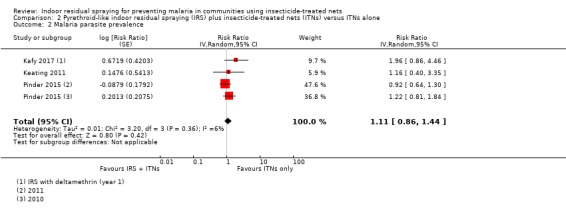
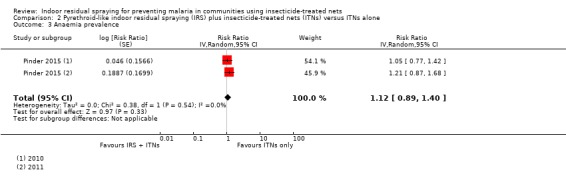
Main results: Six cRCTs (eight comparisons) met our inclusion criteria conducted since 2008 in sub-Saharan Africa. Malaria transmission in all sites was from mosquitoes belonging to the Anopheles gambiae s.l. complex species; two trials in Benin and Tanzania also reported the vector Anopheles funestus. Three trials used insecticide with targets different to pyrethroids (two used bendiocarb and one used pirimiphos-methyl); two trials used dichloro-diphenyl-trichlorethane (DDT), an insecticide with the same target as pyrethroids; and one trial used both types of insecticide (pyrethroid deltamethrin in the first year, switching to bendiocarb for the second-year). ITN usage was greater than 50% in three trials, and less than 50% in the remainder.Indoor residual spraying using 'non-pyrethroid-like' insecticides Adding IRS with a non-pyrethroid-like insecticide had mixed results. Overall, we do not know if the addition of IRS impacted on malaria incidence (rate ratio 0.93, 95% CI 0.46 to 1.86; 2 cRCTs, 566 child-years; very low-certainty evidence); it may have reduced malaria parasite prevalence (0.67, 95% CI 0.35 to 1.28; 5 comparisons from 4 cRCTs, 10,440 participants; low-certainty evidence); and it may have reduced the prevalence of anaemia (RR CI 0.46, 95% 0.18 to 1.20; 3 comparisons from 2 cRCTs, 2026 participants; low-certainty evidence). Three trials reported the impact on EIR, with variable results; overall, we do not know if IRS had any effect on the EIR in communities using ITNs (very low-certainty evidence). Trials also reported the adult mosquito density and the sporozoite rate, but we could not summarize or pool these entomological outcomes due to unreported data. ITN usage did not explain the variation in malaria outcomes between different studies. One trial reported no effect on malaria incidence or parasite prevalence in the first year, when the insecticide used for IRS had the same target as pyrethroids, but showed an effect on both outcomes in the second year, when the insecticide was replaced by one with a different target.Two trials measured the prevalence of pyrethroid resistance before and after IRS being introduced: no difference was detected, but these data are limited.Indoor residual spraying using 'pyrethroid-like' insecticidesAdding IRS using a pyrethroid-like insecticide did not appear to markedly alter malaria incidence (rate ratio 1.07, 95% CI 0.80 to 1.43; 2 cRCTs, 15,717 child-years; moderate-certainty evidence), parasite prevalence (RR 1.11, 95% CI 0.86 to 1.44; 3 cRCTs, 10,820 participants; moderate-certainty evidence), or anaemia prevalence (RR 1.12, 95% CI 0.89 to 1.40; 1 cRCT, 4186 participants; low-certainty evidence). Data on the entomological inoculation rate (EIR) were limited, and therefore we do not know if IRS had any effect on the EIR in communities using ITNs (very low-certainty evidence).
Authors' conclusions: Four trials have evaluated adding IRS using 'non-pyrethroid-like' insecticides in communities using ITNs. Some of these trials showed effects, and others did not. Three trials have evaluated adding IRS using 'pyrethroid-like' insecticides in communities using ITNs, and these studies did not detect an additional effect of the IRS. Given the wide geographical variety of malaria endemicities, transmission patterns, and insecticide resistance, we need to be cautious with inferences to policy from the limited number of trials conducted to date, and to develop relevant further research to inform decisions.
Conflict of interest statement
LC: none.
JP: none.
PG is the Director of READ‐It, a DFID‐funded research programme that aims to increase the number of decisions in low‐ and middle‐income countries based on reliable evidence.
Figures
References
References to studies included in this review
Corbel 2012 {published data only}
-
- Corbel V, Akogbeto M, Damien GB, Djenontin A, Chandre F, Rogier C, et al. Combination of malaria vector control interventions in pyrethroid resistance area in Benin: a cluster randomised controlled trial. Lancet Infectious Diseases 2012;12(8):617‐26. - PubMed
Kafy 2017 {published data only}
-
- Kafy HT, Ismail BA, Mnzava AP, Lines J, Abdin MS, Eltaher JS, et al. Impact of insecticide resistance in Anopheles arabiensis on malaria incidence and prevalence in Sudan and the costs of mitigation. Proceedings of the National Academy of Sciences of the United States of America 2017;114(52):E11267‐75. [DOI: 10.1073/pnas.1713814114] - DOI - PMC - PubMed
Keating 2011 {published data only}
-
- Keating J, Locatelli A, Gebremichael A, Ghebremeskel T, Mufunda J, Mihreteab S, et al. Evaluating indoor residual spray for reducing malaria infection prevalence in Eritrea: results from a community randomized control trial. Acta Tropica 2011;119(2):107‐13. - PubMed
Pinder 2015 {published data only}
-
- Pinder M, Jawara M, Jarju LB, Salami K, Jeffries D, Adiamoh M, et al. Efficacy of indoor residual spraying with dichlorodiphenyltrichloroethane against malaria in Gambian communities with high usage of long‐lasting insecticidal mosquito nets: a cluster‐randomised controlled trial. Lancet 2015;385(9976):1436‐46. - PubMed
Protopopoff 2018 {published data only}
-
- Protopopoff N, Mosha JF, Lukole E, Charlwood JD, Wright A, Mwalimu CD, et al. Effectiveness of a long‐lasting piperonyl butoxide‐treated insecticidal net and indoor residual spray interventions, separately and together, against malaria transmitted by pyrethroid‐resistant mosquitoes: a cluster, randomised controlled, two‐by‐two factorial design trial. Lancet 2018;391(10130):1577‐88. - PMC - PubMed
West 2014 {published data only}
-
- West PA, Protopopoff N, Wright A, Kivaju Z, Tigererwa R, Mosha FW, et al. Indoor residual spraying in combination with insecticide‐treated nets compared to insecticide‐treated nets alone for protection against malaria: a cluster randomised trial in Tanzania. PLoS Medicine 2014;11(4):e1001630. - PMC - PubMed
References to studies excluded from this review
Abeku 2014 {published data only}
-
- Abeku TA, Helinski M, Ssekitooleko J, Kirby MJ, Kyomuhangi I, Magumba G, et al. Variations in malaria epidemiology in relation to vector control coverage in nine districts of Uganda. 63rd Annual Meeting of the American Society of Tropical Medicine and Hygiene; 2014 Nov 2‐6; New Orleans (LA). 2014.
Bekele 2012 {published data only}
Diallo 2015 {published data only}
-
- Diallo A, Cisse B, Tairou F, Ba E, Gomis J, Sy O, et al. A cluster‐randomized trial of targeted control to eliminate malaria in central Senegal: main results in year 2. American Journal of Tropical Medicine and Hygiene 2015;93(4):81.
-
- Diallo A, Cisse B, Tairou F, Ba EH, Sy O, Gomis J, et al. A cluster‐randomized trial of targeted control to eliminate malaria in central Senegal: study design and acceptability of the interventions. American Journal of Tropical Medicine and Hygiene 2014;91(5 (Suppl 1)):198.
-
- Sy O, Cisse B, Diallo A, Tairou F, Ba EK, Ndiaye JL, et al. Efficacy of Actellic (R) 300 CS (pirimiphos‐methyl) after two years of indoor residual spraying in Senegal. American Journal of Tropical Medicine and Hygiene 2015;93(4):81‐2.
-
- Tairou F, Ba EH, Diallo A, Sy O, Cisse B, Gomis JF, et al. The costs and cost‐effectiveness of two spatially targeted, multi‐component malaria elimination strategies: results of a large three‐arm cluster‐randomized trial in rural Senegal. American Journal of Tropical Medicine and Hygiene 2015;93(4):81.
Fullman 2013 {published data only}
Gari 2016 {published data only}
Gimnig 2016 {published data only}
-
- Gimnig JE, Otieno P, Were V, Marwanga D, Abong'o D, Wiegand R, et al. The effect of indoor residual spraying on the prevalence of malaria parasite infection, clinical malaria and anemia in an area of perennial transmission and moderate coverage of insecticide treated nets in Western Kenya. PloS One 2016;11(1):e0145282. - PMC - PubMed
Hamel 2011 {published data only}
-
- Hamel MJ, Otieno P, Bayoh N, Kariuki S, Were V, Marwanga D, et al. The combination of indoor residual spraying and insecticide‐treated nets provides added protection against malaria compared with insecticide‐treated nets alone. American Journal of Tropical Medicine and Hygiene 2011;85(6):1080‐6. - PMC - PubMed
Katureebe 2016 {published data only}
Kitau 2015 {published data only}
-
- Kitau J, Protopopoff N, Wright A, West P, Mosha FW, Kisinza W, et al. Anopheles arabiensis is not successfully controlled by indoor residual spraying in Northwest Tanzania: implication for malaria vector control in the area. Tropical Medicine & International Health 2015;20:19‐20.
-
- Protopopoff N, Kitau J, Wright A, West P, Mosha FW, Kisinza W, et al. Anopheles arabiensis is not successfully controlled by indoor residual spraying in northwest Tanzania: Implication for malaria vector control in the area. American Journal of Tropical Medicine and Hygiene 2014;91(5 (Suppl 1)):415.
Lyimo 1991 {published data only}
-
- Lyimo EO, Msuya FH, Rwegoshora RT, Nicholson EA, Mnzava AE, Lines JD, et al. Trial of pyrethroid impregnated bednets in an area of Tanzania holoendemic for malaria. Part 3. Effects on the prevalence of malaria parasitaemia and fever. Acta Tropica 1991;49(3):157‐63. - PubMed
Matowo 2015 {published data only}
-
- Matowo J, Kitau J, Kaaya R, Kavishe R, Wright A, Kisinza W, et al. Trends in the selection of insecticide resistance in Anopheles gambiae sl mosquitoes in northwest Tanzania during a community randomized trial of longlasting insecticidal nets and indoor residual spraying. Medical and Veterinary Entomology 2015;29(1):51‐9. - PMC - PubMed
Pinder 2011 {published data only}
-
- Pinder M, Jawara M, Jarju LB, Kandeh B, Jeffries D, Lluberas MF, et al. To assess whether indoor residual spraying can provide additional protection against clinical malaria over current best practice of long‐lasting insecticidal mosquito nets in The Gambia: study protocol for a two‐armed cluster‐randomised trial. Trials 2011;12(1):147. - PMC - PubMed
Pinder 2012 {published data only}
-
- Pinder M, Jawara MS, Jarju LB, Kandeh B, Jeffries D, Bojang KA, et al. To assess whether indoor residual spraying can provide additional protection against clinical malaria over current best practice of long‐lasting insecticidal mosquito nets in the Gambia: a two‐armed cluster‐randomized study. American Journal of Tropical Medicine and Hygiene 2012;87(5 (Suppl 1)):139. - PMC - PubMed
Protopopoff 2007a {published data only}
Protopopoff 2007b {published data only}
Protopopoff 2015a {published data only}
-
- Protopopoff N, Charlwood D, Mosha J, Wright A, Kisinza W, Mosha F, et al. Evaluation of a novel long lasting insecticidal net to indoor residual spray product, separately to together, against malaria transmitted by pyrethroid resistant mosquitoes in northwest Tanzania: a cluster randomized controlled trial. American Journal of Tropical Medicine and Hygiene 2015;93(4):572.
Protopopoff 2015b {published data only}
-
- Protopopoff N, Wright A, West PA, Tigererwa R, Mosha FW, Kisinza W, et al. Combination of insecticide treated nets and indoor residual spraying in northern Tanzania provides additional reduction in vector population density and malaria transmission rates compared to insecticide treated nets alone: a randomised control trial. PloS One 2015;10(11):e0142671. - PMC - PubMed
-
- Protopopoff N, Wright A, West PA, Tigererwa R, Mosha FW, Kisinza W, et al. Correction: Combination of insecticide treated nets and indoor residual spraying in Northern Tanzania provides additional reduction in vector population density and Malaria transmission rates compared to insecticide treated nets alone: a randomised control trial. PloS One 2016;11(1):e0146629. - PMC - PubMed
West 2012 {published data only}
-
- West PA, Protopopoff N, Rowland M, Wright A, Kivaju Z, Kirby M, et al. Comparison of long‐lasting insecticidal nets versus long‐lasting insecticidal nets in combination with indoor residual house spraying for malaria vector control: results of a cluster randomized trial. American Journal of Tropical Medicine and Hygiene 2012;87(5 (Suppl 1)):3.
West 2015 {published data only}
Zhou 2013 {published data only}
References to studies awaiting assessment
Chaccour 2018 {published data only}
-
- Chaccour CJ, Alonso S, Zulliger R, Wagman J, Saifodine A, Candrinho B, et al. Combination of indoor residual spraying with long‐lasting insecticide‐treated nets for malaria control in Zambezia, Mozambique: a cluster randomised trial and cost‐effectiveness study protocol. BMJ Global Health 2018;3(1):e000610. - PMC - PubMed
Deressa 2016 {published data only}
-
- Loha E, Deressa W, Gari T, Balkew M, Kenea O, Solomon T, et al. Combining long‐lasting insecticidal nets and indoor residual spraying for malaria prevention in Ethiopia: a cluster randomized controlled trial. American Journal of Tropical Medicine and Hygiene 2017;97:602‐3.
Hamainza 2016 {published data only}
-
- Hamainza B, Sikaala CH, Moonga HB, Chanda J, Chinula D, Mwenda M, et al. Incremental impact upon malaria transmission of supplementing pyrethroid‐impregnated long‐lasting insecticidal nets with indoor residual spraying using pyrethroids or the organophosphate, pirimiphos methyl. Malaria Journal 2016;15(1):100. - PMC - PubMed
Additional references
Balshem 2011
Bhatt 2015
Deeks 2011
-
- Deeks JJ, Higgins JP, Altman DG, on behalf of the Cochrane Statistical Methods Group. Chapter 9: Analysing data and undertaking meta‐analyses. In: Higgins JP, Green S, editor(s). Cochrane Handbook for Systematic Reviews of Interventions Version 5.1.0 (updated March 2011). The Cochrane Collaboration, 2011. Available from handbook.cochrane.org.
Gleave 2018
Goodman 2001
-
- Goodman CA, Mnzava AE, Dlamini SS, Sharp BL, Mthembu DJ, Gumede JK. Comparison of the cost and cost‐effectiveness of insecticide‐treated bednets and residual house‐spraying in KwaZulu‐Natal, South Africa. Tropical Medicine & International Health 2001;6(4):280‐95. - PubMed
Guyatt 2011
Harbord 2006
-
- Harbord RM, Egger M, Sterne JA. A modified test for small‐study effects in meta‐analyses of controlled trials with binary endpoints. Statistics in Medicine 2006;25(20):3443‐57. - PubMed
Higgins 2011a
-
- Higgins JP, Deeks JJ, Altman DG, on behalf of the Cochrane Statistical Methods Group. Chapter 16: Special topics in statistics. In: Higgins JP, Green S, editor(s). Cochrane Handbook for Systematic Reviews of Interventions Version 5.1.0 (updated March 2011). The Cochrane Collaboration, 2011. Available from handbook.cochrane.org.
Higgins 2011b
Killeen 2006
Killeen 2018
-
- Killeen GF, Ranson H. Insecticide‐resistant malaria vectors must be tackled. Lancet 2018;391(10130):551‐2. - PubMed
Kitau 2012
Kleinschmidt 2009
Ojuka 2015
-
- Ojuka P, Boum Y 2nd, Denoeud‐Ndam L, Nabasumba C, Muller Y, Okia M, et al. Early biting and insecticide resistance in the malaria vector Anopheles might compromise the effectiveness of vector control intervention in Southwestern Uganda. Malaria Journal 2015;14:148. [DOI: 10.1186/s12936-015-0653-z] - DOI - PMC - PubMed
Okumu 2011
Pluess 2010
Pryce 2018
Review Manager 2014 [Computer program]
-
- Nordic Cochrane Centre, The Cochrane Collaboration. Review Manager 5 (RevMan 5). Version 5.3. Copenhagen: Nordic Cochrane Centre, The Cochrane Collaboration, 2014.
Shililu 2004
-
- Shililu J, Ghebremeskel T, Seulu FE, Mengistu S, Fekadu HE, Zerom M, et al. Seasonal abundance, vector behavior, and malaria parasite transmission in Eritrea. Journal of the American Mosquito Control Association 2004;20(2):155‐64. - PubMed
WHO 2011
-
- World Health Organization. Vitamin and Mineral Nutrition Information System. Haemoglobin concentrations for the diagnosis of anaemia and assessment of severity. 2011. www.who.int/vmnis/indicators/haemoglobin/en/index.html (accessed 5 June 2017).
WHO 2012
-
- World Health Organization. Global plan for insecticide resistance management in malaria vectors. 2012. apps.who.int/iris/bitstream/10665/44846/1/9789241564472_eng.pdf (accessed 5 June 2017).
WHO 2014a
-
- World Health Organization. WHO guidance for countries on combining indoor residual spraying and long‐lasting insecticidal nets. 2014. www.who.int/malaria/publications/atoz/who‐guidance‐combining‐irs_llins‐m... (accessed 3 March 2018).
WHO 2014b
-
- World Health Organization. WHO recommended long‐lasting insecticidal nets. 2014. www.who.int/whopes/Long_lasting_insecticidal_nets_06_Feb_2014.pdf (accessed 3 March 2018).
WHO 2014c
-
- World Health Organization. WHO recommended insecticide products for treatment of mosquito nets for malaria vector control. 2014. www.who.int/whopes/Insecticides_ITN_Malaria_Nov2014.pdf (accessed 3 March 2018).
WHO 2014d
-
- World Health Organization. WHO guidance for countries on combining indoor residual spraying and long‐lasting insecticidal nets. www.who.int/malaria/publications/atoz/who‐guidance‐combining‐irs‐llins/en/ (accessed 29 June 2018).
WHO 2015a
-
- World Health Organization. Indoor residual spraying: an operational manual for indoor residual spraying (IRS) for malaria transmission control and elimination. 2nd edition. apps.who.int/iris/bitstream/10665/177242/1/9789241508940_eng.pdf?ua=1&am... (accessed 5 June 2017).
WHO 2015b
-
- World Health Organization. Global Technical Strategy for Malaria 2016–2030. apps.who.int/iris/bitstream/10665/176712/1/9789241564991_eng.pdf?ua=1&am.... Geneva, Switzerland: WHO, (accessed 5 June 2017).
WHO 2015c
-
- World Health Organization. Guidelines for the treatment of malaria. 3rd edition. 2015. apps.who.int/iris/bitstream/10665/162441/1/9789241549127_eng.pdf?ua=1&am.... Geneva, Switzerland: WHO, (accessed 5 June 2017).
WHO 2017a
-
- World Health Organization. World Malaria Report 2017. apps.who.int/iris/bitstream/handle/10665/259492/9789241565523‐eng.pdf;js... (accessed 25 Oct 2018).
WHO 2017b
-
- World Health Organization. A framework for malaria elimination. apps.who.int/iris/bitstream/10665/254761/1/9789241511988‐eng.pdf?ua=1. Geneva, Switzerland: WHO, (accessed 5 June 2017).
Yakob 2011
Zaim 2000
-
- Zaim M, Aitio A, Nakashima N. Safety of pyrethroid‐treated mosquito nets. Medical and Veterinary Entomology 2000;14(1):1‐5. - PubMed
References to other published versions of this review
Choi 2017
-
- Choi L, Pryce J, Garner P. The combination of indoor residual spraying with insecticide‐treated nets versus insecticide‐treated nets alone for preventing malaria. Cochrane Database of Systematic Reviews 2017, Issue 6. [DOI: 10.1002/14651858.CD012688] - DOI
Publication types
MeSH terms
Substances
Grants and funding
LinkOut - more resources
Full Text Sources
Medical
Miscellaneous
