Association of Black Race With Prostate Cancer-Specific and Other-Cause Mortality
- PMID: 31120534
- PMCID: PMC6547116
- DOI: 10.1001/jamaoncol.2019.0826
Association of Black Race With Prostate Cancer-Specific and Other-Cause Mortality
Abstract
Importance: Black men are more likely to die of prostate cancer than white men. In men with similar stages of disease, the contribution of biological vs nonbiological differences to this observed disparity is unclear.
Objective: To quantify the association of black race with long-term survival outcomes after controlling for known prognostic variables and access to care among men with prostate cancer.
Design, setting, and participants: This multiple-cohort study included updated individual patient-level data of men with clinical T1-4N0-1M0 prostate cancer from the following 3 cohorts: Surveillance, Epidemiology, and End Results (SEER [n = 296 273]); 5 equal-access regional medical centers within the Veterans Affairs health system (VA [n = 3972]); and 4 pooled National Cancer Institute-sponsored Radiation Therapy Oncology Group phase 3 randomized clinical trials (RCTs [n = 5854]). Data were collected in the 3 cohorts from January 1, 1992, through December 31, 2013, and analyzed from April 27, 2017, through April 13, 2019.
Exposures: In the VA and RCT cohorts, all patients received surgery and radiotherapy, respectively, with curative intent. In SEER, radical treatment, hormone therapy, or conservative management were received.
Main outcomes and measures: Prostate cancer-specific mortality (PCSM). Secondary measures included other-cause mortality (OCM). To adjust for demographic-, cancer-, and treatment-related baseline differences, inverse probability weighting (IPW) was performed.
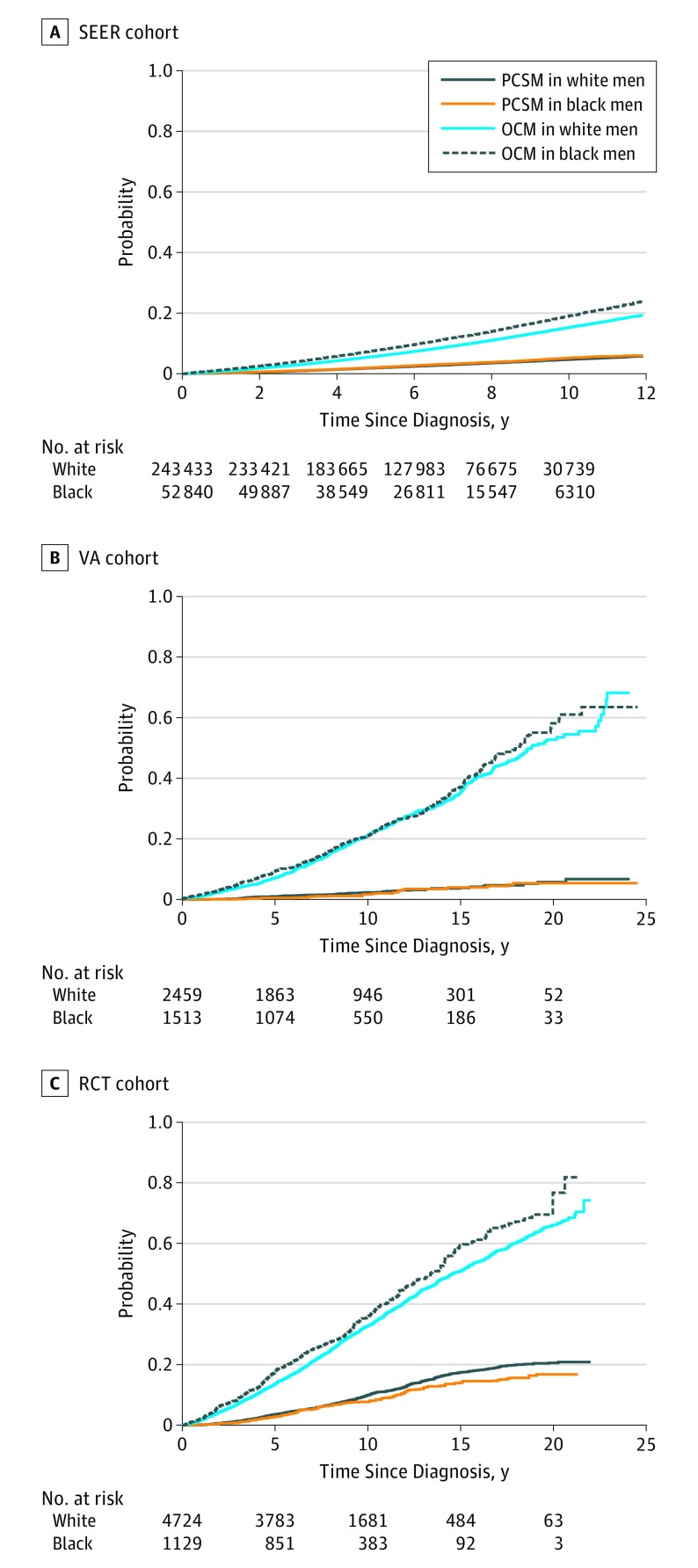
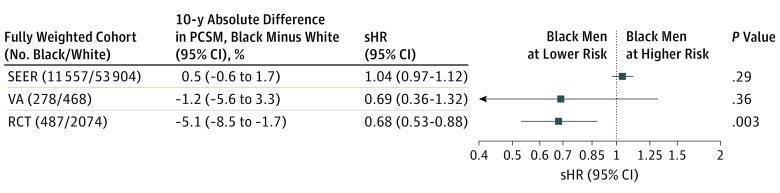
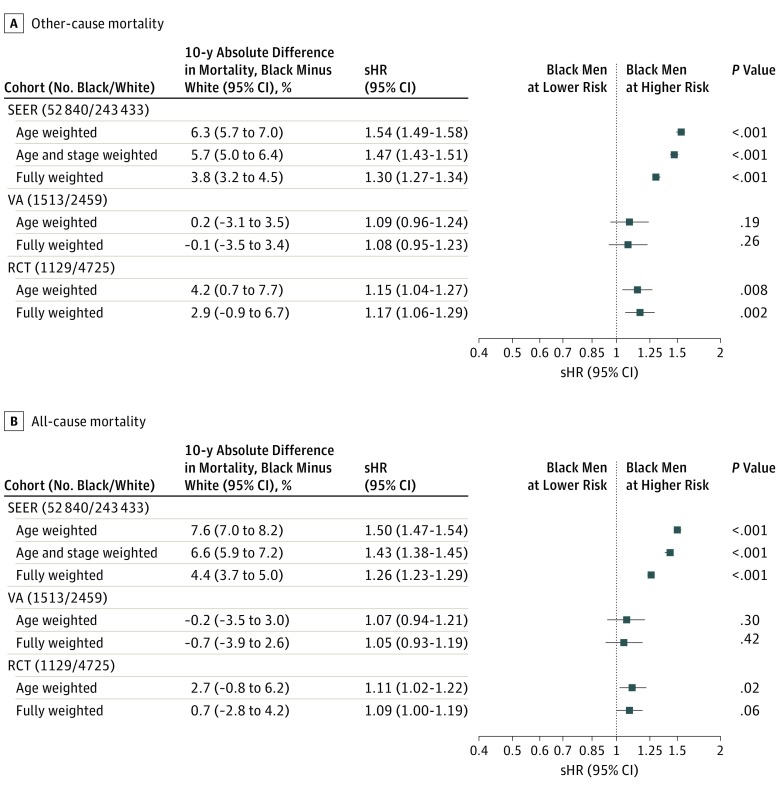
Results: Among the 306 100 participants included in the analysis (mean [SD] age, 64.9 [8.9] years), black men constituted 52 840 patients (17.8%) in the SEER cohort, 1513 (38.1%) in the VA cohort, and 1129 (19.3%) in the RCT cohort. Black race was associated with an increased age-adjusted PCSM hazard (subdistribution hazard ratio [sHR], 1.30; 95% CI, 1.23-1.37; P < .001) within the SEER cohort. After IPW adjustment, black race was associated with a 0.5% (95% CI, 0.2%-0.9%) increase in PCSM at 10 years after diagnosis (sHR, 1.09; 95% CI, 1.04-1.15; P < .001), with no significant difference for high-risk men (sHR, 1.04; 95% CI, 0.97-1.12; P = .29). No significant differences in PCSM were found in the VA IPW cohort (sHR, 0.85; 95% CI, 0.56-1.30; P = .46), and black men had a significantly lower hazard in the RCT IPW cohort (sHR, 0.81; 95% CI, 0.66-0.99; P = .04). Black men had a significantly increased hazard of OCM in the SEER (sHR, 1.30; 95% CI, 1.27-1.34; P < .001) and RCT (sHR, 1.17; 95% CI, 1.06-1.29; P = .002) IPW cohorts.
Conclusions and relevance: In this study, after adjustment for nonbiological differences, notably access to care and standardized treatment, black race did not appear to be associated with inferior stage-for-stage PCSM. A large disparity remained in OCM for black men with nonmetastatic prostate cancer.
Conflict of interest statement
Figures

Comment in
-
Racial Inequality in Prostate Cancer Outcomes-Socioeconomics, Not Biology.JAMA Oncol. 2019 Jul 1;5(7):983-984. doi: 10.1001/jamaoncol.2019.0812. JAMA Oncol. 2019. PMID: 31120499 Free PMC article. No abstract available.
-
Equal access = equal outcomes in black and white men.Nat Rev Urol. 2019 Aug;16(8):447. doi: 10.1038/s41585-019-0207-1. Nat Rev Urol. 2019. PMID: 31182855 No abstract available.
-
Re: Association of Black Race with Prostate Cancer-specific and Other-cause Mortality Dess RT, Hartman HE, Mahal BA, et al JAMA Oncol 2019;5:975-83.Eur Urol. 2020 Jan;77(1):129-130. doi: 10.1016/j.eururo.2019.08.036. Epub 2019 Oct 17. Eur Urol. 2020. PMID: 31630893 No abstract available.
-
Biology vs Access to Care-Relative Contribution to Racial Disparities in Prostate Cancer-In Reply.JAMA Oncol. 2019 Dec 1;5(12):1810-1811. doi: 10.1001/jamaoncol.2019.4509. JAMA Oncol. 2019. PMID: 31670754 No abstract available.
-
Biology vs Access to Care-Relative Contribution to Racial Disparities in Prostate Cancer.JAMA Oncol. 2019 Dec 1;5(12):1809-1810. doi: 10.1001/jamaoncol.2019.4497. JAMA Oncol. 2019. PMID: 31670755 No abstract available.
-
Re: Association of Black Race with Prostate Cancer-specific and Other-cause Mortality.Eur Urol. 2021 Dec;80(6):758-759. doi: 10.1016/j.eururo.2021.09.004. Epub 2021 Sep 15. Eur Urol. 2021. PMID: 34535345 No abstract available.
References
-
- National Cancer Institute NCI Center to Reduce Cancer Health Disparities (CRCHD). https://www.cancer.gov/about-nci/organization/crchd. Published April 5, 2018. Accessed July 6, 2018.