


Breast cancer histologic subtypes show excess familial clustering
- PMID: 31120568
- PMCID: PMC6716995
- DOI: 10.1002/cncr.32198
Breast cancer histologic subtypes show excess familial clustering
Abstract
Background: The inherited predisposition to developing specific histologic subtypes of invasive breast carcinoma has been incompletely investigated. By using a large, population-based database, the authors sought to investigate familial clustering of breast cancer by histologic subtype.
Methods: By using the Utah Population Database, which links genealogy records to the National Cancer Institute's statewide Surveillance, Epidemiology, and End Results cancer registry, the authors identified patients with breast cancer by histology and tested for evidence of shared genetic predisposition to histologic specific subtypes by examining pairwise relatedness and estimating the relative risk (RR) among first-degree, second-degree, and third-degree relatives.
Results: The authors identified 23,629 individuals in the Utah Population Database who had at least 3 generations of genealogy and at least 1 primary breast cancer, 2883 (12.2%) of which were specific histologic subtypes other than invasive ductal carcinoma (including inflammatory [n = 178], lobular [n = 1688], and mucinous [n = 542]). Statistically significant excess distant relatedness was identified for the mucinous subtype (P = .011) as well as for inflammatory breast cancers (P = .024). The RR for breast cancer of any histology in second-degree relatives was significantly increased for patients with inflammatory (RR, 1.32; 95% CI, 1.02-1.68; P = .03), lobular (RR, 1.36; 95% CI, 1.25-1.47; P < .001), and mucinous (RR, 1.27; 95% CI, 1.12-1.44; P = .00021) subtypes.
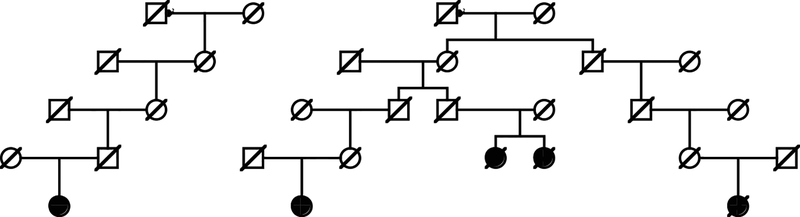
Conclusions: These findings provide evidence for significant familial clustering within histological subtypes for lobular, mucinous, and inflammatory breast carcinomas. Further research is required to identify the underlying genetic variants responsible for the increased risk. Studies of high-risk pedigrees segregating a specific histologic subtype could be a powerful design for predisposition gene identification.
Keywords: Utah Population Database (UPDB); breast cancer; familiality; inflammatory; lobular; mucinous.
© 2019 American Cancer Society.
Conflict of interest statement
Figures
References
-
- Kleihues P, Sobin LH. World Health Organization classification of tumors. Cancer. 2000;88: 2887. - PubMed
-
- Tavassoli FA, Devilee P. Pathology and Genetics of Tumours of the Breast and Female Genital Organs. . Lyon, France: IARC Press, 2003.
-
- Nguyen B, Veys I, Leduc S, et al. Genomic, transcriptomic, epigenetic, and immune profiling of mucinous breast cancer. J Natl Cancer Inst. 2019. - PubMed
-
- Kehr EL, Jorns JM, Ang D, et al. Mucinous breast carcinomas lack PIK3CA and AKT1 mutations. Hum Pathol. 2012;43: 2207–2212. - PubMed
MeSH terms
Grants and funding
LinkOut - more resources
Full Text Sources
Medical
