Randomized Controlled Trial
. 2019 May 23;14(5):e0216712.
doi: 10.1371/journal.pone.0216712. eCollection 2019.

Metabolic, mitochondrial, renal and hepatic safety of enfuvirtide and raltegravir antiretroviral administration: Randomized crossover clinical trial in healthy volunteers

Affiliations
Randomized Controlled Trial

Metabolic, mitochondrial, renal and hepatic safety of enfuvirtide and raltegravir antiretroviral administration: Randomized crossover clinical trial in healthy volunteers

Sergio Barroso et al. PLoS One. .

Abstract

Context: Classical antiretroviral agents may acutely impact on metabolic, mitochondrial, renal and hepatic function in HIV-infected and uninfected persons. Fusion and integrase inhibitors are supposed to be safer, but have been scarcely investigated. To avoid any interference with HIV or other antiretrovirals, we assessed markers of these toxicities in healthy adult volunteers treated with Enfuvirtide (T20) or Raltegravir (RAL).

Methods: Twenty-six healthy participants were randomized to T20/90mg vs. placebo (n = 12) or RAL/400mg vs. placebo (n = 14) every 12h in two 7-day periods separated by a 4-week washout period. Major end-points were changes in lipid profile (total cholesterol, high-density-lipoprotein (HDL)-cholesterol, low-density-lipoprotein (LDL)-cholesterol, triglycerides), insulin resistance (glucose) and mitochondrial toxicity (mitochondrial DNA content-mtDNA-in peripheral blood mononuclear cells). Renal and hepatic toxicity (creatinine, alanine transaminase (AST), alanine aminotransferase (ALT), bilirubin and total plasma proteins) and overall safety were also analysed. Effect of period, treatment, and basal measures were evaluated for each end-point.

Results: Neither T20-administration nor RAL-administration yielded to any statistic significant change in the markers of metabolic, mitochondrial, renal or hepatic toxicity assessed. No symptoms indicative of drug toxicity were neither found in any subject.

Conclusions: In absence of HIV infection, or concomitant treatment, short-term exposure to T20 or RAL in healthy adult volunteers did not lead to any indicative changes in toxicity markers thus presuming the safe profile of both drugs.


Conflict of interest statement

The authors have declared that no competing interests exist.

Figures
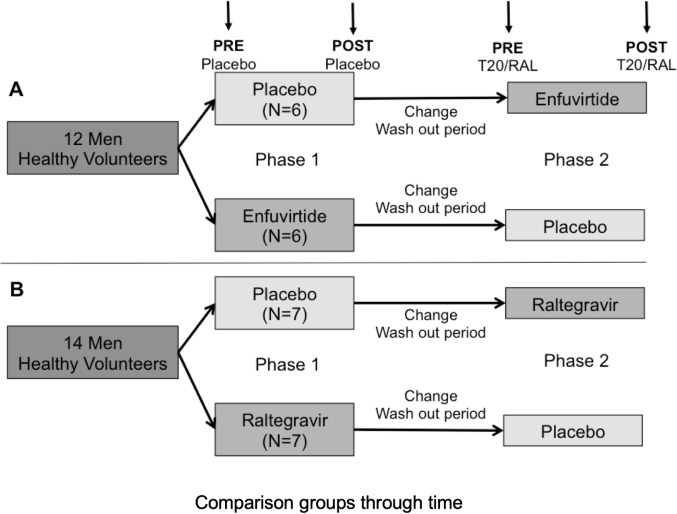
Fig 1
Fig 1
A: Flow diagram of enfuvirtide crossover. From a total of 12 healthy volunteers; 50% were randomized to placebo/enfuviride sequence. B: Flow diagram of raltegravir crossover. From a total of 14 healthy volunteers; 50% were randomized to placebo/raltegravir sequence. Blood samples (upper arrows) were obtained before (PRE) and after (POST) both phases. Each phase was 1 week long, separated from each other by a washout period of four weeks. Volunteers started with phase 1 trial (placebo/treatment) followed by a washout period and posterior phase 2 (treatment/placebo, according to the first made intervention).
Fig 2
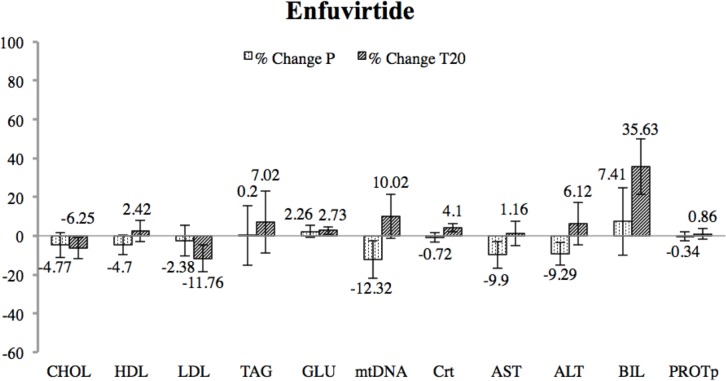
Fig 2. Percentage of change between final and baseline measurements for enfuvirtide (T20) and placebo interventions.
Significance was assessed through a Wilcoxon test. Variation is represented with error bars through the SEM value. No significant change was detected after T20 treatment.
Fig 3
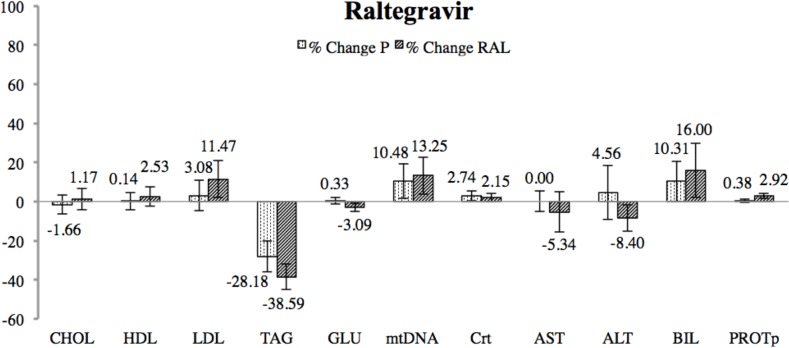
Fig 3. Percentage of change between final and baseline measurements for raltegravir (RAL) and placebo interventions.
Significance was assessed through a Wilcoxon test. Variation is represented with error bars through the SEM value. No significant change was detected after T20 treatment.

References

    1. Hammer SM, Saag MS, Schooley RT, Jacobsen DM, Thompson MA, Carpenter CCJ, et al. CLINICIAN ‘ S CORNER Treatment for Adult HIV Infection. J Am Med Assoc. 2006;296: 827–843. - PubMed
    1. Hughes A, Barber T, Nelson M. New treatment options for HIV salvage patients: An overview of second generation PIs, NNRTIs, integrase inhibitors and CCR5 antagonists. Journal of Infection. 2008. pp. 1–10. 10.1016/j.jinf.2008.05.006 - DOI - PubMed
    1. WHO CG. The use of antiretroviral drugs for treating and preventing HIV infection. World Heal Organ. 2016; - PubMed
    1. Atta MG, Seigneux S De, Lucas GM. Nephropharmacology for the Clinician Clinical Pharmacology in HIV Therapy. Clin J Am Soc Nephrol. 2018; 1–10. 10.2215/CJN.02240218 - DOI - PMC - PubMed
    1. Brinkman K, Smeitink J a, Romijn J a, Reiss P. Mitochondrial toxicity induced by nucleoside-analogue reverse- transcriptase inhibitors is a key factor in the pathogenesis of antiretroviral-therapy-related lipodystrophy. Lancet. 1999;354: 1112–1115. 10.1016/S0140-6736(99)06102-4 - DOI - PubMed

Publication types

MeSH terms