


Body fat anthropometric indexes: Which of those identify better high cardiovascular risk subjects? A comparative study in Spanish population
- PMID: 31120940
- PMCID: PMC6532872
- DOI: 10.1371/journal.pone.0216877
Body fat anthropometric indexes: Which of those identify better high cardiovascular risk subjects? A comparative study in Spanish population
Abstract
Aim: To determine the association of body mass index (BMI), waist circumference (WC), waist to hip ratio (WHR), waist to height ratio (WHtr) and Body Shape Index (ABSI) with high cardiovascular risk (CVR), as well as to determine whether how strong are these relationships.
Material and methods: A cross-sectional study was carried out in Spanish Caucasian adults. 3,456 subjects completed the study, 45.78% males, aged < 65 years and non-diabetic subjects. Anthropometric/biochemical variables were measured. We determined ABSI based on WC adjusted for height and weight. High CVR was defined as ≥ 20% according to the Framingham chart, ≥ 5% with the SCORE chart, and ≥ 7.5% with the ACC/AHA guide. Areas under the receiver operating characteristic curves (AUCs) were estimated for each anthropometric measure.
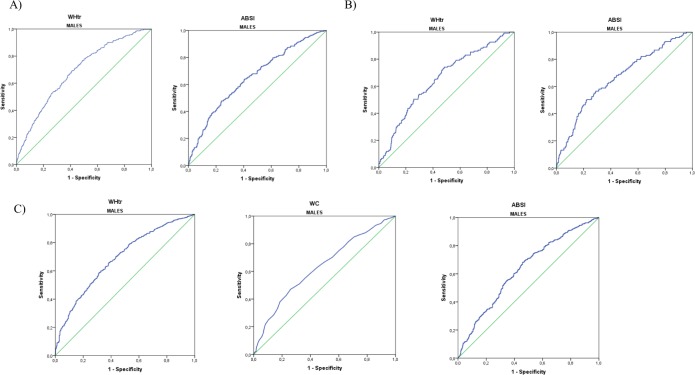
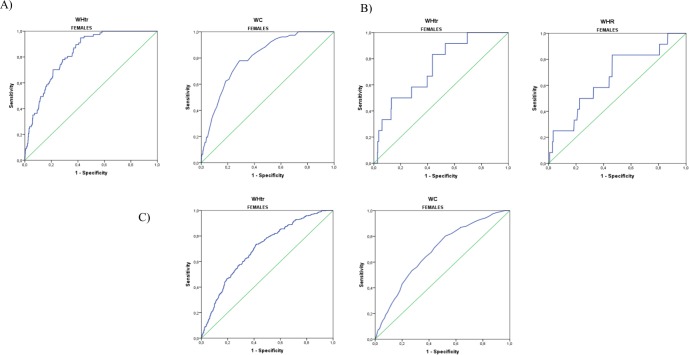
Results: Most significant AUCs in males were: WHtr and ABSI for Framingham ≥ 20% and SCORE ≥ 5%. Also significant were WHtr, WC and ABSI for ACCA/AHA ≥ 7.5%. On the other hand, most significant AUCs in females were: WHtr and WC for Framingham ≥ 20%; and WHtr and WHR for SCORE ≥ 5%, WHtr, and WC for ACC/AHA guide ≥ 7.5%.
Conclusions: Overall, the best anthropometric index identifying Spanish males and females who are at high risk for CV events is WHtr. ABSI was also found to be a good anthropometric index to predict high CVR in Spanish males according to FR, SCORE and ACC/AHA charts. For Spanish females, WC is a good anthropometric index according to FR and ACC/AHA guide, while WHR is better according to SCORE.
Conflict of interest statement
The authors have read the journal's policy and the authors of this manuscript have the following competing interests: MSR received grants funding from Eli Lilly Lab (2010-115-B99) & Bayer Pharmaceutical Co. (2005-115-B99), respectively. CFP also received partial support for this study from Fundación Mutua Madrileña (FMM-2008), Spain. There are no patents, products in development or marketed products associated with this research to declare. This does not alter our adherence to PLOS ONE policies on sharing data and materials.
Figures
References
-
- Global Burden of Metabolic Risk Factors for Chronic Diseases Collaboration (BMI Mediated Effects), Lu Y, Hajifathalian K, Ezzati M, Woodward M, Rimm EB, Danaei G. Metabolic mediators of the effects of body-mass index, overweight, and obesity on coronary heart disease and stroke: a pooled analysis of 97 prospective cohorts with 1.8 million participants. Lancet. 2014; 383(9921): 970–83. 10.1016/S0140-6736(13)61836-X - DOI - PMC - PubMed
Publication types
MeSH terms
LinkOut - more resources
Full Text Sources
Miscellaneous
