


Evaluation of model performance to predict survival after transjugular intrahepatic portosystemic shunt placement
- PMID: 31120995
- PMCID: PMC6533008
- DOI: 10.1371/journal.pone.0217442
Evaluation of model performance to predict survival after transjugular intrahepatic portosystemic shunt placement
Abstract
Background/aims: The MELD score was developed to predict survival after transjugular intrahepatic portosystemic shunt (TIPS) placement. Given changes in practice patterns and development of new prognostic tools in cirrhosis, we aimed to evaluate common models to predict mortality after TIPS placement.
Methods: Analysis of consecutive patients who underwent TIPS placement for ascites or bleeding. Performance to predict 90-day mortality was assessed by C statistic for six models (MELD, MELD-Na, CLIF-C ACLF, Child-Pugh, Platelet-Albumin-Bilirubin, and Emory score). Added predictive value to MELD score was assessed for univariate predictors of 90-day mortality. Stratified analysis by TIPS indication, emergent placement status, and TIPS stent type was performed.
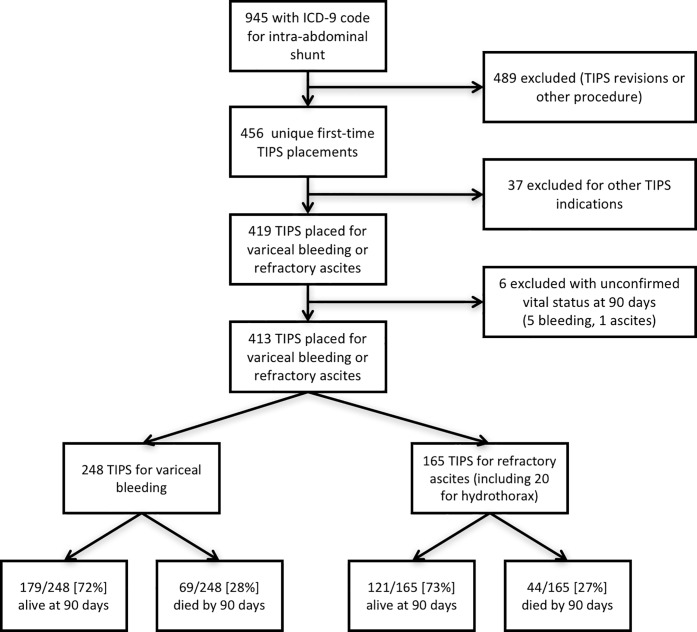
Results: 413 patients were analyzed (248 with variceal bleeding, 165 with refractory ascites). 90-day mortality was 27% (113/413). Mean MELD score was 15 ± 7.9. MELD score best predicted mortality for all patients (c = 0.779), for variceal bleeding (c = 0.844), and for emergent TIPS (c = 0.817). CLIF-C ACLF score best predicted mortality for refractory ascites (c = 0.707). Addition of sodium to the MELD score did not improve predictive value across multiple strata. Addition of hemoglobin improved MELD score's predictive value in variceal bleeding. Addition of age improved MELD score's predictive value in refractory ascites.
Conclusions: MELD score best predicted 90-day mortality. Addition of sodium to the MELD score did not improve its performance, though mortality prediction was improved using Age-MELD for ascites and Hemoglobin-MELD for bleeding. An individualized risk stratification approach may be best when considering candidates for TIPS placement.
Conflict of interest statement
The authors have declared that no competing interests exist.
References
-
- Rossle M, Richter GM, Noldge G, Palmaz JC, Wenz W, Gerok W. New non-operative treatment for variceal haemorrhage. Lancet. 1989;2(8655):153 . - PubMed
-
- Bureau C, Thabut D, Oberti F, Dharancy S, Carbonell N, Bouvier A, et al. Transjugular Intrahepatic Portosystemic Shunts With Covered Stents Increase Transplant-free Survival of Patients With Cirrhosis and Recurrent Ascites. Gastroenterology. 2016. S0016-5085(16)35110-1 [pii]. - PubMed
-
- Stewart CA, Malinchoc M, Kim WR, Kamath PS. Hepatic encephalopathy as a predictor of survival in patients with end-stage liver disease. Liver Transplantation: official publication of the American Association for the Study of Liver Diseases and the International Liver Transplantation Society. 2007;13(10):1366–71. 10.1002/lt.21129 - DOI - PubMed
Publication types
MeSH terms
Substances
Grants and funding
LinkOut - more resources
Full Text Sources
