


Association of Stroke Among Adults Aged 18 to 49 Years With Long-term Mortality
- PMID: 31121602
- PMCID: PMC6547225
- DOI: 10.1001/jama.2019.6560
Association of Stroke Among Adults Aged 18 to 49 Years With Long-term Mortality
Abstract
Importance: Stroke remains the second leading cause of death worldwide. Approximately 10% to 15% of all strokes occur in young adults. Information on prognosis and mortality specifically in young adults is limited.
Objective: To determine short- and long-term mortality risk after stroke in young adults, according to age, sex, and stroke subtype; time trends in mortality; and causes of death.
Design, setting, and participants: Registry- and population-based study in the Netherlands of 15 527 patients aged 18 to 49 years with first stroke between 1998 and 2010, and follow-up until January 1, 2017. Patients and outcomes were identified through linkage of the national Hospital Discharge Registry, national Cause of Death Registry, and the Dutch Population Register.
Exposures: First stroke occurring at age 18 to 49 years, documented using International Classification of Diseases, Ninth Revision, and International Statistical Classification of Diseases and Related Health Problems, Tenth Revision, codes for ischemic stroke, intracerebral hemorrhage, and stroke not otherwise specified.
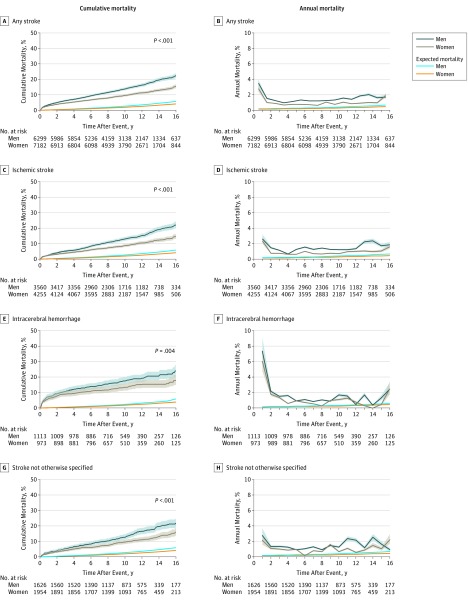
Main outcomes and measures: Primary outcome was all-cause cumulative mortality in 30-day survivors at end of follow-up, stratified by age, sex, and stroke subtype, and compared with all-cause cumulative mortality in the general population.
Results: The study population included 15 527 patients with stroke (median age, 44 years [interquartile range, 38-47 years]; 53.3% women). At end of follow-up, a total of 3540 cumulative deaths had occurred, including 1776 deaths within 30 days after stroke and 1764 deaths (23.2%) during a median duration of follow-up of 9.3 years (interquartile range, 5.9-13.1 years). The 15-year mortality in 30-day survivors was 17.0% (95% CI, 16.2%-17.9%). The standardized mortality rate compared with the general population was 5.1 (95% CI, 4.7-5.4) for ischemic stroke (observed mortality rate 12.0/1000 person-years [95% CI, 11.2-12.9/1000 person-years]; expected rate, 2.4/1000 person-years; excess rate, 9.6/1000 person-years) and the standardized mortality rate for intracerebral hemorrhage was 8.4 (95% CI, 7.4-9.3; observed rate, 18.7/1000 person-years [95% CI, 16.7-21.0/1000 person-years]; expected rate, 2.2/1000 person-years; excess rate, 16.4/1000 person-years).
Conclusions and relevance: Among young adults aged 18 to 49 years in the Netherlands who were 30-day survivors of first stroke, mortality risk compared with the general population remained elevated up to 15 years later.
Conflict of interest statement
Figures
References
-
- Barker-Collo S, Bennett DA, Krishnamurthi RV, et al. ; GBD 2013 Writing Group; GBD 2013 Stroke Panel Experts Group . Sex differences in stroke incidence, prevalence, mortality and disability-adjusted life years: results from the Global Burden of Disease Study 2013. Neuroepidemiology. 2015;45(3):203-214. doi: 10.1159/000441103 - DOI - PMC - PubMed
-
- World Health Organization Cardiovascular diseases (CVDs). https://www.who.int/news-room/fact-sheets/detail/cardiovascular-diseases.... Accessed May 10, 2019.
Publication types
MeSH terms
LinkOut - more resources
Full Text Sources
Medical
