. 2019 May 22;8(5):142.
doi: 10.3390/antiox8050142.

A Simple and a Reliable Method to Quantify Antioxidant Activity In Vivo

Affiliations

A Simple and a Reliable Method to Quantify Antioxidant Activity In Vivo

María Pilar de Torre et al. Antioxidants (Basel). .

Abstract

The characterization of compounds with antioxidant activity is of great interest due to their ability to reduce reactive oxygen species production and, therefore, prevent some age-related diseases. Its antioxidant capacity can be analyzed by different methods both in vitro and in vivo. Caenorhabditis elegans is an in vivo model widely used in ageing research. Until now, available tests analyze functional effects in the worms, so the antioxidant activity of the compound is indirectly monitored. We have developed a simple and a reliable method to quantify internal antioxidant activity in vivo. To validate this method, we analyzed an aqueous green tea extract and two other compounds with a well-known antioxidant activity and without this activity. The results obtained (EC50 green tea = 21.76 ± 1.28 µg/mL; EC50 positive control = 8.50 ± 0.33 µg/mL; negative control EC50 > 500 µg/mL) can help in the design of further in vivo experiments. Thus, our method can be used as a previous screening capable of reducing the gap between in vitro and in vivo assays.

Keywords: C. elegans; DPPH scavenging; green tea; rosmarinic acid.


Conflict of interest statement

The authors declare no conflict of interest.

Figures
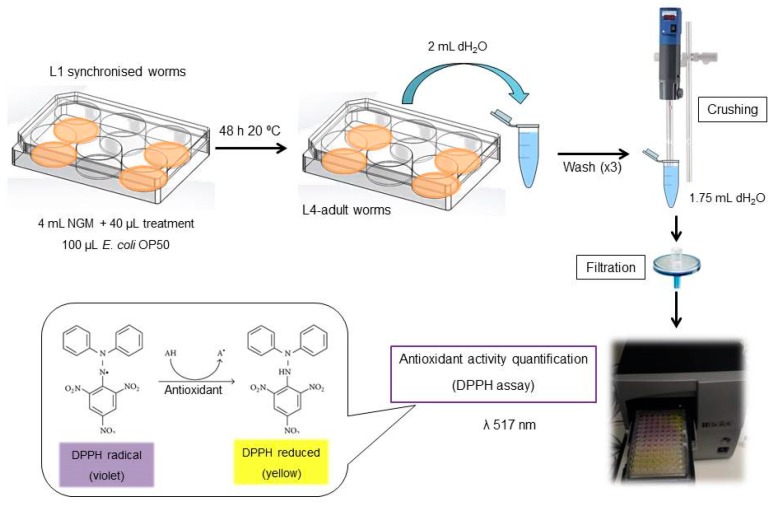
Figure 1
Figure 1
Step-by-step protocol for the proposed method.
Figure 2
Figure 2
Temporal evolution of antioxidant activity in vitro (DPPH•) expressed in EC50 (mean ± SD µg/mL). Dark spots and continuous line correspond to data from treatment with green tea. Empty spots and dashed line correspond to data from treatment with rosmarinic acid (RA). Antioxidant activities of both green tea and RA showed differences in all the time-points (p < 0.001). Table below the graph shows the EC50 mean values (SD) µg/mL. * indicates the time points in which statistical differences (p < 0.05) with their consecutive value could be observed.
Figure 3
Figure 3
Temporal evolution of antioxidant activity in vivo (DPPH•) expressed in EC50 (mean ± SD µg/mL). Dark spots and continuous line correspond to data from treatment with green tea. Empty spots and dashed line correspond to data from treatment with rosmarinic acid (RA). Antioxidant activities of both green tea and RA showed differences in all the time-points (p < 0.001). Table below the graph shows the EC50 mean values (SD) µg/mL. * indicates the time points in which statistical differences (p < 0.05) with their consecutive value could be observed.

References

    1. Wickens A.P. Ageing and the free radical theory. Respir. Physiol. 2001;128:379–391. doi: 10.1016/S0034-5687(01)00313-9. - DOI - PubMed
    1. Harman D. Free radical theory of aging. Mutat. Res. 1992;275:257–266. doi: 10.1016/0921-8734(92)90030-S. - DOI - PubMed
    1. Huang W., Zhang X., Chen W. Role of oxidative stress in Alzheimer’s disease. Biomed. Rep. 2016;4:519–522. doi: 10.3892/br.2016.630. - DOI - PMC - PubMed
    1. Ullah A., Khan A., Khan I. Diabetes mellitus and oxidative stress—A concise review. Saudi Pharm. J. 2016;24:547–553. - PMC - PubMed
    1. Krishnaiah D., Sarbatly R., Nithyanandam R. A review of the antioxidant potential of medicinal plant species. Food Bioprod. Process. 2011;89:217–233. doi: 10.1016/j.fbp.2010.04.008. - DOI

LinkOut - more resources
