. 2019 May 22:2:196.
doi: 10.1038/s42003-019-0447-x. eCollection 2019.

Preliminary design of a new degradable medical device to prevent the formation and recurrence of intrauterine adhesions

Affiliations

Preliminary design of a new degradable medical device to prevent the formation and recurrence of intrauterine adhesions

Salome Leprince et al. Commun Biol. .

Abstract

Intrauterine adhesions lead to partial or complete obliteration of the uterine cavity and have life-changing consequences for women. The leading cause of adhesions is believed to be loss of stroma resulting from trauma to the endometrium after surgery. Adhesions are formed when lost stroma is replaced by fibrous tissue that join the uterine walls. Few effective intrauterine anti-adhesion barriers for gynecological surgery exist. We designed a degradable anti-adhesion medical device prototype to prevent adhesion formation and recurrence and restore uterine morphology. We focused on ideal degradation time for complete uterine re-epithelialization for optimal anti-adhesion effect and clinical usability. We developed a triblock copolymer prototype [poly(lactide) combined with high molecular mass poly(ethylene oxide)]. Comparative pre-clinical studies demonstrated in vivo anti-adhesion efficacy. Ease of introduction and optimal deployment in a human uterus confirmed clinical usability. This article provides preliminary data to develop an intrauterine medical device and conduct a clinical trial.

Keywords: Experimental models of disease; Translational research.


Conflict of interest statement

Competing interestsX.G., S.L., S.H., V.L, J.C., and C.P. declare no competing financial interests but the following competing non-financial interests: the authors (X.G., S.L., S.H., V.L, J.C., and C.P.), the University of Montpellier, CNRS, and the University Hospital of Nîmes applied for a patent in 2014 for the polymers and their applications in gynecology. The patent application number is WO201602061. Our patent application is currently being evaluated and expected to have a response by the end of 2020. Two of the authors (S.H. and X.G.) have developed a start-up based on the results of the current study, and one of the authors (S.L.) is currently employed in this new company. L.A, S.W., I.L., A.B., H.T., and R.DeT. declare no competing financial and non-financial interests.

Figures
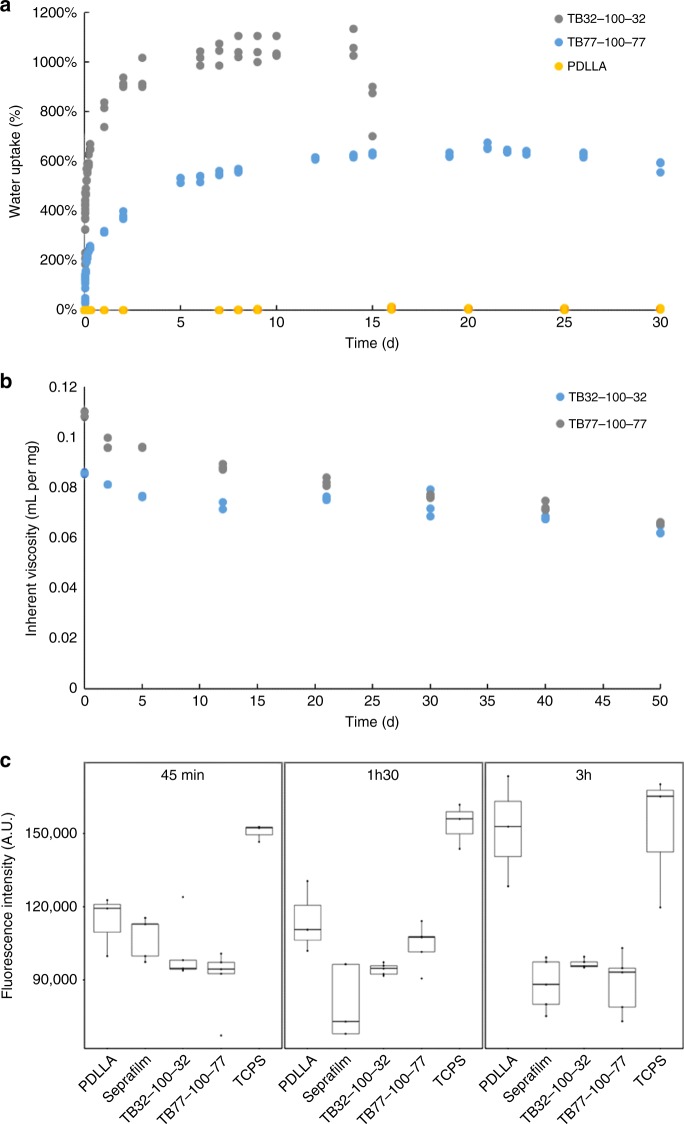
Fig. 1
Fig. 1
Water uptake, in vitro degradation and in vitro cell adhesion of copolymer films. a Water uptake (%) of triblock films and PDLLA in saline solution (initial pH 7.4) at 37 °C (n = 3 independent samples). b Inherent viscosity during in vitro degradation after immersion in saline solution (initial pH 7.4; 37 °C). c Adhesion of the NCTC 929 cells after 45 min, 1H30 and 3H on copolymer films, PDLLA film, Seprafilm®, and control group (TCPS). All data points and standard deviations are the result of n = 3 independent samples
Fig. 2
Fig. 2
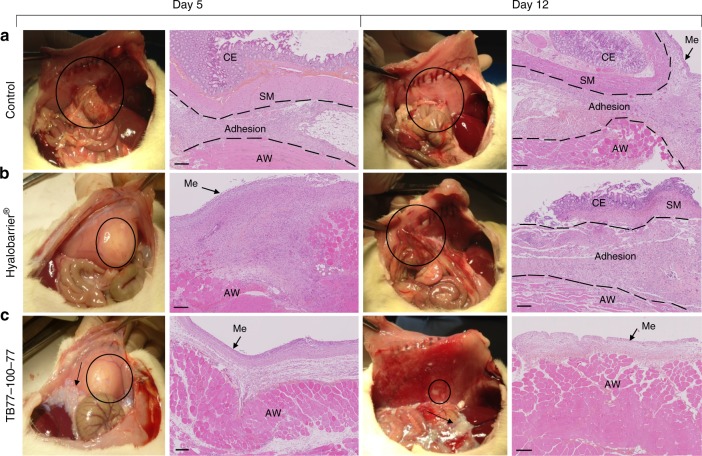
Prevention of peritoneal adhesions. Macroscopic images and histological examination (HES staining) of the wound site in rats 5 and 12 days after surgical trauma. a Control group: without treatment. b Group treated by instillation of Hyalobarrier gel. c. Group treated by implantation of TB77-100-77 films. In macroscopic images, circles indicate the site of peritoneal defect and black arrows indicate residues of TB77-100-77. For histological examination, Me: Mesothelial cells; CE: Cecal mucosa; SM: Visceral Smooth Muscle; AW: Abdominal Wall. Scale bars: 200 µm
Fig. 3
Fig. 3
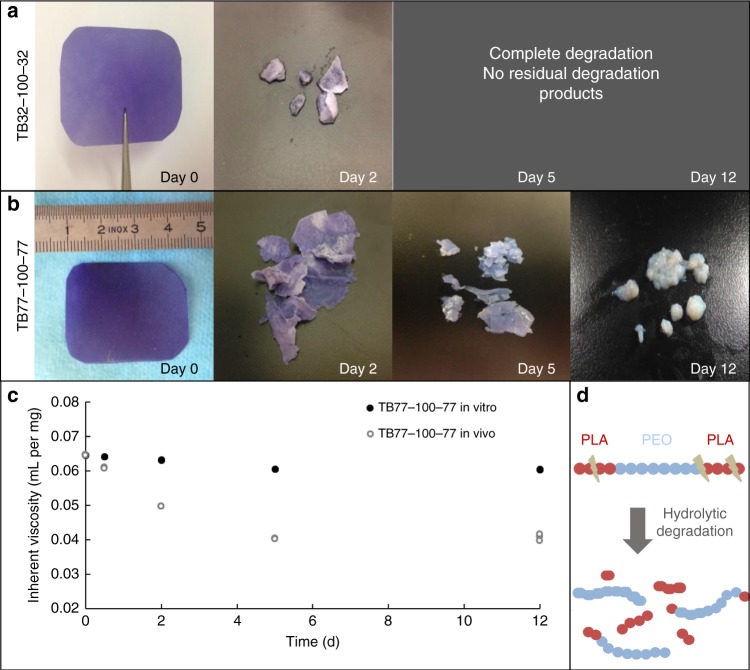
In vivo degradation study of copolymer films after surgical trauma in the abdominal cavity. a TB32-100-32 films residues at initial time and after 2, 5, and 12 days. b TB77-100-77 films residues at initial time and after 2, 5, and 12 days. c Comparison of inherent viscosity of TB77-100-77 films during in vitro degradation after immersion in saline solution and in vivo degradation after surgical trauma. d Schematic degradation of triblock copolymers
Fig. 4
Fig. 4
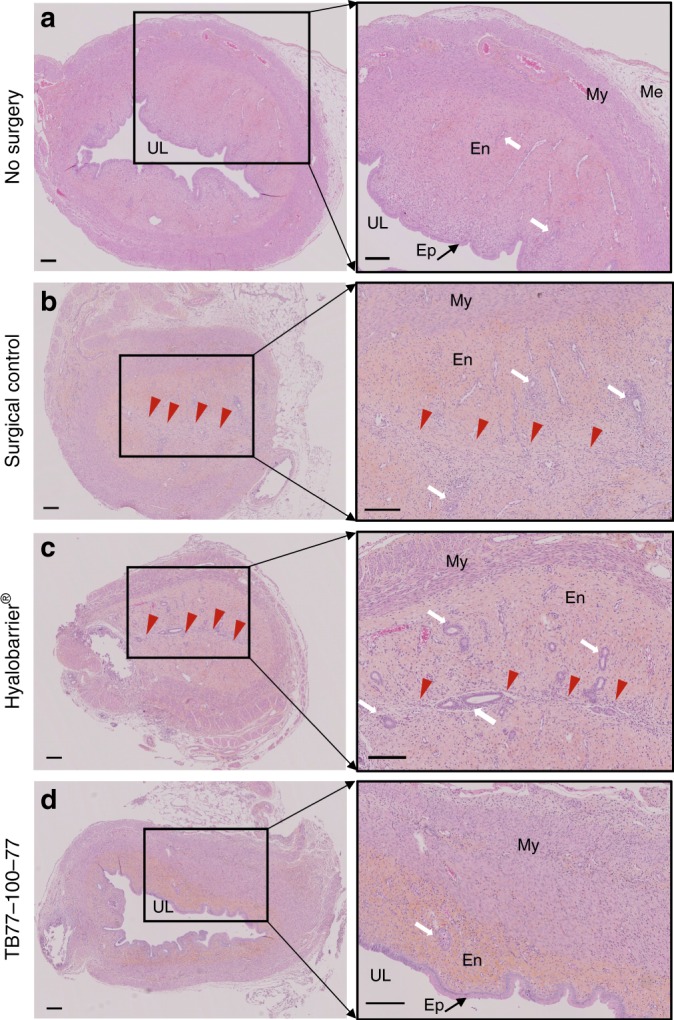
Prevention of intrauterine adhesions. Histological observations and higher magnification of each images of uterine tissues by H&E staining. a Normal uterine tissue (no surgery). b Intrauterine adhesion 7 days after scraping surgery of the control group. c Intrauterine adhesion 7 days after scraping surgery of the Hyalobarrier®-treated group. d Uterine tissue 7 days after scraping surgery of the TB77-100-77-treated group. Scale bars in microphotographs indicate 200 µm. UL: uterine lumen; Ep: epithelium; En: endometrium; My: myometrium; Me: mesothelium. Red arrows indicate adhesions
Fig. 5
Fig. 5
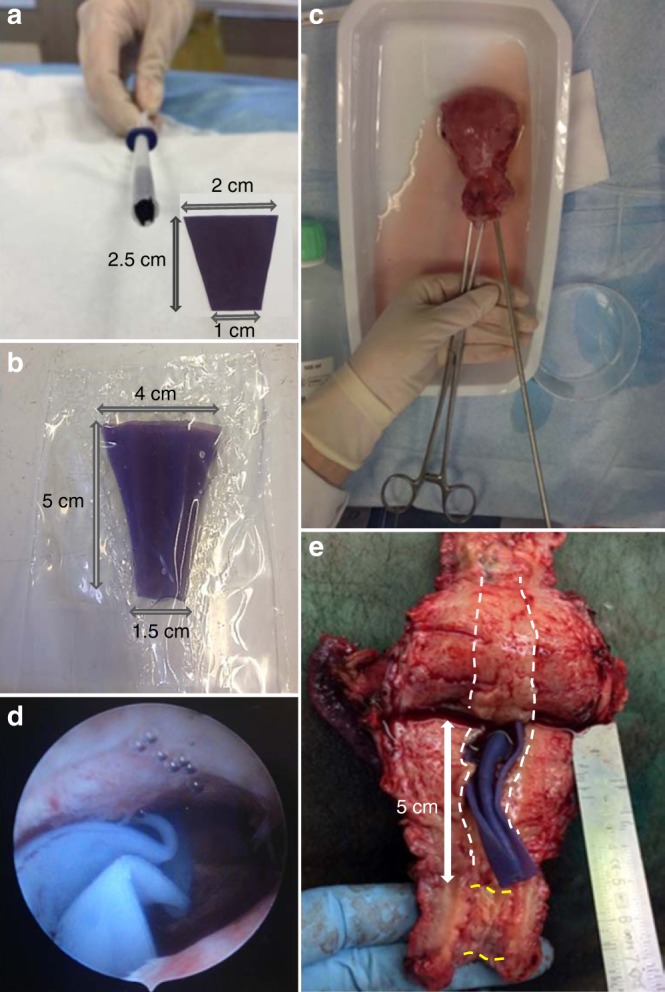
Ex vivo in utero deployment study of TB77-100-77 prototype. a TB77-100-77 film folded and introduced into a 5-mm IUD applicator tube; b In vitro deployment of the TB77-100-77 film in an anatomical uterus model after 60 min; c Illustrations of instillation of physiological saline solution at 37 °C into a uterine cavity. d Observations of the prototype deployment by hysteroscopy after 15 min; e Opening uterus after 60 min and visualization of the prototype deployment. White dotted lines indicate the delimitation of the uterine cavity and yellow dotted lines indicate the delimitation of the canal cervix

References

    1. Asherman JG. Amenorrhoea traumatica (Atretica) J. Obstet. Gynaecol. Br. Emp. 1948;55:23–30. doi: 10.1111/j.1471-0528.1948.tb07045.x. - DOI - PubMed
    1. Asherman JG. Traumatic intra-uterine adhesions. J. Obstet. Gynaecol. Br. Emp. 1950;57:892–896. doi: 10.1111/j.1471-0528.1950.tb06053.x. - DOI - PubMed
    1. Conforti A, Alviggi C, Mollo A, De Placido G, Magos A. The management of Asherman syndrome: a review of literature. Reprod. Biol. Endocrin. 2013;11:118. doi: 10.1186/1477-7827-11-118. - DOI - PMC - PubMed
    1. Taskin O, et al. Role of endometrial suppression on the frequency of intrauterine adhesions after resectoscopic surgery. J. Am. Assoc. Gynecol. Laparosc. 2000;7:351–354. doi: 10.1016/S1074-3804(05)60478-1. - DOI - PubMed
    1. Bhandari S, Ganguly I, Agarwal P, Singh A, Gupta N. Effect of myomectomy on endometrial cavity: a prospective study of 51 cases. J. Hum. Reprod. Sci. 2016;9:107–111. doi: 10.4103/0974-1208.183509. - DOI - PMC - PubMed

Publication types

MeSH terms