


Characterisation of a solvent-tolerant haloarchaeal (R)-selective transaminase isolated from a Triassic period salt mine
- PMID: 31123770
- PMCID: PMC6597733
- DOI: 10.1007/s00253-019-09806-y
Characterisation of a solvent-tolerant haloarchaeal (R)-selective transaminase isolated from a Triassic period salt mine
Abstract
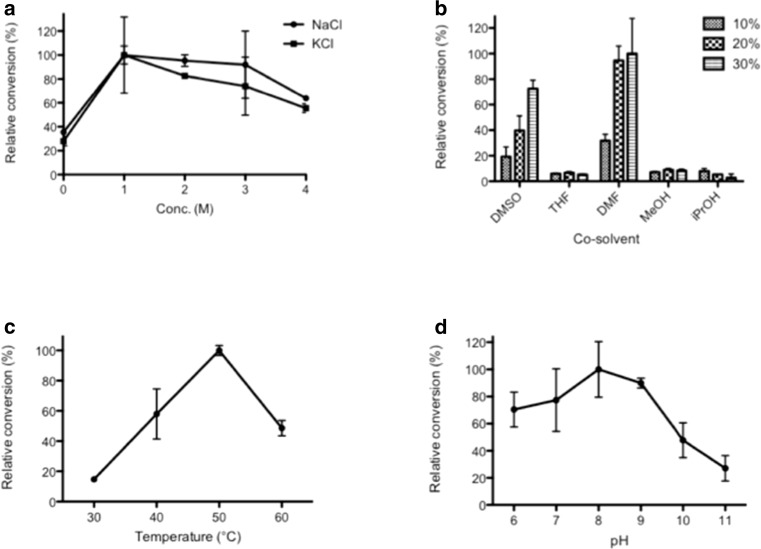
Transaminase enzymes (TAms) are becoming increasingly valuable in the chemist's toolbox as a biocatalytic route to chiral amines. Despite high profile successes, the lack of (R)-selective TAms and robustness under harsh industrial conditions continue to prove problematic. Herein, we report the isolation of the first haloarchaeal TAm (BC61-TAm) to be characterised for the purposes of pharmaceutical biocatalysis. BC61-TAm is an (R)-selective enzyme, cloned from an extremely halophilic archaeon, isolated from a Triassic period salt mine. Produced using a Haloferax volcanii-based expression model, the resulting protein displays a classic halophilic activity profile, as well as thermotolerance (optimum 50 °C) and organic solvent tolerance. Molecular modelling predicts the putative active site residues of haloarchaeal TAms, with molecular dynamics simulations providing insights on the basis of BC61-TAm's organic solvent tolerance. These results represent an exciting advance in the study of transaminases from extremophiles, providing a possible scaffold for future discovery of biocatalytic enzymes with robust properties.
Keywords: Archaea; Biocatalysis; Halophile; Organic solvent; Transaminase.
Conflict of interest statement
The authors declare that they have no conflict of interest.
Figures




References
-
- Amoozegar MA, Siroosi M, Atashgahi S, Smidt H, Ventosa A. Systematics of haloarchaea and biotechnological potential of their hydrolytic enzymes. Microbiology (United Kingdom) 2017;163:623–645. - PubMed
-
- Aziz RK, Bartels D, Best AA, DeJongh M, Disz T, Edwards RA, Formsma K, Gerdes S, Glass EM, Kubal M, Meyer F, Olsen GJ, Olson R, Osterman AL, Overbeek RA, McNeil LK, Paarmann D, Paczian T, Parrello B, Pusch GD, Reich C, Stevens R, Vassieva O, Vonstein V, Wilke A, Zagnitko O. The RAST Server: rapid annotations using subsystems technology. BMC Genomics. 2008;9:75. doi: 10.1186/1471-2164-9-75. - DOI - PMC - PubMed
-
- Baud D, Jeffries JWE, Moody TS, Ward JM, Hailes HC. A metagenomics approach for new biocatalyst discovery: application to transaminases and the synthesis of allylic amines. Green Chem. 2017;19:1134–1143. doi: 10.1039/C6GC02769E. - DOI
-
- Bezsudnova EY, Boyko KM, Popov VO. Properties of bacterial and archaeal branched chain amino acid aminotransferases. Biochem. 2017;82:1572–1591. - PubMed
MeSH terms
Substances
Grants and funding
LinkOut - more resources
Full Text Sources
Molecular Biology Databases
