


Variables associated with an inability to learn clean intermittent self-catheterization after urogynecologic surgery
- PMID: 31123797
- PMCID: PMC8549115
- DOI: 10.1007/s00192-019-03974-1
Variables associated with an inability to learn clean intermittent self-catheterization after urogynecologic surgery
Abstract
Introduction and hypothesis: Post-operative urinary retention is a common problem affecting close to half of all women undergoing pelvic reconstructive surgery. This was an exploratory analysis that was aimed at identifying factors associated with an inability to learn clean intermittent self-catheterization (CISC) after a failed post-operative retrograde voiding trial (RGVT).
Methods: We performed a retrospective case-control study of women who underwent pelvic organ prolapse or urinary incontinence surgery within a single division from 2016 to 2018. We compared women who could learn CISC with those unable to learn and discharged home with an indwelling catheter (IC). Analyses were carried out using Fisher's exact test, the Mann-Whitney U test, the Chi-squared test, and the t test with logistic regression.
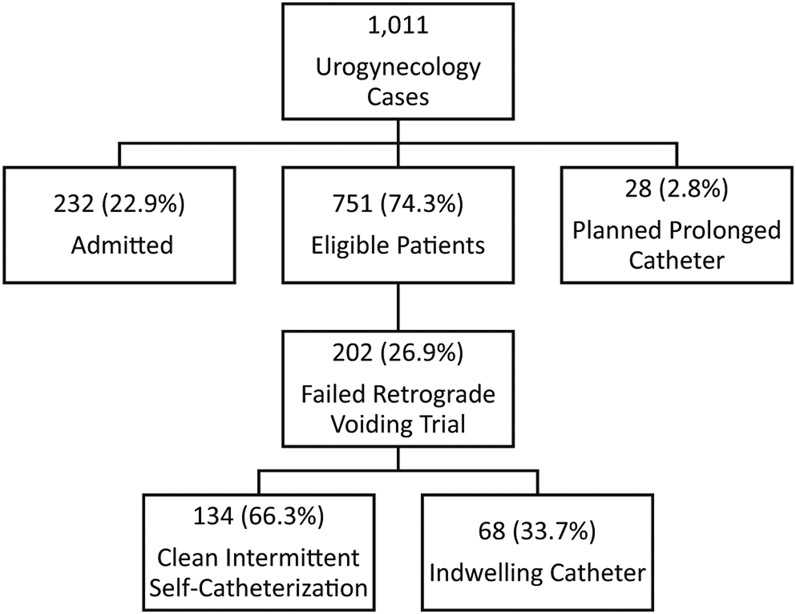
Results: Of the 202 women who failed their RGVT, 134 (66.3%) were able to learn CISC and 68 (33.7%) were not. Older age, urinary incontinence, diabetes and colpectomy/colpocleisis were associated with an inability to learn CISC (p < 0.05). Women with an IC were more likely to have an office visit related to catheter care (65.7% vs 5.2%, p < 0.001). A UTI within 30 days of surgery was more common with CISC (16.4% vs 6.0%, p = 0.037). In a multivariate logistic regression model, each increasing year of age was associated with a 1.036-fold decrease in the ability to learn CISC (aOR 1.036, 95% CI 1.002-1.071; p = 0.04).
Conclusions: Increasing age was the only variable identified on multivariate logistic regression as a risk factor for failure to learn CISC. Further studies are needed to identify barriers to learning post-operative self-catheterization.
Keywords: Pelvic organ prolapse; Post-operative urinary retention; Self-catheterization.
Conflict of interest statement
References
-
- Walters MD, Karram MM, editors. Urogynecology and reconstructive pelvic surgery. 4th ed. Philadelphia: Elsevier; 2015.
-
- Hakvoort RA, Dijkgraaf MG, Burger MP, Emanuel MH, Roovers JP. Predicting short-term urinary retention after vaginal prolapse surgery. Neurourol Urodyn. 2009;28(3):225–8. - PubMed
-
- Turner LC, Kantartzis K, Shepherd JP. Predictors of postoperative acute urinary retention in women undergoing minimally invasive sacral colpopexy. Female Pelvic Med Reconstr Surg. 2015;21(1): 39–42. - PubMed
-
- Book NM, Novi B, Novi JM, Pulvino JQ. Postoperative voiding dysfunction following posterior colporrhaphy. Female Pelvic Med Reconstr Surg. 2012;18(1):32–4. - PubMed
MeSH terms
Grants and funding
LinkOut - more resources
Full Text Sources
