


Quantifying Batrachochytrium dendrobatidis and Batrachochytrium salamandrivorans Viability
- PMID: 31124019
- PMCID: PMC6682578
- DOI: 10.1007/s10393-019-01414-6
Quantifying Batrachochytrium dendrobatidis and Batrachochytrium salamandrivorans Viability
Abstract
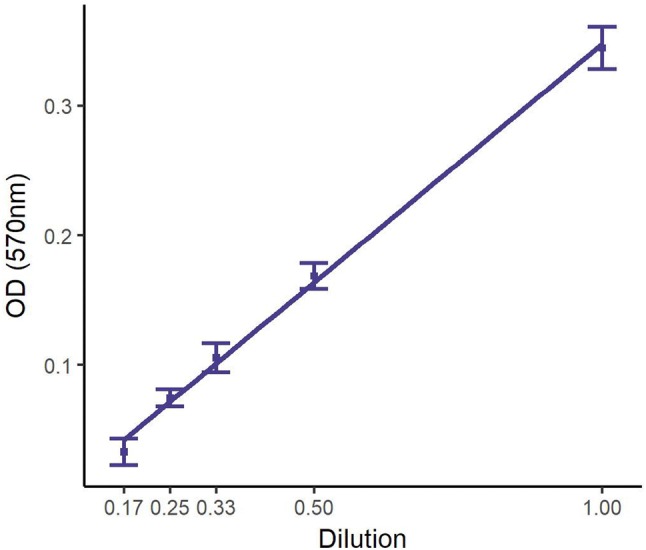
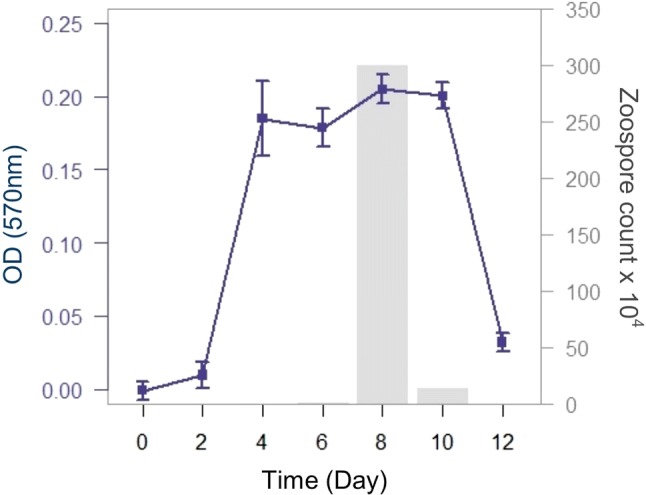
The disease chytridiomycosis is responsible for global amphibian declines. Chytridiomycosis is caused by Batrachochytrium dendrobatidis (Bd) and B. salamandrivorans (Bsal), fungal pathogens with stationary and transmissible life stages. Establishing methods that quantify growth and survival of both life stages can facilitate research on the pathophysiology and disease ecology of these pathogens. We tested the efficacy of the MTT assay, a colorimetric test of cell viability, and found it to be a reliable method for quantifying the viability of Bd and Bsal stationary life stages. This method can provide insights into these pathogens' growth and reproduction to improve our understanding of chytridiomycosis.
Keywords: Amphibian declines; Batrachochytrium dendrobatidis; Batrachochytrium salamandrivorans; Disease; MTT assay; Pathogen.
Figures


References
-
- Altman FP. Tetrazolium salts and formazans. Progress in Histochemistry and Cytochemistry. 1976;9(III):3–51. - PubMed
-
- Berger L, Speare R, Daszak P, Green DE, Cunningham AA, Goggin CL, Slocombe R, Ragan MA, Hyatt AD, McDonald KR, Hines HB. Chytridiomycosis causes amphibian mortality associated with population declines in the rain forests of Australia and Central America. Proceedings of the National Academy of Sciences. 1998;95(15):9031–9036. doi: 10.1073/pnas.95.15.9031. - DOI - PMC - PubMed
Publication types
MeSH terms
Grants and funding
LinkOut - more resources
Full Text Sources
Medical
