


Molecular pathology of tumors of the central nervous system
- PMID: 31124566
- PMCID: PMC6683853
- DOI: 10.1093/annonc/mdz164
Molecular pathology of tumors of the central nervous system
Abstract
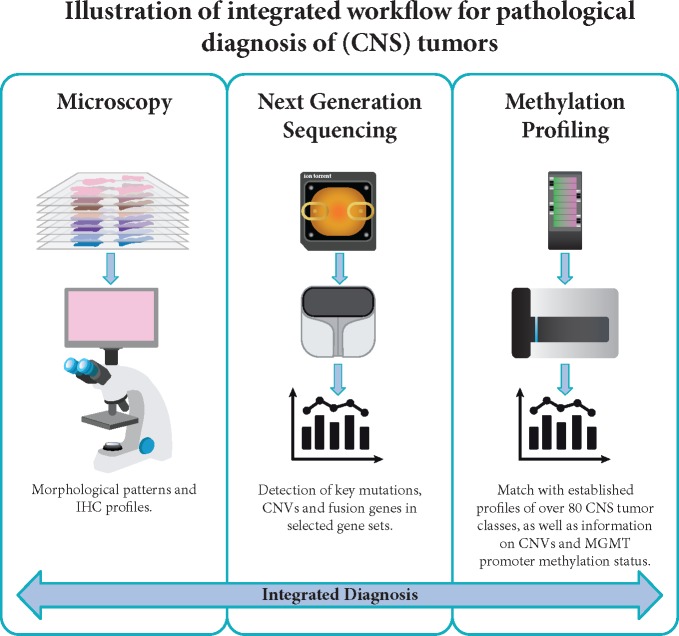
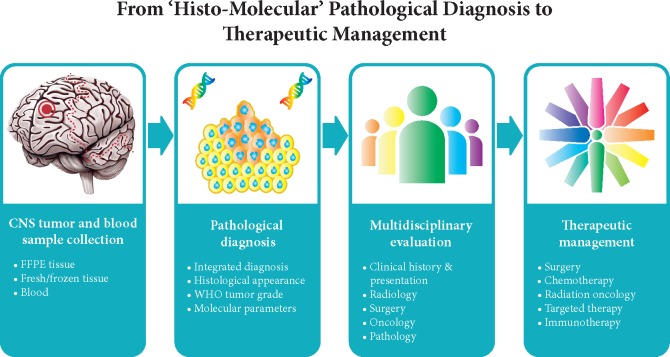
Since the update of the 4th edition of the WHO Classification of Central Nervous System (CNS) Tumors published in 2016, particular molecular characteristics are part of the definition of a subset of these neoplasms. This combined 'histo-molecular' approach allows for a much more precise diagnosis of especially diffuse gliomas and embryonal CNS tumors. This review provides an update of the most important diagnostic and prognostic markers for state-of-the-art diagnosis of primary CNS tumors. Defining molecular markers for diffuse gliomas are IDH1/IDH2 mutations, 1p/19q codeletion and mutations in histone H3 genes. Medulloblastomas, the most frequent embryonal CNS tumors, are divided into four molecularly defined groups according to the WHO 2016 Classification: wingless/integrated (WNT) signaling pathway activated, sonic hedgehog (SHH) signaling pathway activated and tumor protein p53 gene (TP53)-mutant, SHH-activated and TP53-wildtype, and non-WNT/non-SHH-activated. Molecular characteristics are also important for the diagnosis of several other CNS tumors, such as RELA fusion-positive subtype of ependymoma, atypical teratoid rhabdoid tumor (AT/RT), embryonal tumor with multilayered rosettes, and solitary fibrous tumor/hemangiopericytoma. Immunohistochemistry is a helpful alternative for further molecular characterization of several of these tumors. Additionally, genome-wide methylation profiling is a very promising new tool in CNS tumor diagnostics. Much progress has thus been made by translating the most relevant molecular knowledge into a more precise clinical diagnosis of CNS tumors. Hopefully, this will enable more specific and more effective therapeutic approaches for the patients suffering from these tumors.
Keywords: CNS tumor; embryonal tumor; glioma; integrated diagnosis; medulloblastoma; molecular pathology.
© The Author(s) 2019. Published by Oxford University Press on behalf of the European Society for Medical Oncology.
Figures
References
-
- Louis DN, Ohgaki H, Wiestler OD. et al. WHO Classification of Tumours of the Central Nervous System, 4th edition Lyon: International Agency for Research on Cancer (IARC; ) 2007.
-
- Kros JM, Gorlia T, Kouwenhoven MC. et al. Panel review of anaplastic oligodendroglioma from European Organization For Research and Treatment of Cancer Trial 26951: assessment of consensus in diagnosis, influence of 1p/19q loss, and correlations with outcome. J Neuropathol Exp Neurol 2007; 66(6): 545–551. - PubMed
-
- Louis DN, Ohgaki H, Wiestler OD. et al. World Health Organization Histological Classification of Tumours of the Central Nervous System. Lyon: International Agency for Research on Cancer (IARC; ) 2016.
Publication types
MeSH terms
Substances
LinkOut - more resources
Full Text Sources
Other Literature Sources
Medical
Research Materials
Miscellaneous
