


The President's Malaria Initiative contributed to reducing malaria burden in sub-Saharan Africa between 2004 and 2014: Evidence from generalized estimating equation analysis
- PMID: 31125380
- PMCID: PMC6534374
- DOI: 10.1371/journal.pone.0217103
The President's Malaria Initiative contributed to reducing malaria burden in sub-Saharan Africa between 2004 and 2014: Evidence from generalized estimating equation analysis
Abstract
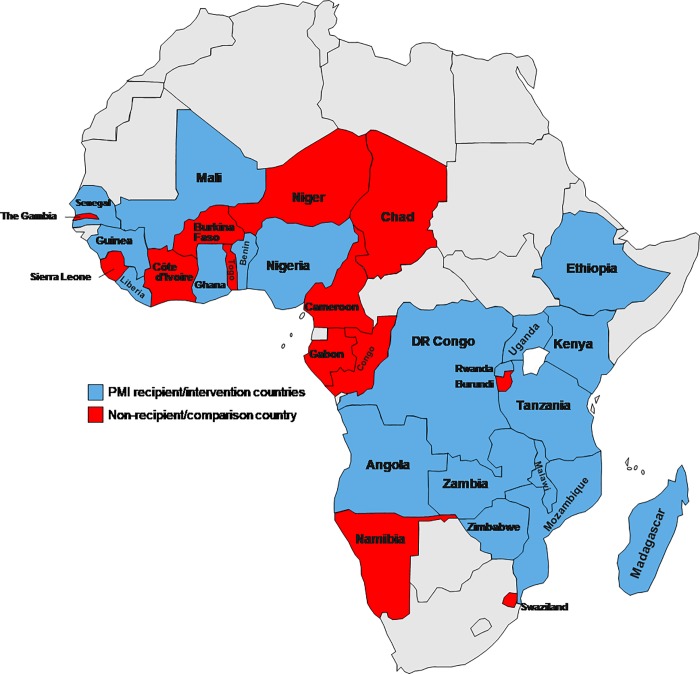
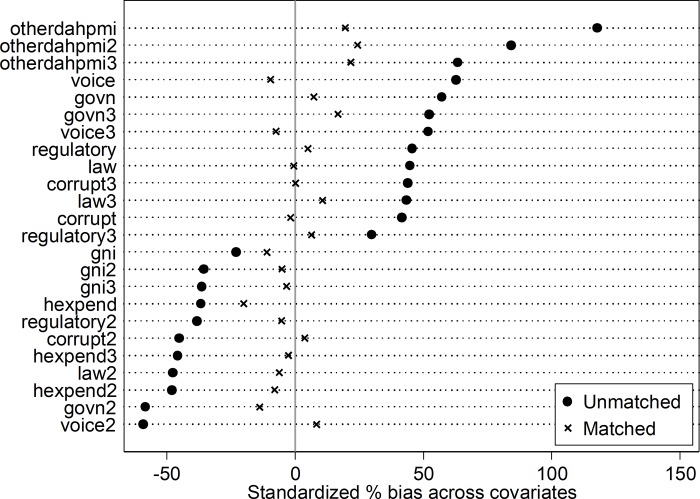
The President's Malaria Initiative (PMI) launched in 2005 as a key player in malaria prevention and treatment in sub-Saharan Africa (SSA). Several country-specific evaluations have demonstrated great progress in reducing under-five mortality associated with scaling up malaria interventions in PMI priority countries. Documentation of PMI's specific contributions was limited, until the publication of Jakubowski, et al., which used difference-in-difference analysis to show a higher reduction of under-five mortality in PMI-supported countries than in others. To generate more evidence, this study used rigorous statistical analyses to assess the reduction in mortality attributable to PMI support. The study used generalized estimating equations and a series of matching procedures to evaluate the impact of PMI on under-five mortality and on population coverage of insecticide-treated nets (ITNs), indoor residual spraying (IRS), and artemisinin-based combination therapy (ACT) in SSA. The analyses used country-level secondary data and controlled for several country-level characteristics assumed to influence outcome measures of interest, PMI program participation, or both. The Mahalanobis distance metric, with 1:1 nearest neighbor matching adjusting for bias in population size in the particular country, showed a reduction in under-five mortality by approximately 12 per 1,000 live births (95% Confidence Interval [CI]: 20.6-3.1; p = 0.012). There were statistically significant increases in the population coverage of ITNs, IRS, and ACTs in PMI countries over the implementation period. ITN use in the population was 0.23% higher (95% CI average treatment effect on the treated: 0.17-0.30; p<0.001) in PMI-recipient countries than in non-PMI countries. The findings show that PMI contributed significantly to increasing the coverage of malaria control interventions and reducing under-five mortality in SSA.
Conflict of interest statement
YY confirms that his commercial affiliation does not alter our adherence to PLOS ONE policies on sharing data and materials.
Figures
References
-
- Dieleman JL, Schneider MT, Haakenstad A, Singh L, Sadat N, Birger M, et al. Development assistance for health: past trends, associations, and the future of international financial flows for health. The Lancet. 2016;387(10037):2536–44. - PubMed
-
- World Health Organization. World malaria report 2015. World Health Organization; 2016 Jan 30. [available on internet at http://www.who.int/malaria/publications/world-malaria-report-2015/report...]: 27 July 2018.
-
- Hershey C, Florey LS, Ali D, Bennett A, Luhanga M, Mathanga DP, et al. Malaria control interventions protect against malaria parasitemia, severe anemia and all-cause mortality in children less than five years of age in Malawi, 2000–2010. Am J Trop Med Hyg. 2017;97(3_Suppl):76–88 10.4269/ajtmh.17-0203 - DOI - PMC - PubMed
Publication types
MeSH terms
Substances
LinkOut - more resources
Full Text Sources
Medical
Research Materials
