


Seizure severity is associated with poor quality of life in people living with epilepsy (PLWE) in Uganda: A cross-sectional study
- PMID: 31125798
- PMCID: PMC6597271
- DOI: 10.1016/j.yebeh.2019.04.033
Seizure severity is associated with poor quality of life in people living with epilepsy (PLWE) in Uganda: A cross-sectional study
Abstract
Rationale: There is a paucity of information about the association of seizure severity and quality of life (QoL) in people living with epilepsy (PLWE) in sub-Saharan Africa. We evaluated the relationship between seizure severity and health-related quality of life (HRQoL) of patients with epilepsy being followed up in an outpatient neurology clinic in urban central Uganda.
Methods: Forty-eight PLWE who met the study inclusion criteria were enrolled. The study questionnaire was comprised of the Chalfont Seizure Severity Scale (CSSS) and the Quality of Life Inventory in Epilepsy (QOLIE-31). Spearman's rank correlation coefficient was used to determine the association between seizure severity and QoL score.
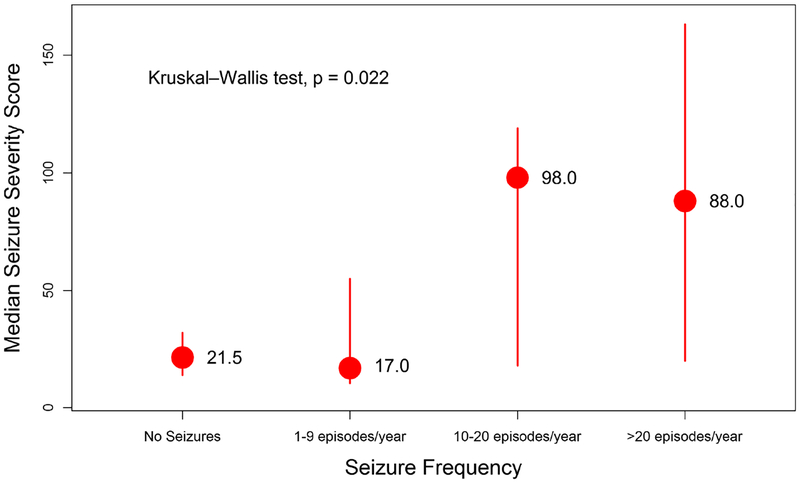
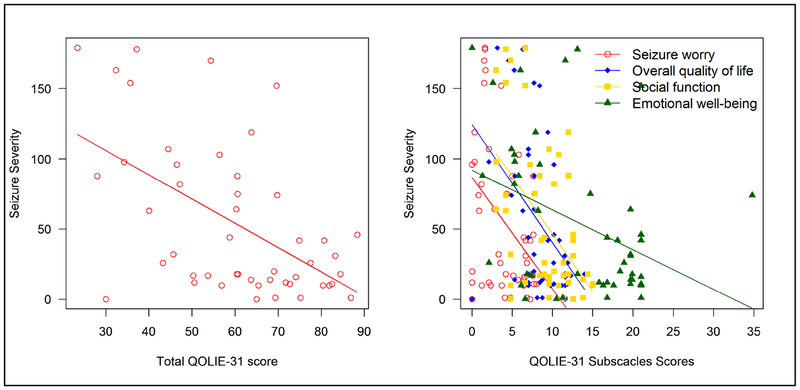
Results: The median age of the study participants was 25 years, with median age (interquartile range (IQR)) of epilepsy onset of 12 (6-18) years. Over 57.4% of the study participants were unemployed. The mean (standard deviation (SD)) of QOLIE-31 and Seizure Severity Score was 62.5 (14.5) and 62.4 (1.6), respectively. There was no gender difference in the seizure severity scores (p = 0.451). An inverse relationship existed between seizure severity and the total QOLIE-31 score (Spearman's rank correlation coefficient, r = -0.48, p = 0.001), and seizure worry (r = -0.31, p = 0.030).
Conclusions: In this Ugandan sample, seizure severity is unacceptably high and directly impacts the life of PLWE. Interventions that reduce seizure severity are urgently needed in our settings to reduce seizures and improve the QoL in PLWE.
Keywords: Epilepsy; Quality of life; Seizure; Severity.
Copyright © 2019 Elsevier Inc. All rights reserved.
Conflict of interest statement
Figures
References
-
- World Health Organisation, editor. Epilepsy Geneva: WHO; 2009.
-
- Leidy NK, Elixhauser A, Vickrey B, Means E, Willian MK. Seizure frequency and the health-related quality of life of adults with epilepsy. Neurology. 1999;53(1):162–6. - PubMed
-
- van Hout B, Gagnon D, Souetre E, Ried S, Remy C, Baker G, et al. Relationship between seizure frequency and costs and quality of life of outpatients with partial epilepsy in France, Germany, and the United Kingdom. Epilepsia. 1997;38(11):1221–6. - PubMed
Publication types
MeSH terms
Grants and funding
LinkOut - more resources
Full Text Sources
Medical
Miscellaneous
