. 2019 Sep;95(1):41-45.
doi: 10.1016/j.diagmicrobio.2019.03.015. Epub 2019 Apr 11.

Recombinase polymerase amplification assay for rapid detection of Monkeypox virus

Affiliations

Recombinase polymerase amplification assay for rapid detection of Monkeypox virus

Saskia Dede Davi et al. Diagn Microbiol Infect Dis. 2019 Sep.

Abstract

In this study, a rapid method for the detection of Central and West Africa clades of Monkeypox virus (MPXV) using recombinase polymerase amplification (RPA) assay targeting the G2R gene was developed. MPXV, an Orthopoxvirus, is a zoonotic dsDNA virus, which is listed as a biothreat agent. RPA was operated at a single constant temperature of 42°C and produced results within 3 to 10 minutes. The MPXV-RPA-assay was highly sensitive with a limit of detection of 16 DNA molecules/μl. The clinical performance of the MPXV-RPA-assay was tested using 47 sera and whole blood samples from humans collected during the recent MPXV outbreak in Nigeria as well as 48 plasma samples from monkeys some of which were experimentally infected with MPXV. The specificity of the MPXV-RPA-assay was 100% (50/50), while the sensitivity was 95% (43/45). This new MPXV-RPA-assay is fast and can be easily utilised at low resource settings using a solar powered mobile suitcase laboratory.

Keywords: Monkeypox Virus; Recombinase polymerase amplification assay; mobile suitcase; point of need; rapid detection system.


Figures

Fig. 1
Fig. 1
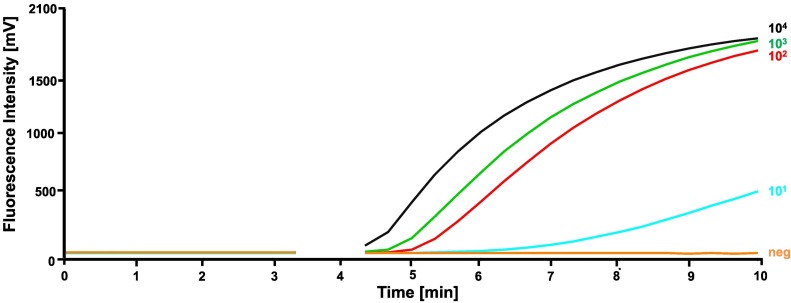
Analytical sensitivity of the MPXV-RPA-assay tested with a tenfold dilution of the molecular DNA standard (104 – 100 DNA molecules/μl). The primer combination FP3 + RP3 detected the concentration 104 – 101 DNA molecules/μl. After 230 seconds a mixing step was performed.
Fig. 2
Fig. 2
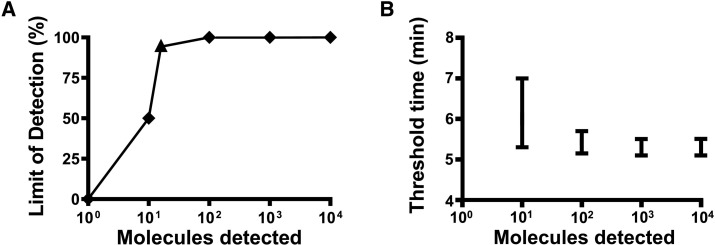
Probit regression analysis of the dataset of the eight repetitions of the analytical sensitivity test of the MPXV-RPA-assay for the determination of the detection limit (A) and semi-logarithmic regression of the detection time (B). Performing the probit regression analysis on the dataset revealed a detection limit of 16 DNA molecules/μl in 95% of the cases (A). Using Prism Software, a semi-logarithmic regression of the data from the eight runs on a dilution range of the molecular DNA standard (104-100 DNA molecules/reaction) were performed. The lowest concentration of 101 DNA molecules/μl was detected after a maximum of seven minutes (B).
Fig. 3
Fig. 3
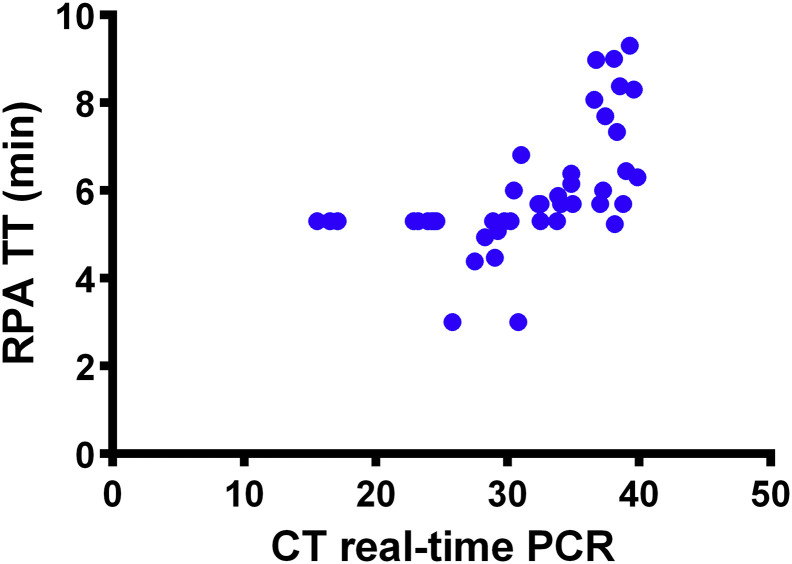
Screening of 45 blood, plasma or serum samples from MXPV infected macaques and humans by real-time PCR and RPA assays. Linear regression analysis of real-time RT-PCR cycle threshold values (Ct) and RPA threshold time in minutes (TT) were determined. No correlation was found between TT and Ct values since the RPA is much faster than the real-time PCR. Diagnostic sensitivity of real-time PCR assay was 100%, while that of MPXV-RPA-assay was 95 %(43/45).

References

    1. Abd El Wahed A., El-Deeb A., El-Tholoth M., Abd El Kader H., Ahmed A., Hassan S., et al. A Portable Reverse Transcription Recombinase Polymerase Amplification Assay for Rapid Detection of Foot-and-Mouth Disease Virus. PLoS One. 2013;8 - PMC - PubMed
    1. Abd El Wahed A., Weidmann M., Hufert F.T. Diagnostics-in-a-Suitcase: Development of a portable and rapid assay for the detection of the emerging avian influenza A (H7N9) virus. J Clin Virol. 2015;69:16–21. - PMC - PubMed
    1. Abd El Wahed A., Patel P., Faye O., Thaloengsok S., Heidenreich D., Matangkasombut P., et al. Recombinase Polymerase Amplification Assay for Rapid Diagnostics of Dengue Infection. PLoS One. 2015;10 - PMC - PubMed
    1. Babonneau J., Bernard C., Marion E., Chauty A., Kempf M., Robert R., et al. Development of a dry-reagent-based qPCR to facilitate the diagnosis of Mycobacterium ulcerans infection in endemic countries. PLoS Negl Trop Dis. 2015;9 - PMC - PubMed
    1. Breman J.G., Henderson D.A. Diagnosis and management of smallpox. N Engl J Med. 2002;346:1300–1308. - PubMed

Publication types