


Correspondence between lung function and symptom measures from the Cystic Fibrosis Respiratory Symptom Diary-Chronic Respiratory Infection Symptom Score (CFRSD-CRISS)
- PMID: 31126901
- PMCID: PMC6868291
- DOI: 10.1016/j.jcf.2019.05.009
Correspondence between lung function and symptom measures from the Cystic Fibrosis Respiratory Symptom Diary-Chronic Respiratory Infection Symptom Score (CFRSD-CRISS)
Abstract
Background: Pulmonary exacerbations (PEx) in cystic fibrosis (CF) patients reduce quality of life. Lung function, measured by the percent predicted forced expiratory volume in 1 s (ppFEV1), is widely used to evaluate PEx treatments. We analyzed the correspondence of ppFEV1 with 8 patient-reported symptom-based questions from the Cystic Fibrosis Respiratory Symptom Diary-Chronic Respiratory Infection Symptom Score (CFRSD-CRISS).
Methods: Data were derived from the observational Standardized Treatment of Pulmonary Exacerbations (STOP) study. CF patients who had CFRSD-CRISS and ppFEV1 measurements on ≥2 timepoints were included: 1) day of initial PEx, 2) 7 days later, and/or 3) end of PEx. We calculated age-stratified Spearman correlation coefficients and 95% confidence intervals (95% CIs) between the change in ppFEV1 and change in CFRSD-CRISS items from index to day 7 and from index to the end of PEx treatment.
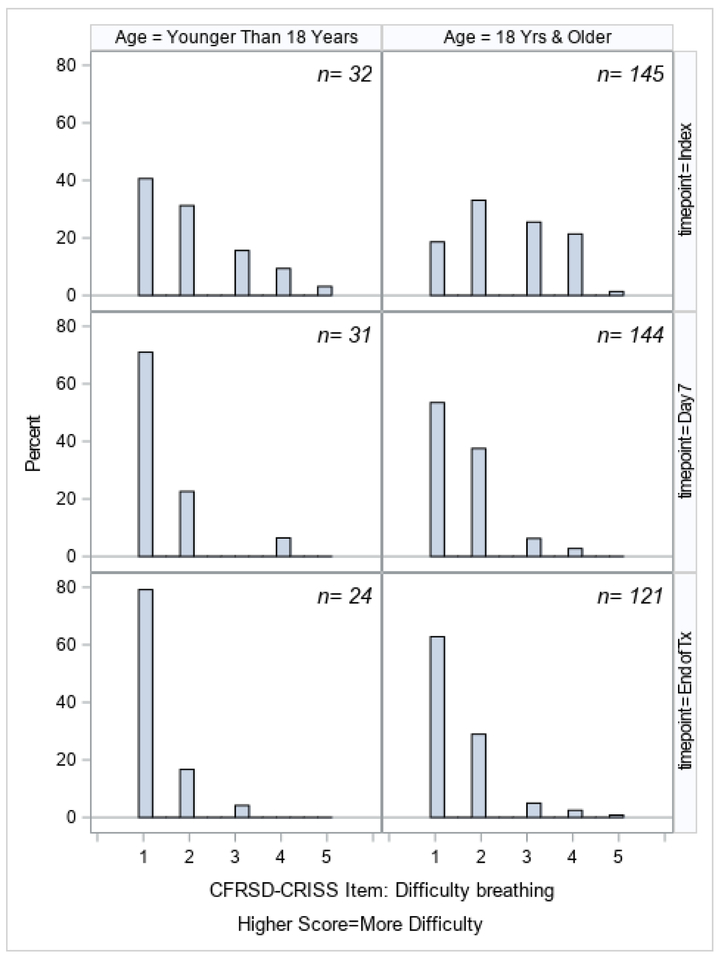
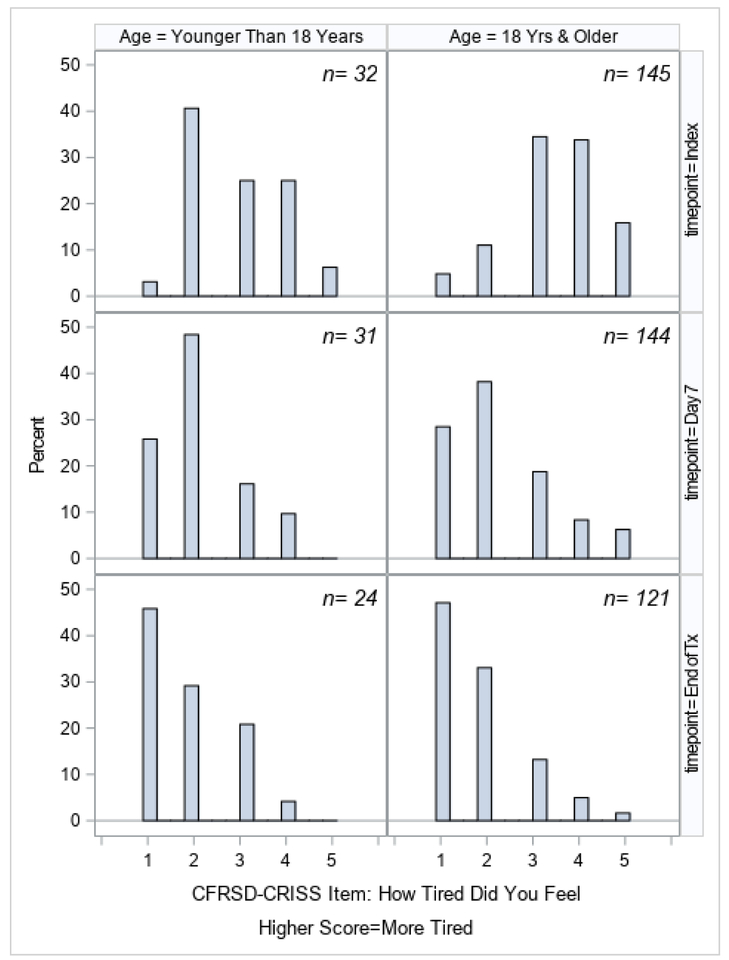
Results: Lung function and symptom scores improved by the end of treatment; however, correlations between ppFEV1 and the specific CFRSD-CRISS measures were mostly weak to moderate. An exception was that among patients <18, we observed moderately strong correlations between changes in ppFEV1 and cough severity (r = -0.58 (95% CI: -0.80, -0.21)), mucus quantity (r = -0.51 (-0.77, -0.11)), and wheezing (r = -0.53 (-0.78, -0.14)) from index until end of treatment.
Conclusions: As novel treatments are developed for PEx, it is important to ensure that improvement is measured meaningfully. The generally weak associations between patient-reported symptoms and ppFEV1 that we found suggest that these measures capture different aspects of the disease and both metrics are important when evaluating new treatments.
Keywords: Cystic Fibrosis Respiratory Symptom Diary - Chronic Respiratory Infection Symptom Score; Cystic fibrosis; Lung function; Pulmonary exacerbations.
Copyright © 2019 European Cystic Fibrosis Society. Published by Elsevier B.V. All rights reserved.
Conflict of interest statement
Conflict of Interest Statement:
Laura Gold has no conflicts of interest to report.
Donald Patrick has no conflicts of interest to report.
Ryan Hansen has no conflicts of interest to report.
Christopher Goss has no conflicts of interest to report.
Larry Kessler has no conflicts of interest to report.
Figures





References
-
- Cystic Fibrosis Foundation (CFF). About Cystic Fibrosis. Cystic Fibrosis Foundation 2018.
-
- Reid DW, Blizzard CL, Shugg DM, Flowers C, Cash C, Greville HM. Changes in cystic fibrosis mortality in Australia, 1979–2005. Med J Aust. 2011;195:392–5. - PubMed
-
- Cystic Fibrosis Foundation (CFF). Cystic Fibrosis Foundation Patient Registry: 2017 Annual Data Report. In: (CFF) CFF, editor. Bethesda, MD: 2017.
Publication types
MeSH terms
Grants and funding
LinkOut - more resources
Full Text Sources
Medical
Research Materials
