


Changes in intake of plant-based diets and weight change: results from 3 prospective cohort studies
- PMID: 31127828
- PMCID: PMC6735841
- DOI: 10.1093/ajcn/nqz049
Changes in intake of plant-based diets and weight change: results from 3 prospective cohort studies
Abstract
Background: Studies have found beneficial effects of plant-based diets on weight. However, not all plant foods are necessarily beneficial.
Objectives: The aim of this study was to examine associations of changes in intake of 3 variations of plant-based diet indices (overall, healthful, and unhealthful) with weight change over 4-y intervals spanning >20 y.
Methods: Data from 3 ongoing prospective observational cohort studies in the United States were used, namely the Nurses' Health Study (NHS), NHS2, and the Health Professionals Follow-up Study (HPFS), with 126,982 adult men and women. Self-reported diet data were collected every 4 y, and self-reported weight data were used to compute weight change every 4 y over >20 y of follow-up.
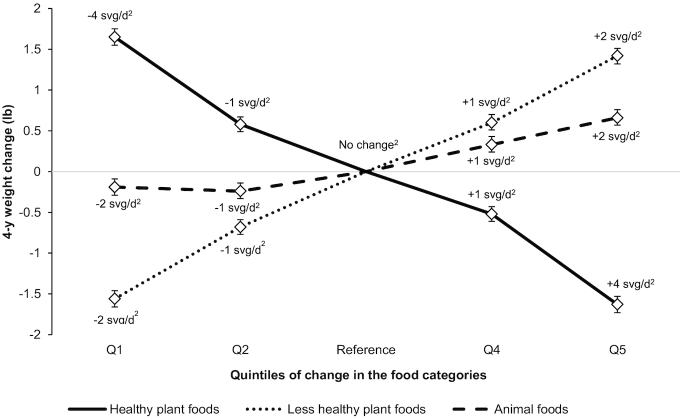
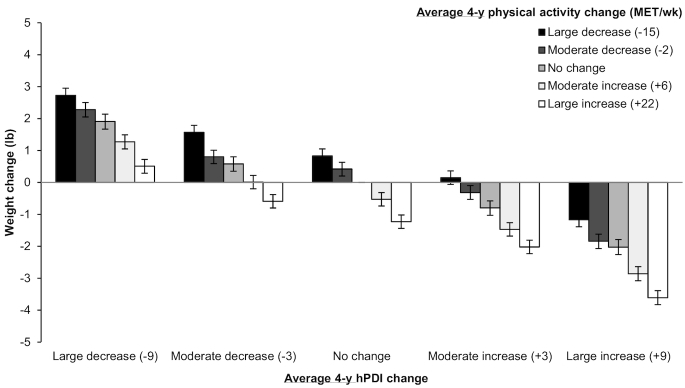
Results: On average, participants gained a mean of 0.90 kg (HPFS) to 1.98 kg (NHS2) over 4-y intervals. Different types of plant-based diet indices were associated with different amounts of weight gain. After adjusting for several potential confounders, including concomitant changes in other lifestyle factors, a 1-SD increase in intake of an overall plant-based diet index was associated with 0.04 kg less weight gain over 4-y periods (95% CI: 0.05, 0.02 kg; P < 0.001). A 1-SD increase in intake of a healthful version of a plant-based diet index (emphasizing whole grains, fruits/vegetables, nuts/legumes, vegetable oils, tea/coffee) was associated with 0.68 kg less weight gain over 4-y periods (95% CI: 0.69, 0.66 kg; P < 0.001). Conversely, a 1-SD increase in an unhealthful version of a plant-based diet index (emphasizing refined grains, potato/fries, sweets, sweetened drinks/juices) was associated with 0.36 kg more weight gain (95% CI: 0.34, 0.37 kg, P < 0.001).
Conclusion: Plant-based diets, especially when rich in healthier plant foods, are associated with less weight gain over 4-y intervals. This supports current recommendations to increase intake of healthy plant foods, and reducing intake of less-healthy plant foods and animal foods, for improved health outcomes.
Keywords: dietary pattern; epidemiology; obesity; plant-based diets; prospective cohort studies; weight change.
Copyright © American Society for Nutrition 2019.
Figures
Comment in
-
Preventing weight gain more important than weight loss and more realistic to study in cohorts than in randomized controlled trials.Am J Clin Nutr. 2019 Sep 1;110(3):544-545. doi: 10.1093/ajcn/nqz101. Am J Clin Nutr. 2019. PMID: 31127808 No abstract available.
References
-
- WHO. Global health risks: mortality and burden of disease attributable to selected major risks. Geneva: WHO; 2009.
-
- Sacks FM, Castelli WP, Donner A, Kass EH. Plasma lipids and lipoproteins in vegetarians and controls. N Engl J Med. 1975;292(22):1148–51. - PubMed
-
- Ornish D, Brown SE, Scherwitz LW, Billings JH, Armstrong WT, Ports TA, McLanahan SM, Kirkeeide RL, Brand RJ, Gould KL. Can lifestyle changes reverse coronary heart disease? The Lifestyle Heart Trial. Lancet. 1990;336(8708):129–33. - PubMed
-
- Chiu YF, Hsu CC, Chiu TH, Lee CY, Liu TT, Tsao CK, Chuang SC, Hsiung CA. Cross-sectional and longitudinal comparisons of metabolic profiles between vegetarian and non-vegetarian subjects: a matched cohort study. Br J Nutr. 2015;114(8):1313–20. - PubMed
