


Distorted gaze direction input to attentional priority map in spatial neglect
- PMID: 31128129
- PMCID: PMC6667735
- DOI: 10.1016/j.neuropsychologia.2019.05.017
Distorted gaze direction input to attentional priority map in spatial neglect
Abstract
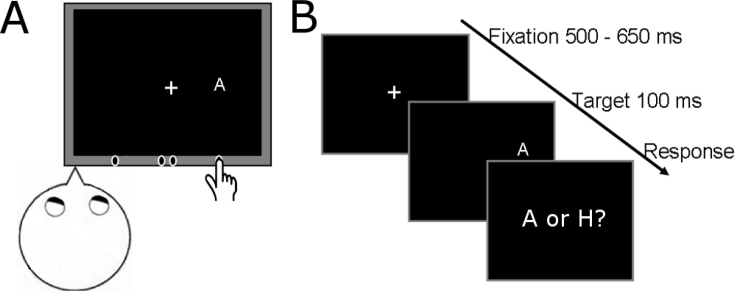
A contribution of the gaze signals to the attention imbalance in spatial neglect is presumed. Direct evidence however, is still lacking. Theoretical models for spatial attention posit an internal representation of locations that are selected in the competition for neural processing resources - an attentional priority map. Following up on our recent research showing an imbalance in the allocation of attention after an oculoproprioceptive perturbation in healthy volunteers, we investigated here whether the lesion in spatial neglect distorts the gaze direction input to this representation. Information about one's own direction of gaze is critical for the coordinate transformation between retinotopic and hand proprioceptive locations. To assess the gaze direction input to the attentional priority map, patients with left spatial neglect performed a cross-modal attention task in their normal, right hemispace. They discriminated visual targets whose location was cued by the patient's right index finger hidden from view. The locus of attention in response to the cue was defined as the location with the largest decrease in reaction time for visual discrimination in the presence vs. absence of the cue. In two control groups consisting of healthy elderly and patients with a right hemisphere lesion without neglect, the loci of attention were at the exact location of the cues. In contrast, neglect patients allocated attention at 0.5⁰-2⁰ rightward of the finger for all tested locations. A control task using reaching to visual targets in the absence of visual hand feedback ruled out a general error in visual localization. These findings demonstrate that in spatial neglect the gaze direction input to the attentional priority map is distorted. This observation supports the emerging view that attention and gaze are coupled and suggests that interventions that target gaze signals could alleviate spatial neglect.
Keywords: Attention; Coordinate transformation; Spatial neglect; Stroke.
Copyright © 2019 The Authors. Published by Elsevier Ltd.. All rights reserved.
Figures



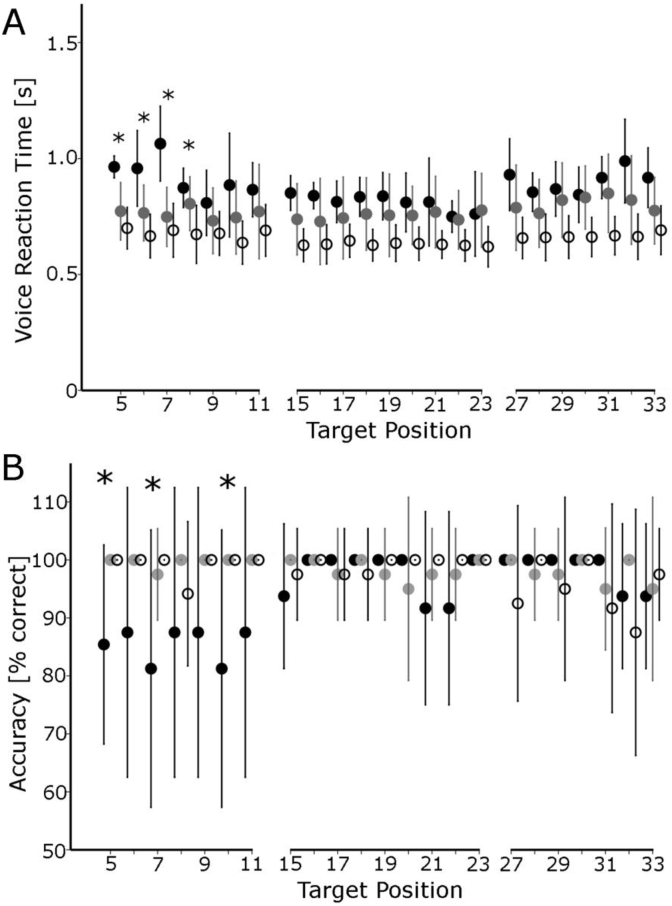
 ) and healthy controls (◯) for targets located further than 11° to the right of the body midline (error bars show one standard deviation, * denotes p< 0.05, independent samples t-tests, neglect vs. control, for either control group).
 ) and the absence of the finger position cue (
 ). The arrow indicates the location of the cue in trials when the cue was present. NEG – patients with spatial neglect, HEC – healthy elderly controls, PCG – patient control group. Error bars show one standard deviation.
 , ASG-
 , SG-
, SG- , UH-
, UH- ; PCG - patient control group; HEC – healthy elderly controls.
 , ASG-, SG-, UH-; PCG-patient control group; HEC – healthy elderly controls.
References
-
- Albert M. A simple test of visual neglect. Neurology. 1973;23:658–664. - PubMed
Publication types
MeSH terms
LinkOut - more resources
Full Text Sources
