Comparative Study
. 2019 Jun:152:89-96.
doi: 10.1016/j.rmed.2019.04.005. Epub 2019 Apr 17.

Serum CXCL11 correlates with pulmonary outcomes and disease burden in sarcoidosis

Affiliations
Comparative Study

Serum CXCL11 correlates with pulmonary outcomes and disease burden in sarcoidosis

Nicholas K Arger et al. Respir Med. 2019 Jun.

Abstract

Background: Sarcoidosis is a systemic granulomatous disease of unknown etiology that affects the lungs in 90% of patients, but has a wide range of disease manifestations and outcomes including chronic and progressive courses. Noninvasive biomarkers are needed to assess these outcomes and guide decisions for long term monitoring and treatment. Interferon-gamma (IFN-γ)-inducible chemotactic cytokines (chemokines), CXCL9, CXCL10 and CXCL11, show promise in this regard because they have been implicated in the pathogenesis of and reflect the burden of granulomatous inflammation. CXCL11 has been reported to have unique functional properties in modulating adaptive immunity in model systems so our goal was to examine serum levels of CXCL11 in relation to clinical outcomes in a heterogeneous cohort of sarcoidosis subjects.

Methods: CXCL19, CXCL10, and CXCL11 serum levels were measured in sarcoidosis and healthy subjects using ELISA assay. We determined relationships between CXCL11 and standard clinical inflammatory markers, expression of IFN-γ-related genes in whole blood, organ involvement, dyspnea scores, and measures of pulmonary function.

Results: In a cross-sectional analysis of 104 sarcoidosis subjects, serum CXCL11 was significantly elevated compared to 49 healthy controls (p < 0.001). CXCL11 was positively correlated with CXCL9 and CXCL10 (p < 0.001), sedimentation rate (p < 0.01), and mean expression of three IFN-γ-related genes in whole blood (GBP1, STAT1, and STAT2) (p < 0.001). CXCL11 was inversely correlated with FVC %predicted (%pred) and FEV1 %pred and higher levels were associated with higher patient-reported dyspnea scores. We found positive correlations between CXCL11 and number of organs involved. Using survival analyses, we found that CXCL11 levels were predictive of future pulmonary function test (PFT) decline (log rank <0.001 and HR of log10(CXCL11) = 5.1, 95% CI 1.2-21, p = 0.026).

Conclusions: The pattern of expression of serum CXCL11 in sarcoidosis patients suggests that this blood measure could be helpful in identifying patients that need longer-term monitoring for progressive thoracic and extra-thoracic sarcoidosis.

Keywords: CXCL10; CXCL11; CXCL9; Chemokine; Interferon-gamma; Sarcoidosis.


Conflict of interest statement

Conflict of interest All the other authors declare that they have no conflict of interest.

Figures

Fig. 1.
Fig. 1.
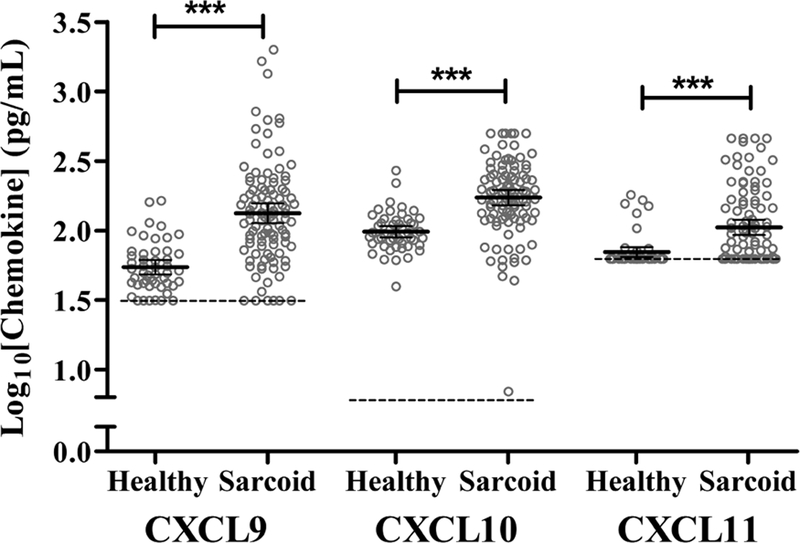
Serum chemokine levels in sarcoidosis and healthy control subjects. Levels of the CXCL9, CXL10, and CXCL11 were measured using Quanitikine® ELISA kits from 104 sarcoidosis subjects and 49 healthy control subjects. Measured values are displayed as log10 transformations of chemokines with bars designating mean values with 95% confidence intervals (*** = p < 0.001). The lower limits of assay detection are denoted by the dashed lines and grey open circles represent individual subject measurements. Abbreviations: “Healthy” = healthy control measurements; “Sarcoid” = sarcoidosis measurements.
Fig. 2.
Fig. 2.
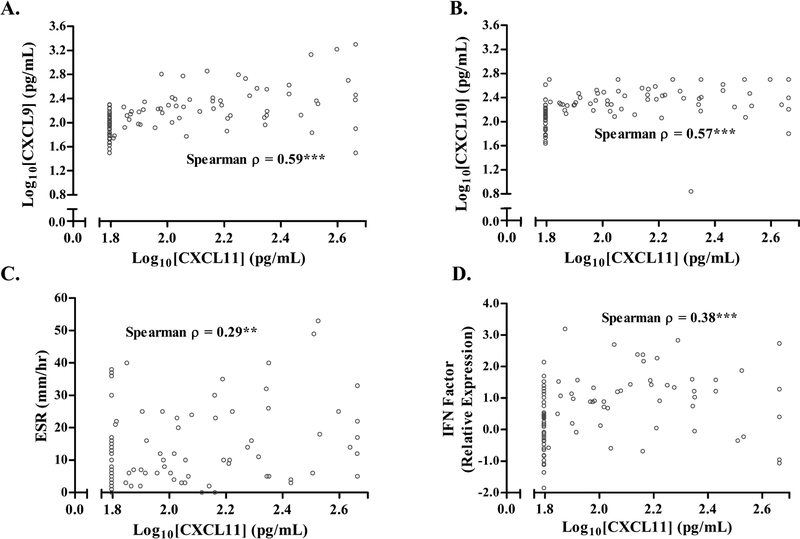
Correlations of serum CXCL11 with other blood measurements in sarcoidosis subjects. In sarcoidosis subjects, CXCL11 levels were positively correlated with A) CXCL9 and B) CXCL10, C) ESR and D) a gene expression composite score reflecting IFN-γ-related signaling (genes, GBP1, STAT1, and STAT2). Blood samples were processed and analyzed as described in Methods. Data are displayed as log10 transformation of individual CXCL11 levels (represented by open gray circles) with Spearman correlations (**p <0.01 and ***p<0.001). Abbreviations: ESR = Erythrocyte Sedimentation Rate, IFN Factor = Interferon Factor, IFN-γ = Interferon-gamma.
Fig. 3.
Fig. 3.
Relationships between serum CXCL11 levels and pulmonary function measurements and dyspnea scores. A) CXCL11 levels were compared between sarcoidosis subjects dichotomized into two groups based on normal or abnormal spirometry and diffusing capacity measurements using a threshold of 80% predicted. B&C) Correlations between CXCL11 and both FVC %pred and FEV1 %pred. D) Correlations between CXCL11 and dyspnea scores where increasing score reflects more dyspnea. Data are displayed as A) log10 transformation of serum CXCL11 (individual levels denoted by grey open circles), bars representing mean values with 95% confidence intervals, and the lower limits of assay detection denoted by the dashed line; statistical significance was determined using the Wilcoxon rank-sum test (***p< 0.001 *p <0.05). For B-D), Spearman correlations of log10 transformation of CXCL11 levels (and Dyspnea scores) where indicated (*p <0.05, p = 0.058). Abbreviations: FEV1 %pred = Forced Expiratory Volume in 1 Second percent predicted, FVC %pred = Forced Vital Capacity percent predicted, DLCO %pred = Diffusing Capacity for Carbon Monoxide percent predicted.
Fig. 4.
Fig. 4.
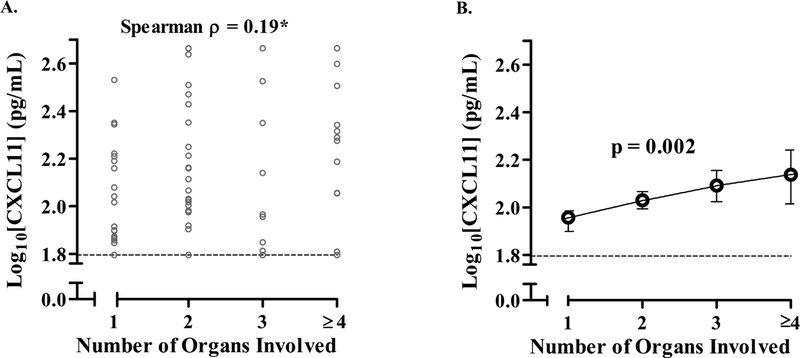
Relationship between serum CXCL11 levels and the number of organs involved with sarcoidosis. A) Correlation of CXCL11 levels and number of organs involved in sarcoidosis subjects. Organ assessments were performed by study physician review of the patient’s records. Thoracic lymphadenopathy and/or parenchymal involvement was counted as one organ system (thoracic) and subjects with four or greater organs were counted as four or greater organs. B) Relationship between CXCL11 levels and organ involvement after adjusting for age, race, gender, and immunosuppression use. In A), data are displayed as the log10 transformation of individual CXCL11 levels (individual values denoted by open gray circles) with the lower limits of assay detection denoted by the dashed line and the Spearman correlation coefficient (*p < 0.05). In B), predicted values for log10CXCL11 at each organ number are plotted (open circles) with 95% confidence intervals based on a non-parametric regression model adjusting for age, race, gender, and immunosuppression use; statistical significance was calculated by bootstrap analysis with 1000 replicates (p = 0.002). Sample size for each number of organs involved 1) N = 36; 2) N = 35; 3) N = 16; > 4) N = 17.
Fig. 5.
Fig. 5.
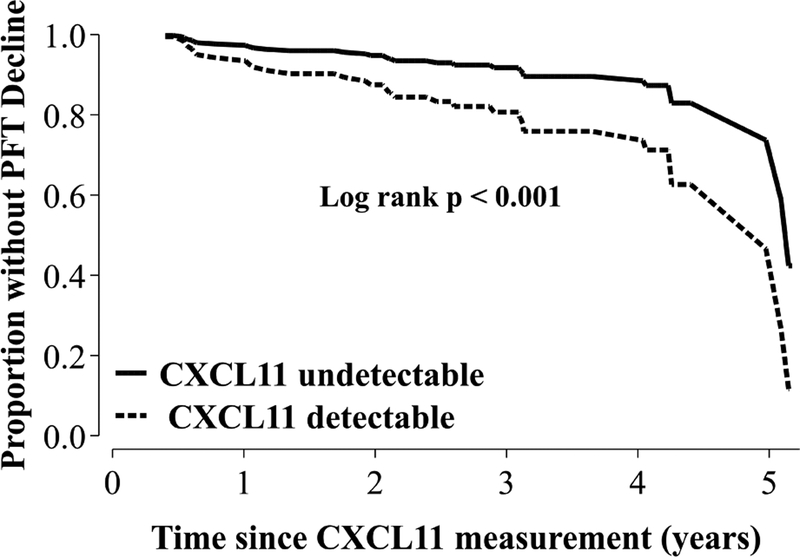
Relationship between serum CXCL11 measurement and longitudinal decline in lung function. Thirty-three subjects were identified who experienced a decline in absolute FVC or DLCO of 10% or 15%, respectively, over the study period (5 years). Total time at risk for all subjects analyzed was 226 person-years. We used a Cox proportional hazard modeling that adjusted for age, race, sex, immunosuppression use, and initial radiographic burden of lung involvement as assessed by chest x-ray “Scadding Stage” to determine a hazard ratio for CXCL11. We also dichotomized subjects based on whether they had a CXCL11 level that was undetectable (<62.5 pg/mL, N = 37) or detectable (>62.5 pg/mL, N = 48). Using this dichotomous designation, the adjusted log rank p-value was <0.001 and the HR was also statically significant (hazard ratio 2.5, 95% CI 1.1 – 5.7 p = 0.027). Data are displayed as adjusted survival curves for detectable versus undetectable CXCL11 levels. Abbreviations: DLCO = Diffusing Capacity for Carbon Monoxide, FVC = Forced Vital Capacity, HR = hazard ratio.

References

    1. Chappell AG, Cheung WY, Hutchings HA. Sarcoidosis: a long-term follow up study. Sarcoidosis, vasculitis, and diffuse lung diseases : official journal of WASOG. 2000;17(2):167–73. - PubMed
    1. Robinson BW, McLemore TL, Crystal RG. Gamma interferon is spontaneously released by alveolar macrophages and lung T lymphocytes in patients with pulmonary sarcoidosis. J Clin Invest. 1985;75(5):1488–95. - PMC - PubMed
    1. Prasse A, Georges CG, Biller H, Hamm H, Matthys H, Luttmann W, Virchow JC. Th1 cytokine pattern in sarcoidosis is expressed by bronchoalveolar CD4(+) and CD8(+) T cells. Clinical and experimental immunology. 2000;122(2):241–8. - PMC - PubMed
    1. Inui N, Chida K, Suda T, Nakamura H. TH1/TH2 and TC1/TC2 profiles in peripheral blood and bronchoalveolar lavage fluid cells in pulmonary sarcoidosis. The Journal of allergy and clinical immunology. 2001;107(2):337–44. - PubMed
    1. Mollers M, Aries SP, Dromann D, Mascher B, Braun J, Dalhoff K. Intracellular cytokine repertoire in different T cell subsets from patients with sarcoidosis. Thorax. 2001;56(6):487–93. - PMC - PubMed

Publication types

MeSH terms