


Systematic Review and Meta-Analysis of Genetic Risk of Developing Chronic Postsurgical Pain
- PMID: 31129315
- PMCID: PMC6874752
- DOI: 10.1016/j.jpain.2019.05.008
Systematic Review and Meta-Analysis of Genetic Risk of Developing Chronic Postsurgical Pain
Abstract
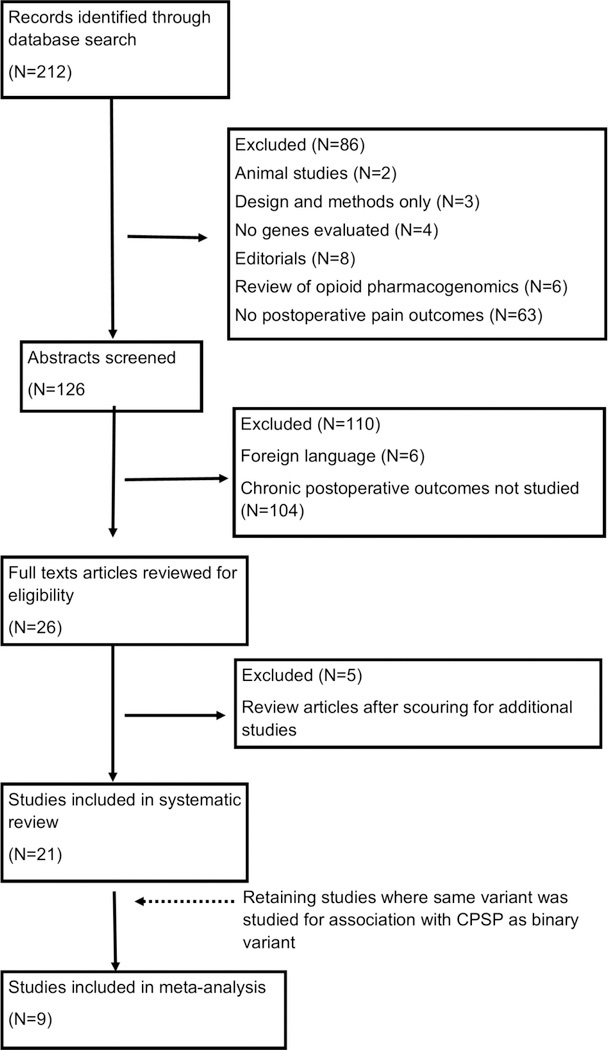
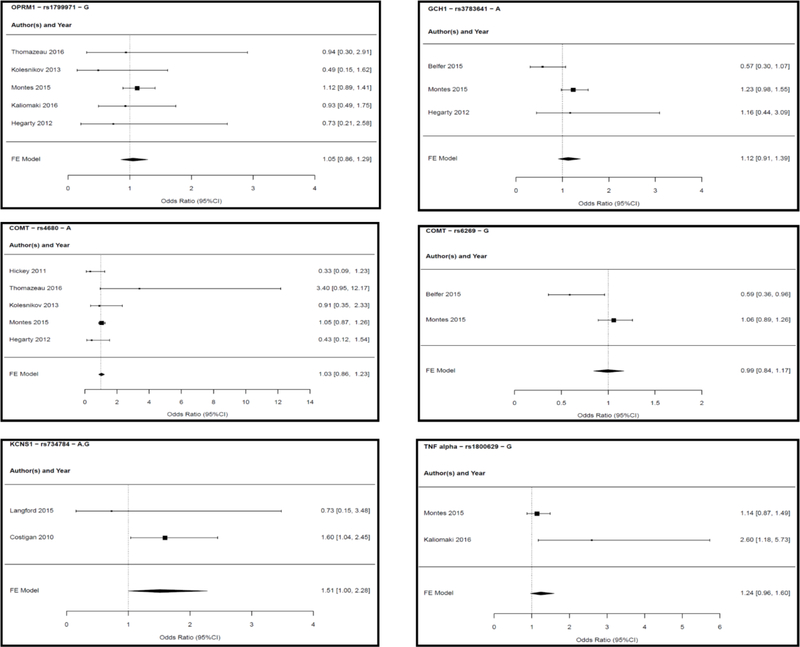
Chronic postsurgical pain (CPSP) is a significant detriment to postsurgical recovery and a risk factor for prolonged opioid use. Emerging evidence suggests the estimated heritability for chronic pain is 45% and that genetic factors partially explain individual susceptibility to CPSP. The aim of this study was to systematically review, assess quality, and summarize the studies in humans that have investigated genetic factors associated with CPSP. We also conducted a meta-analysis to derive a single effect size for evaluable genetic associations with CPSP. Our comprehensive literature search included review of 21 full-text articles evaluating variants of 69 genes for association with CPSP. We found significant gene variant associations reported for variants/haplotypes of 26 genes involved in neurotransmission, pain signaling, immune responses and neuroactive ligand-receptor interaction, with CPSP. Six variants of 5 genes (COMT: rs4680 and rs6269, OPRM1: rs1799971, GCH1: rs3783641, KCNS1: rs734784 and TNFA: rs1800629), were evaluated by more than one study and were included in the meta-analysis. At rs734784 (A>G) of KCNS1, presence of G allele marginally increased risk of CPSP (Additive genetic model; Odds ratio: 1.511; 95% CI 1-2.284; P value: .050), while the other variants did not withstand meta-analyses criteria. Our findings demonstrate the role of genetic factors with different functions in CPSP, and also emphasize that single genetic factors have small effect sizes in explaining complex conditions like CPSP. Heterogeneity in surgical cohorts, population structure, and outcome definitions, as well as small number of available studies evaluating same variants, limit the meta-analysis. There is a need for large-scale, homogenous, replication studies to validate candidate genes, and understand the underlying biological networks underpinning CPSP. PERSPECTIVE: Our systematic review comprehensively describes 21 studies evaluating genetic association with CPSP, and limitations thereof. A meta-analysis of 6 variants (5 genes) found marginally increased risk for CPSP associated with rs734784 A>G of the potassium voltage-gated channel gene (KCNS1). Understanding genetic predisposition for CPSP will enable prediction and personalized management.
Keywords: Chronic postsurgical pain; genetics; meta-analysis; systematic review.
Copyright © 2019 United States Association for the Study of Pain, Inc. Published by Elsevier Inc. All rights reserved.
Figures
References
-
- Belfer I, Dai F, Kehlet H, Finelli P, Qin L, Bittner R, Aasvang EK. Association of functional variations in COMT and GCH1 genes with postherniotomy pain and related impairment. Pain;156:273–279;2015. - PubMed
-
- Beyer A, Koch T, Schroder H, Schulz S, Hollt V. Effect of the A118G polymorphism on binding affinity, potency and agonist-mediated endocytosis, desensitization, and resensitization of the human mu-opioid receptor. J Neurochem;89:553–560;2004. - PubMed
Publication types
MeSH terms
Grants and funding
LinkOut - more resources
Full Text Sources
Other Literature Sources
Miscellaneous
