


doi: 10.1021/jacs.9b00941.
Epub 2019 May 30.
Chemical On/Off Switching of Mechanically Planar Chirality and Chiral Anion Recognition in a [2]Rotaxane Molecular Shuttle
Affiliations
- PMID: 31129959
- PMCID: PMC6693800
- DOI: 10.1021/jacs.9b00941
Item in Clipboard
Chemical On/Off Switching of Mechanically Planar Chirality and Chiral Anion Recognition in a [2]Rotaxane Molecular Shuttle
J Am Chem Soc.
.
Abstract
We exploit a reversible acid-base triggered molecular shuttling process to switch an appropriately designed rotaxane between prochiral and mechanically planar chiral forms. The mechanically planar enantiomers and their interconversion, arising from ring shuttling, have been characterized by NMR spectroscopy. We also show that the supramolecular interaction of the positively charged rotaxane with optically active anions causes an imbalance in the population of the two enantiomeric coconformations. This result represents an unprecedented example of chiral molecular recognition and can disclose innovative approaches to enantioselective sensing and catalysis.
Conflict of interest statement
The authors declare no competing financial interest.
Figures
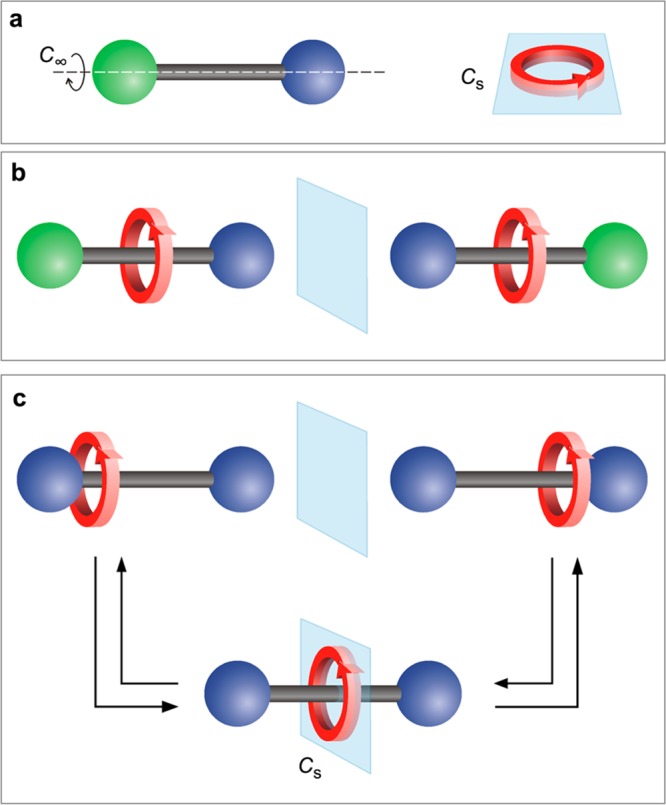
Schematic
representation of a C∞v symmetric
axle and a Cs symmetric ring
(a); the two enantiomers of a mechanically planar (MP) chiral rotaxane
(b); the two enantiomers of a coconformationally MP chiral rotaxane
and their interconversion by ring shuttling through an achiral coconformation
that features a mirror plane (c).
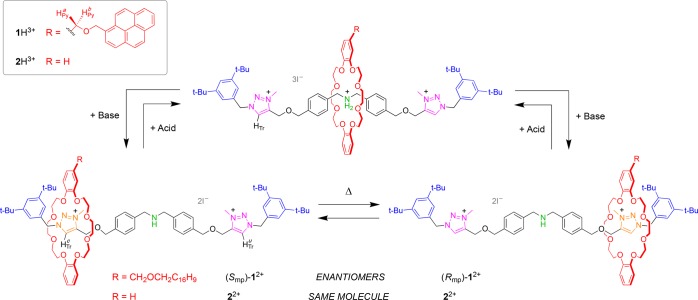
The latter species can exist
in two interconverting co-conformations, which constitute an enantiomeric
pair for 12+ (see ref (6) for the assignment of the
absolute configurations) while they are the same molecule in the case
of 22+. The starting rotaxanes are regenerated
upon addition of an acid.
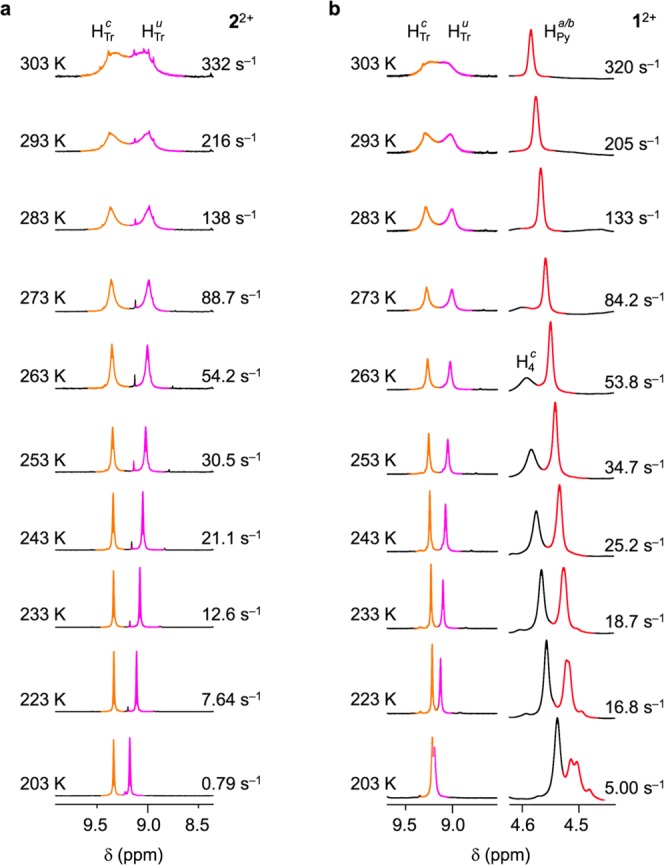
(a) Variable temperature (VT) 1H NMR spectra (500 MHz,
CD2Cl2) of 22+ in the
region of the triazolium protons (HTru, HTrc). (b) VT 1H NMR spectra (500 MHz, CD2Cl2) of 12+ in the regions of the triazolium protons (HTru, HTrc; left) and of the methylene protons in the pyrenyl
tether of the macrocycle, adjacent to the dioxybenzene unit (HPya, HPyb; right). See Scheme 1 and SI for proton labeling.
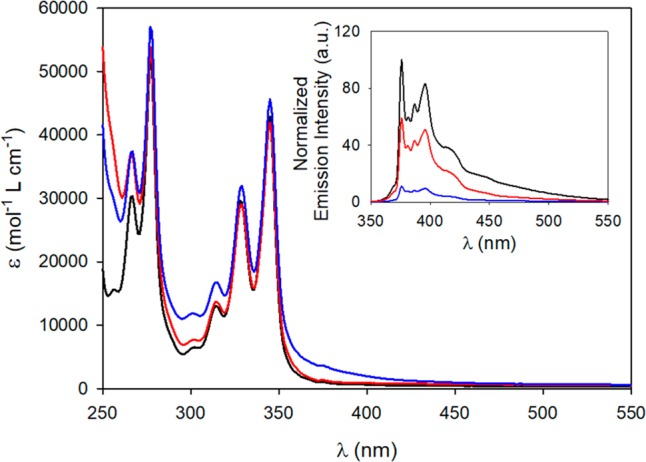
Absorption
and fluorescence (inset, λexc = 328
nm) spectra of the free macrocycle (black), 1H3+ (blue) and 12+ (red). Air equilibrated CH2Cl2, 20 °C.
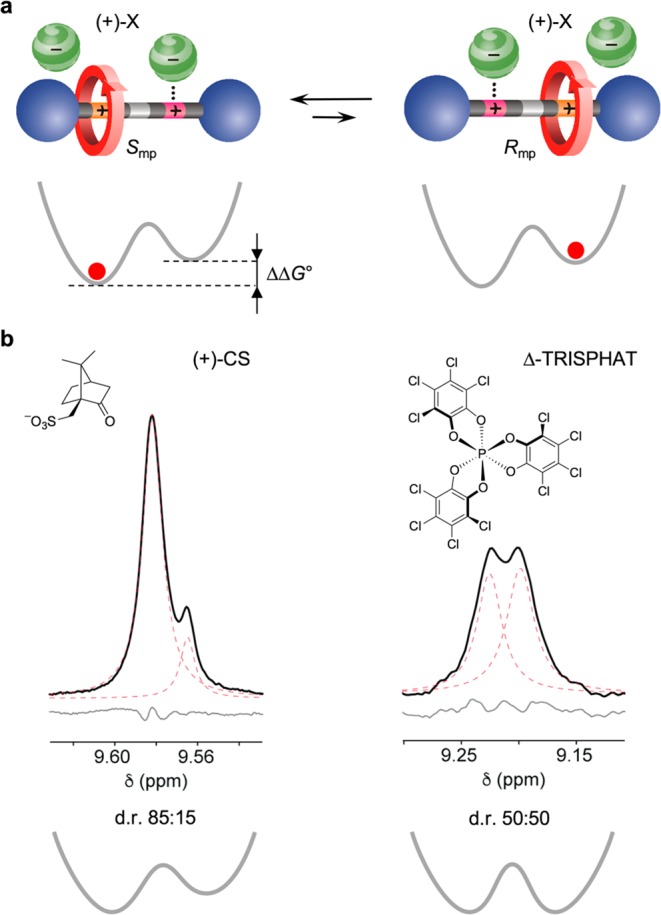
(a) Interconversion
between two diastereomeric ion pairs composed
of a coconformationally MP chiral rotaxane dication, such as 12+, and a chiral monoanion. In the proposed structures,
one anion is coordinated to the unencircled triazolium, while another
is weakly paired with the encircled site. Simplified potential energy
curves for the location of the ring along the axle are also shown.
As the two ion pairs can have different stabilities [ΔΔG° ≠ 0], the ring distribution between the two
identical stations can become unbalanced. (b) Partial 1H NMR spectra (500 MHz) of the HTruresonance in 12+ after the addition
of 8 equiv of the tetrabutylammonium salt of (1S)-(+)-10-camphorsulfonate
(CD2Cl2, 223 K; left) or Δ-TRISPHAT (toluene-d8, 243 K; right). Black, red, and gray traces
show respectively the experimental spectrum, the deconvoluted peaks,
and the fitting residuals.
References
-
- Sauvage J.-P.; Dietrich-Buchecker C.. Molecular Catenanes, Rotaxanes and Knots; Wiley: New York, 1999.
-
- Bruns C. J.; Stoddart J. F.. The Nature of the Mechanical Bond: From Molecules to Machines; Wiley: Hoboken, 2016.
-
- Balzani V.; Credi A.; Venturi M.. Molecular Devices and Machines - Concepts and Perspectives for the Nanoworld; Wiley-VCH: Weinheim, 2008.
Publication types
LinkOut - more resources
Full Text Sources
