Quality of Life Following Male-To-Female Sex Reassignment Surgery
- PMID: 31130156
- PMCID: PMC6546862
- DOI: 10.3238/arztebl.2019.0253
Quality of Life Following Male-To-Female Sex Reassignment Surgery
Abstract
Background: The prevalence of persons who are born with primary and secondary male sexual characteristics but feel that they are female (trans women) is ca. 5.48 per 100 000 males in Germany. In this article, we provide a detailed overview of the currently available data on quality of life after male-to-female sex reassignment surgery.
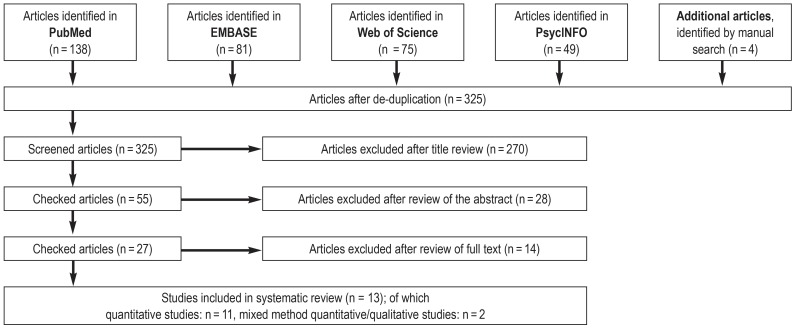
Methods: This review is based on publications retrieved by a systematic literature search that was carried out in the PubMed, EMBASE, Web of Science, and PsycINFO databases in March 2017.
Results: The 13 articles (11 quantitative and 2 mixed quantitative/qualitative studies) that were found to be suitable for inclusion in this review contained information on 1101 study participants. The number of trans women in each study ranged from 3 to 247. Their mean age was 39.9 years (range: 18-76). Seven different questionnaires were used to assess postoperative quality of life. The findings of the studies permit the conclusion that sex reassignment surgery beneficially affects emotional well- being, sexuality, and quality of life in general. In other categories (e.g., "freedom from pain", "fitness", and "energy"), some of the studies revealed worsening after the operation. All of the studies were judged to be at moderate to high risk of bias. The drop-out rates, insofar as they were given, ranged from 12% to 77% (median: 56%).
Conclusion: Current studies indicate that quality of life improves after sex reassign- ment surgery. The available studies are heterogeneous in design. In the future, prospective studies with standardized methods of assessing quality of life and with longer follow-up times would be desirable.
Figures
References
-
- Garcia Nuñez D, Nieder TO. Geschlechtsinkongruenz und -dysphorie. J Gynakol Endokrinol. 2017;15:5–13.
-
- Meyer zu Hoberge S. Prävalenz, Inzidenz und Geschlechterverhältnis der Transsexualität anhand der bundesweit getroffenen Entscheidungen nach dem Transsexuellengesetz in der Zeit von 1991 bis 2000. www.macau.uni-kiel.de/receive/dissertation_diss_00004825?lang=de (last accessed on 20 September 2018)
-
- Falkai P. Diagnostische Kriterien DSM-5®. Göttingen: Hogrefe. 2015
-
- Hage JJ, Karim RB. Ought GIDNOS get nought? Treatment options for nontranssexual gender dysphoria. Plast Reconstr Surg. 2000;105:1222–1227. - PubMed
-
- Coleman E, Bockting W, Botzer M, et al. Standards of Care - Versorgungsempfehlung für die Gesundheit von transsexuellen, transgender und geschlechtsnichtkonformen Personen. www.wpath.org/site_page.cfm?pk_association_webpage_menu=1351&pk_associat... (last accessed on 20 October 2017)
Publication types
MeSH terms
LinkOut - more resources
Full Text Sources