Review
. 2019 May:339:10-23.
doi: 10.1016/j.cellimm.2018.10.006. Epub 2018 Oct 21.

The role of B cells in multiple sclerosis: Current and future therapies

Affiliations
Review

The role of B cells in multiple sclerosis: Current and future therapies

Austin Negron et al. Cell Immunol. 2019 May.

Abstract

While it was long held that T cells were the primary mediators of multiple sclerosis (MS) pathogenesis, the beneficial effects observed in response to treatment with Rituximab (RTX), a monoclonal antibody (mAb) targeting CD20, shed light on a key contributor to MS that had been previously underappreciated: B cells. This has been reaffirmed by results from clinical trials testing the efficacy of subsequently developed B cell-depleting mAbs targeting CD20 as well as studies revisiting the effects of previous disease-modifying therapies (DMTs) on B cell subsets thought to modulate disease severity. In this review, we summarize current knowledge regarding the complex roles of B cells in MS pathogenesis and current and potential future B cell-directed therapies.


Figures

Figure 1.
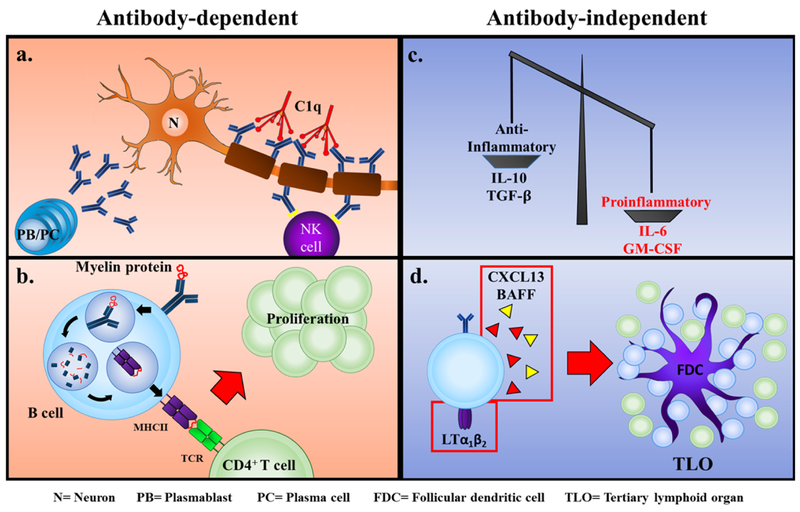
Figure 1.. B cells mediate MS pathology through antibody-dependent and antibody-independent mechanisms.
(a) Myelin-reactive antibodies secreted by autoreactive plasmablasts and plasma cells mediate destruction of the myelin sheath by binding C1q and activating the classical complement pathway or initiating FcγRIIIa-mediated antibody-dependent cell-mediated cytotoxicity by NK cells. b) B cells expressing a myelin-reactive BCR are capable of processing myelin protein and presenting myelin peptide to autoreactive CD4+ T cells, resulting in their activation and proliferation. (c, d) B cells are able to foster an environment conducive to autoimmunity by (c) secreting higher amounts of pro-inflammatory cytokines such as IL-6 and GM-CSF compared with regulatory cytokines such as IL-10 and TGF-b and (d) by secreting cytokines/chemokines including CXCL13 and BAFF which promote the differentiation of FDCs and establishment of TLOs, which facilitate the activation and expansion of autoreactive B and T cells. N= Neuron, PB= Plasmablast, PC= Plasma cell, FDC= Follicular dendritic cell, TLO= Tertiary lymphoid organ.
Figure 2.
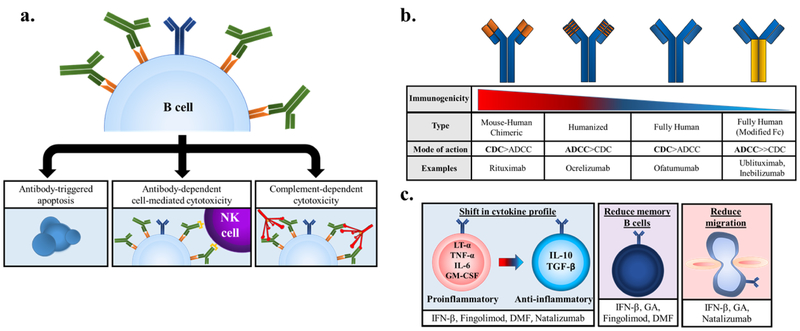
Figure 2.. The mechanisms of action of B cell-depleting msAbs and earlier MS DMTs.
(a) Binding of anti-CD19 or anti-CD20 mAbs mediates B cell depletion via different mechanisms: directly catalyzing antibody-triggered apoptosis (left), initiating antibody-dependent cell-mediated cytotoxicity (ADCC) by binding of the mAb’s Fc region by NK cell-expressed FcγRIIIa (middle), or initiating complement-dependent cytotoxicity (CDC) by binding C1q and activating the classical complement pathway (right). (b) B cell-depleting mAbs display differences in immunogenicity and preferential mechanism of action. (c) DMTs can shift B cell cytokine profiles from pro- to anti-inflammatory (left), reduce circulating memory B cells (middle), or impair migration through down-regulation or inhibition of surface receptors (right).

References

    1. Hampe CS B Cell in Autoimmune Diseases. Scientifica (Cairo) 2012, doi:10.6064/2012/215308 (2012). - DOI - PMC - PubMed
    1. Manz RA, Hauser AE, Hiepe F & Radbruch A Maintenance of serum antibody levels. Annu Rev Immunol 23, 367–386, doi:10.1146/annurev.immunol.23.021704.115723 (2005). - DOI - PubMed
    1. Lehmann-Horn K, Kinzel S & Weber MS Deciphering the Role of B Cells in Multiple Sclerosis-Towards Specific Targeting of Pathogenic Function. Int J Mol Sci 18, doi:10.3390/ijms18102048 (2017). - DOI - PMC - PubMed
    1. Lampropoulou V et al. Suppressive functions of activated B cells in autoimmune diseases reveal the dual roles of Toll-like receptors in immunity. Immunological reviews 233, 146–161, doi:10.1111/j.0105-2896.2009.00855.x (2010). - DOI - PubMed
    1. Rosser EC & Mauri C Regulatory B cells: origin, phenotype, and function. Immunity 42, 607–612, doi:10.1016/j.immuni.2015.04.005 (2015). - DOI - PubMed

Publication types