. 2019 Jun 6;104(6):1182-1201.
doi: 10.1016/j.ajhg.2019.04.011. Epub 2019 May 23.

Lessons Learned from Large-Scale, First-Tier Clinical Exome Sequencing in a Highly Consanguineous Population

Dorota Monies  1 Mohammed Abouelhoda  1 Mirna Assoum  2 Nabil Moghrabi  1 Rafiullah Rafiullah  2 Naif Almontashiri  3 Mohammed Alowain  4 Hamad Alzaidan  4 Moeen Alsayed  4 Shazia Subhani  1 Edward Cupler  5 Maha Faden  6 Amal Alhashem  7 Alya Qari  4 Aziza Chedrawi  8 Hisham Aldhalaan  8 Wesam Kurdi  9 Sameena Khan  8 Zuhair Rahbeeni  4 Maha Alotaibi  6 Ewa Goljan  1 Hadeel Elbardisy  2 Mohamed ElKalioby  10 Zeeshan Shah  1 Hibah Alruwaili  1 Amal Jaafar  1 Ranad Albar  11 Asma Akilan  2 Hamsa Tayeb  1 Asma Tahir  1 Mohammed Fawzy  1 Mohammed Nasr  1 Shaza Makki  2 Abdullah Alfaifi  12 Hanna Akleh  13 Suad Yamani  8 Dalal Bubshait  14 Mohammed Mahnashi  15 Talal Basha  16 Afaf Alsagheir  17 Musad Abu Khaled  8 Khalid Alsaleem  17 Maisoon Almugbel  9 Manal Badawi  8 Fahad Bashiri  18 Saeed Bohlega  8 Raashida Sulaiman  4 Ehab Tous  8 Syed Ahmed  19 Talal Algoufi  19 Hamoud Al-Mousa  20 Emadia Alaki  20 Susan Alhumaidi  21 Hadeel Alghamdi  16 Malak Alghamdi  21 Ahmed Sahly  17 Shapar Nahrir  21 Ali Al-Ahmari  22 Hisham Alkuraya  23 Ali Almehaidib  24 Mohammed Abanemai  24 Fahad Alsohaibaini  24 Bandar Alsaud  20 Rand Arnaout  20 Ghada M H Abdel-Salam  25 Hasan Aldhekri  17 Suzan AlKhater  26 Khalid Alqadi  8 Essam Alsabban  17 Turki Alshareef  27 Khalid Awartani  9 Hanaa Banjar  28 Nada Alsahan  9 Ibraheem Abosoudah  29 Abdullah Alashwal  30 Wajeeh Aldekhail  24 Sami Alhajjar  31 Sulaiman Al-Mayouf  17 Abdulaziz Alsemari  8 Walaa Alshuaibi  32 Saeed Altala  33 Abdulhadi Altalhi  34 Salah Baz  8 Muddathir Hamad  32 Tariq Abalkhail  8 Badi Alenazi  35 Alya Alkaff  9 Fahad Almohareb  36 Fuad Al Mutairi  37 Mona Alsaleh  19 Abdullah Alsonbul  38 Somaya Alzelaye  39 Shakir Bahzad  40 Abdulaziz Bin Manee  17 Ola Jarrad  17 Neama Meriki  41 Bassem Albeirouti  42 Amal Alqasmi  21 Mohammed AlBalwi  43 Nawal Makhseed  44 Saeed Hassan  32 Isam Salih  45 Mustafa A Salih  18 Marwan Shaheen  46 Saadeh Sermin  27 Shamsad Shahrukh  5 Shahrukh Hashmi  46 Ayman Shawli  47 Ameen Tajuddin  48 Abdullah Tamim  49 Ahmed Alnahari  50 Ibrahim Ghemlas  19 Maged Hussein  51 Sami Wali  7 Hatem Murad  8 Brian F Meyer  1 Fowzan S Alkuraya  52
Affiliations

Lessons Learned from Large-Scale, First-Tier Clinical Exome Sequencing in a Highly Consanguineous Population

Dorota Monies et al. Am J Hum Genet. .

Erratum in

  • Lessons Learned from Large-Scale, First-Tier Clinical Exome Sequencing in a Highly Consanguineous Population.
    Monies D, Abouelhoda M, Assoum M, Moghrabi N, Rafiullah R, Almontashiri N, Alowain M, Alzaidan H, Alsayed M, Subhani S, Cupler E, Faden M, Alhashem A, Qari A, Chedrawi A, Aldhalaan H, Kurdi W, Khan S, Rahbeeni Z, Alotaibi M, Goljan E, Elbardisy H, ElKalioby M, Shah Z, Alruwaili H, Jaafar A, Albar R, Akilan A, Tayeb H, Tahir A, Fawzy M, Nasr M, Makki S, Alfaifi A, Akleh H, Yamani S, Bubshait D, Mahnashi M, Basha T, Alsagheir A, Khaled MA, Alsaleem K, Almugbel M, Badawi M, Bashiri F, Bohlega S, Sulaiman R, Tous E, Ahmed S, Algoufi T, Al-Mousa H, Alaki E, Alhumaidi S, Alghamdi H, Alghamdi M, Sahly A, Nahrir S, Al-Ahmari A, Alkuraya H, Almehaidib A, Abanemai M, Alsohaibaini F, Alsaud B, Arnaout R, Abdel-Salam GMH, Aldhekri H, AlKhater S, Alqadi K, Alsabban E, Alshareef T, Awartani K, Banjar H, Alsahan N, Abosoudah I, Alashwal A, Aldekhail W, Alhajjar S, Al-Mayouf S, Alsemari A, Alshuaibi W, Altala S, Altalhi A, Baz S, Hamad M, Abalkhail T, Alenazi B, Alkaff A, Almohareb F, Al Mutairi F, Alsaleh M, Alsonbul A, Alzelaye S, Bahzad S, Manee AB, Jarrad O, Meriki N, Albeirouti B, Alqasmi A, AlBalwi M, Makhseed N, Hassan S, Salih I, Salih MA, Shaheen M, Sermin S, Shahrukh S, Hashmi S, Shawli… See abstract for full author list ➔ Monies D, et al. Am J Hum Genet. 2019 Oct 3;105(4):879. doi: 10.1016/j.ajhg.2019.09.019. Am J Hum Genet. 2019. PMID: 31585110 Free PMC article. No abstract available.

Abstract

We report the results of clinical exome sequencing (CES) on >2,200 previously unpublished Saudi families as a first-tier test. The predominance of autosomal-recessive causes allowed us to make several key observations. We highlight 155 genes that we propose to be recessive, disease-related candidates. We report additional mutational events in 64 previously reported candidates (40 recessive), and these events support their candidacy. We report recessive forms of genes that were previously associated only with dominant disorders and that have phenotypes ranging from consistent with to conspicuously distinct from the known dominant phenotypes. We also report homozygous loss-of-function events that can inform the genetics of complex diseases. We were also able to deduce the likely causal variant in most couples who presented after the loss of one or more children, but we lack samples from those children. Although a similar pattern of mostly recessive causes was observed in the prenatal setting, the higher proportion of loss-of-function events in these cases was notable. The allelic series presented by the wealth of recessive variants greatly expanded the phenotypic expression of the respective genes. We also make important observations about dominant disorders; these observations include the pattern of de novo variants, the identification of 74 candidate dominant, disease-related genes, and the potential confirmation of 21 previously reported candidates. Finally, we describe the influence of a predominantly autosomal-recessive landscape on the clinical utility of rapid sequencing (Flash Exome). Our cohort's genotypic and phenotypic data represent a unique resource that can contribute to improved variant interpretation through data sharing.

Keywords: autozygome; candidate genes; clinical genomics; dual diagnosis; exome; expanded carrier screening; fetal malformation; first-tier; genomics-first; gonadal mosaicism; hybrid phenotype; knockout; multilocus phenotypes; phenotypic expansion; prenatal.


Figures

Figure 1
Figure 1
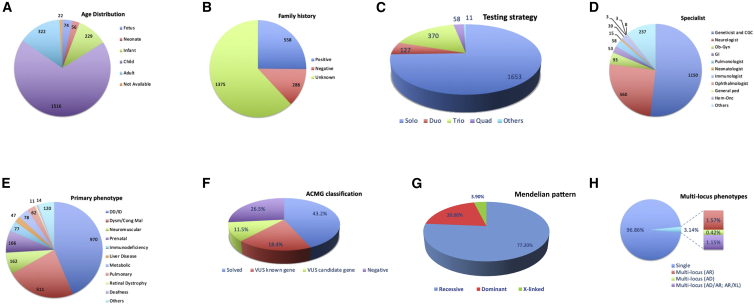
Summary of the Study Cohort Characteristics (A) Age distribution. (B) Family history. (C) Testing strategy. (D) Ordering specialty. (E) Primary indication (prenatal in this figure includes individuals who presented for testing for carrier status). (F) ACMG classification of variants. (G) Mendelian patterns of pathogenic and likely pathogenic variants. (H) Multi-locus phenotypes.

References

    1. Alkuraya F.S. Impact of new genomic tools on the practice of clinical genetics in consanguineous populations: The Saudi experience. Clin. Genet. 2013;84:203–208. - PubMed
    2. Alkuraya, F.S. (2013). Impact of new genomic tools on the practice of clinical genetics in consanguineous populations: The Saudi experience. Clin. Genet. 84, 203-208. - PubMed
    1. Alkuraya F.S. Genetics and genomic medicine in Saudi Arabia. Mol. Genet. Genomic Med. 2014;2:369–378. - PMC - PubMed
    2. Alkuraya, F.S. (2014). Genetics and genomic medicine in Saudi Arabia. Mol. Genet. Genomic Med. 2, 369-378. - PMC - PubMed
    1. Alkuraya F.S. Autozygome decoded. Genet. Med. 2010;12:765–771. - PubMed
    2. Alkuraya, F.S. (2010). Autozygome decoded. Genet. Med. 12, 765-771. - PubMed
    1. Alkuraya F.S. Human knockout research: New horizons and opportunities. Trends Genet. 2015;31:108–115. - PubMed
    2. Alkuraya, F.S. (2015). Human knockout research: New horizons and opportunities. Trends Genet. 31, 108-115. - PubMed
    1. Alsalem A.B., Halees A.S., Anazi S., Alshamekh S., Alkuraya F.S. Autozygome sequencing expands the horizon of human knockout research and provides novel insights into human phenotypic variation. PLoS Genet. 2013;9:e1004030. - PMC - PubMed
    2. Alsalem, A.B., Halees, A.S., Anazi, S., Alshamekh, S., and Alkuraya, F.S. (2013). Autozygome sequencing expands the horizon of human knockout research and provides novel insights into human phenotypic variation. PLoS Genet. 9, e1004030. - PMC - PubMed