Review
. 2019 May 3:10:949.
doi: 10.3389/fimmu.2019.00949. eCollection 2019.

Myeloid-Derived Suppressor Cells: Ductile Targets in Disease

Affiliations
Review

Myeloid-Derived Suppressor Cells: Ductile Targets in Disease

Francesca Maria Consonni et al. Front Immunol. .

Abstract

Myeloid-derived suppressor cells (MDSCs) represent a heterogeneous population of immature myeloid cells with major regulatory functions and rise during pathological conditions, including cancer, infections and autoimmune conditions. MDSC expansion is generally linked to inflammatory processes that emerge in response to stable immunological stress, which alter both magnitude and quality of the myelopoietic output. Inability to reinstate physiological myelopoiesis would fall in an "emergency state" that perpetually reprograms myeloid cells toward suppressive functions. While differentiation and reprogramming of myeloid cells toward an immunosuppressive phenotype can be considered the result of a multistep process that originates in the bone marrow and culminates in the tumor microenvironment, the identification of its driving events may offer potential therapeutic approaches in different pathologies. Indeed, whereas expansion of MDSCs, in both murine and human tumor bearers, results in reduced immune surveillance and antitumor cytotoxicity, placing an obstacle to the effectiveness of anticancer therapies, adoptive transfer of MDSCs has shown therapeutic benefits in autoimmune disorders. Here, we describe relevant mechanisms of myeloid cell reprogramming leading to generation of suppressive MDSCs and discuss their therapeutic ductility in disease.

Keywords: autoimmune diseases; cancer; emergency myelopoiesis; immunosuppression; myeloid-derived suppressor cells (MDSCs).


Figures
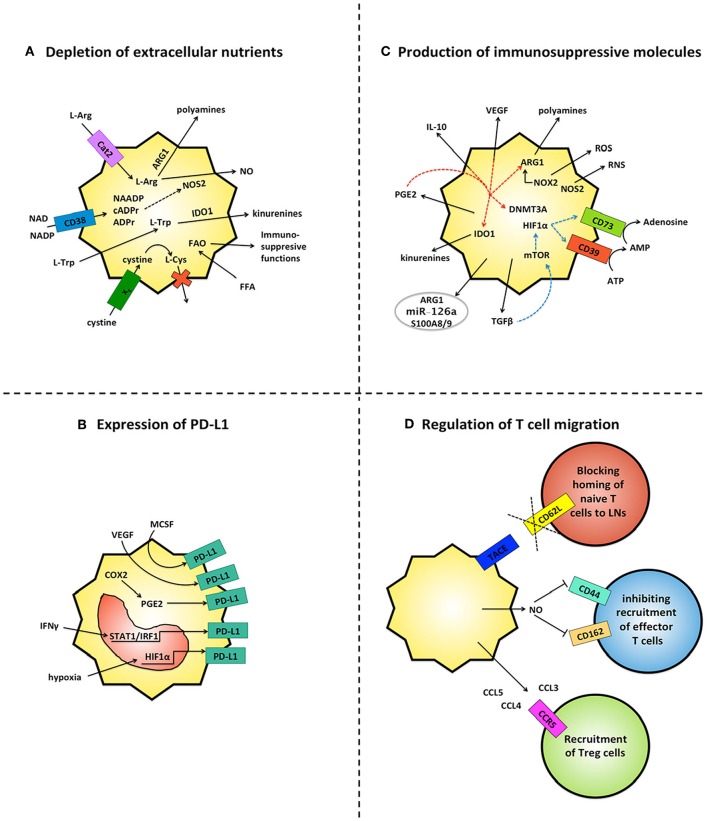
Figure 1
Figure 1
MDSCs inhibit immune responses by multiple mechanisms. (A) MDSCs deplete the extracellular microenvironment of essential nutrients for T cells. Through the up-regulation of metabolic enzymes (e.g. ARG1, NOS2, IDO1) and ectoenzymes (e.g. CD38) MDSCs consume copious amounts of amino acids (L-Arg, L-Trp) and NAD, and concomitantly produce molecules endowed with immunomodulatory activities (e.g. nitric oxide/NO, polyamines and kinurenines). Further, MDSCs internalize cystine without releasing the oxidized L-Cys and up-take of FFA, which fuels FAO and expression of immunosuppressive activities. (B) MDSCs up-regulate PD-L1 in response to multiple microenvironmental signals, including hypoxia via HIF1α, IFNγ via STAT1/IRF1, MCSF and VEGF via unknown mechanisms. Up-regulation of COX2 and PGE2 are also found associated with PD-L1 expression. (C) MDSCs release a range of immunosuppressive soluble molecules. They produce ROS and RNS through NOX-2 and NOS2, adenosine via CD39 and CD73, kinurenines via IDO1, polyamines via ARG1, anti-inflammatory cytokines (IL-10, TGFβ) and PGE2. Both TGFβ (blue lines) and PGE2 (red lines) also create autocrine loops that sustain the production of additional suppressive molecules. TGFβ induces the ectoenzymes CD39 and CD73 via HIF-1 α and PGE2 promotes expression of immunosuppressive molecules (IDO1, IL-10, ARG1 and VEGF) as well as repression of immunogenic-associated genes via DNMT3A. MDSCs also secrete exosomes which contain different molecules, such as immunosuppressive ARG1, inflammatory S100A8/9 and the oncogenic miR-126a. (D) MDSCs modulate T cell trafficking. They limit homing of naïve T cells to LNs by TACE-mediated cleavage of CD62L on T cells and they impair extravasation of effector T cells through NO-mediated down-regulation of adhesion molecules CD162 and CD44. In contrast MDSCs support the recruitment of CCR5+ Treg cells by production of CCL3, CCL4, CCL5.
Figure 2
Figure 2
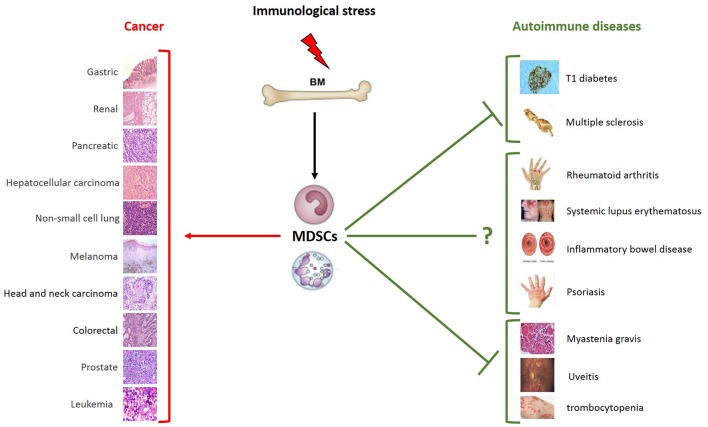
Schematic role of MDSCs in pathology. Immunological stress induces the expansion of MDSCs that play different roles depending on distinct pathological and microenvironmental contexts. MDSCs are characterized by the strong ability to suppress T cell functions. Much clinical and preclinical evidence demonstrates their ability to promote tumor growth and metastasis formation. Given the immunosuppressive phenotype, MDSCs can also play a beneficial role in autoimmune diseases. As shown in the figure, the expansion of MDSCs is protective in some autoimmune diseases, such as type 1 diabetes, multiple sclerosis, myastenia gravis, uveitis and trombocytopenia. Their role in systemic lupus erythematosus, inflammatory bowel disease psoriasis and rheumatoid arthritis remains to be further clarified. The types of tumor and autoimmune diseases in which an expansion of MSDCs have been reported are summarized in the figure. MDSCs, myeloid-derived suppressor cells; BM, bone marrow.

References

    1. Ueha S, Shand FHW, Matsushima K. Myeloid cell population dynamics in healthy and tumor-bearing mice. Int Immunopharmacol. (2011) 11:783–8. 10.1016/j.intimp.2011.03.003 - DOI - PubMed
    1. Velten L, Haas SF, Raffel S, Blaszkiewicz S, Islam S, Hennig BP, et al. . Human haematopoietic stem cell lineage commitment is a continuous process. Nat Cell Biol. (2017) 19:271–81. 10.1038/ncb3493 - DOI - PMC - PubMed
    1. Hirai H, Zhang P, Dayaram T, Hetherington CJ, Mizuno SI, Imanishi J, et al. . C/EBPβ is required for “emergency” granulopoiesis. Nat Immunol. (2006) 7:732–9. 10.1038/ni1354 - DOI - PubMed
    1. Akagi T, Saitoh T, O'Kelly J, Akira S, Gombart AF, Koeffler HP. Impaired response to GM-CSF and G-CSF, and enhanced apoptosis in C/EBP2-deficient hematopoietic cells. Blood. (2008) 111:2999–3004. 10.1182/blood-2007-04-087213 - DOI - PMC - PubMed
    1. Zhang H, Nguyen-Jackson H, Panopoulos AD, Li HS, Murray PJ, Watowich SS. STAT3 controls myeloid progenitor growth during emergency granulopoiesis. Blood. (2010) 116:2462–71. 10.1182/blood-2009-12-259630 - DOI - PMC - PubMed

Publication types

LinkOut - more resources