


Salience Network Disruption in U.S. Army Soldiers With Posttraumatic Stress Disorder
- PMID: 31131337
- PMCID: PMC6529942
- DOI: 10.1177/2470547019850467
Salience Network Disruption in U.S. Army Soldiers With Posttraumatic Stress Disorder
Abstract
Background: Better understanding of the neurobiology of posttraumatic stress disorder (PTSD) may be critical to developing novel, effective therapeutics. Here, we conducted a data-driven investigation using a well-established, graph-based topological measure of nodal strength to determine the extent of functional dysconnectivity in a cohort of active duty US Army soldiers with PTSD compared to controls.
Methods: 102 participants with (n=50) or without PTSD (n=52) completed functional magnetic resonance imaging (fMRI) at rest and during symptom provocation using subject-specific script imagery. Vertex/voxel global brain connectivity with global signal regression (GBCr), a measure of nodal strength, was calculated as the average of its functional connectivity with all other vertices/voxels in the brain gray matter.
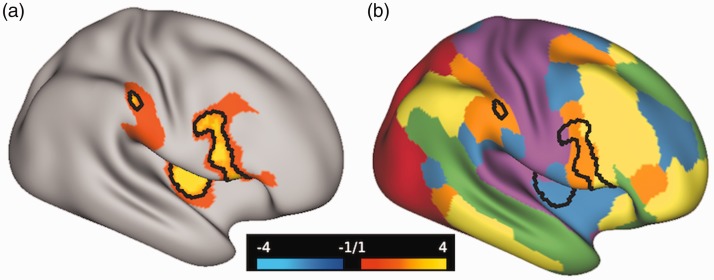
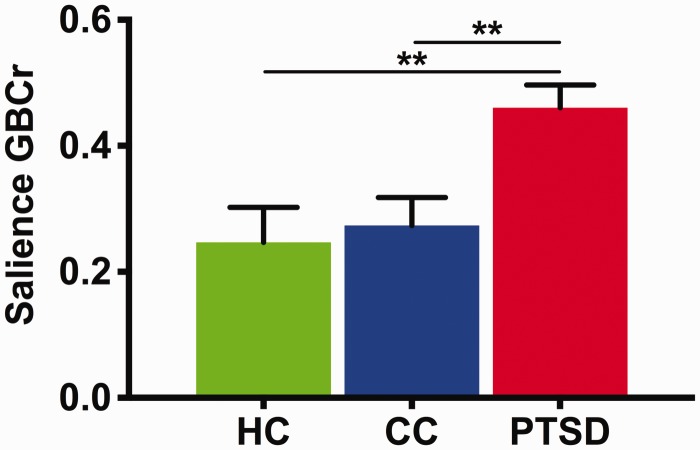
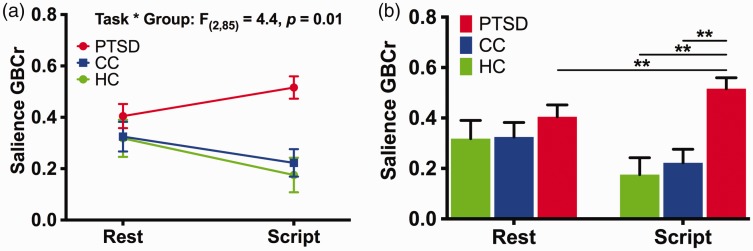
Results: In contrast to during resting-state, where there were no group differences, we found a significantly higher GBCr during symptom provocation, in PTSD participants compared to controls, in areas within the right hemisphere, including anterior insula, caudal-ventrolateral prefrontal, and rostral-ventrolateral parietal cortices. Overall, these clusters overlapped with the ventral and dorsal salience networks. Post hoc analysis showed increased GBCr in these salience clusters during symptom provocation compared to resting-state. In addition, resting-state GBCr in the salience clusters predicted GBCr during symptom provocation in PTSD participants but not in controls.
Conclusion: In PTSD, increased connectivity within the salience network has been previously hypothesized, based primarily on seed-based connectivity findings. The current results strongly support this hypothesis using whole-brain network measure in a fully data-driven approach. It remains to be seen in future studies whether these identified salience disturbances would normalize following treatment.
Keywords: PTSD; Posttraumatic Stress Disorder; fMRI; functional connectivity; salience network; symptom provocation.
Conflict of interest statement
Conflicts of Interest CGA has served as a consultant and/or on advisory boards for FSV7, Genentech and Janssen, and editor of Chronic Stress for Sage Publications, Inc.; he has filed a patent for using mTOR inhibitors to augment the effects of antidepressants (filed on August 20, 2018). JHK is a consultant for AbbVie, Inc., Amgen, Astellas Pharma Global Development, Inc., AstraZeneca Pharmaceuticals, Biomedisyn Corporation, Bristol-Myers Squibb, Eli Lilly and Company, Euthymics Bioscience, Inc., Neurovance, Inc., FORUM Pharmaceuticals, Janssen Research & Development, Lundbeck Research USA, Novartis Pharma AG, Otsuka America Pharmaceutical, Inc., Sage Therapeutics, Inc., Sunovion Pharmaceuticals, Inc., and Takeda Industries; is on the Scientific Advisory Board for Lohocla Research Corporation, Mnemosyne Pharmaceuticals, Inc., Naurex, Inc., and Pfizer; is a stockholder in Biohaven Pharmaceuticals; holds stock options in Mnemosyne Pharmaceuticals, Inc.; holds patents for Dopamine and Noradrenergic Reuptake Inhibitors in Treatment of Schizophrenia, US Patent No. 5,447,948 (issued September 5, 1995), and Glutamate Modulating Agents in the Treatment of Mental Disorders, U.S. Patent No. 8,778,979 (issued July 15, 2014); and filed a patent for Intranasal Administration of Ketamine to Treat Depression. U.S. Application No. 14/197,767 (filed on March 5, 2014); US application or Patent Cooperation Treaty international application No. 14/306,382 (filed on June 17, 2014). Filed a patent for using mTOR inhibitors to augment the effects of antidepressants (filed on August 20, 2018). All other co-authors declare no conflict of interest.
Figures
References
-
- Krystal JH, Davis LL, Neylan TC, et al. It is time to address the crisis in the pharmacotherapy of posttraumatic stress disorder: a consensus statement of the PTSD Psychopharmacology Working Group. Biol Psychiatry 2017; 82: e51–e59. - PubMed
-
- Biswal B, Yetkin FZ, Haughton VM, Hyde JS. Functional connectivity in the motor cortex of resting human brain using echo-planar MRI. Magn Reson Med 1995; 34: 537–541. - PubMed
Grants and funding
LinkOut - more resources
Full Text Sources
