Review
. 2019 May 27;18(1):102.
doi: 10.1186/s12943-019-1021-3.

Long non-coding RNAs in Oral squamous cell carcinoma: biologic function, mechanisms and clinical implications

Affiliations
Review

Long non-coding RNAs in Oral squamous cell carcinoma: biologic function, mechanisms and clinical implications

Lei Zhang et al. Mol Cancer. .

Abstract

There is growing evidence that regions of the genome that cannot encode proteins play an important role in diseases. These regions are usually transcribed into long non-coding RNAs (lncRNAs). LncRNAs, little or no coding potential, are defined as capped transcripts longer than 200 nucleotides. New sequencing technologies have shown that a large number of aberrantly expressed lncRNAs are associated with multiple cancer types and indicated they have emerged as an important class of pervasive genes during the development and progression of cancer. However, the underlying mechanism in cancer is still unknown. Therefore, it is necessary to elucidate the lncRNA function. Notably, many lncRNAs dysregulation are associated with Oral squamous cell carcinoma (OSCC) and affect various aspects of cellular homeostasis, including proliferation, survival, migration or genomic stability. This review expounds the up- or down-regulation of lncRNAs in OSCC and the molecular mechanisms by which lncRNAs perform their function in the malignant cell. Finally, the potential of lncRNAs as non-invasive biomarkers for OSCC diagnosis are also described. LncRNAs hold promise as prospective novel therapeutic targets, but more research is needed to gain a better understanding of their biologic function.

Keywords: Biomarker; Long non-coding RNAs; Oral squamous cell carcinoma (OSCC); Tumorigenesis.


Conflict of interest statement

The authors declare that they have no competing interests.

Figures
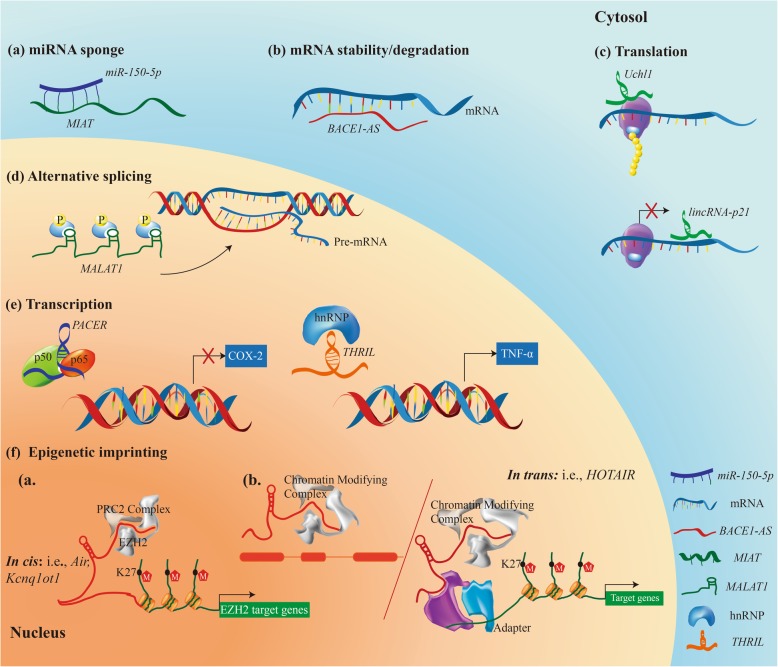
Fig. 1
Fig. 1
LncRNAs exert functions through a variety of signaling pathways in the human body. a miRNA sponge. MIAT, acting as a molecular sponge, binds to miR-150-5p, thereby upregulating the level of miR-150-5p target gene. b mRNA stability/degradation. LncRNA binding to mRNA may stabilize (e.g., BACE1-AS prevents miRNA-induced repression of BACE1 transcript) or decay target transcripts. c Translation. LncRNAs promote (like antisense Uchl) or repress (like lincRNA-p21) translation of transcripts. d Alternative splicing. MALAT1 acting as scaffold for SR proteins regulates pre-mRNA alternative splicing. e Transcription. PACER (lethe and p50-associated Cox-2 extragenic RNA) directly interacts with different subunits of NF-κB, thus preventing it from binding to the Cox-2 promoter. THRIL, together with heterogeneous nuclear ribonucleoproteins (hnRNPs), acts as RNA-protein complex and binds to TNF-α promoter and induces TNF-α expression. f Epigenetic imprinting. Working models of gene regulation by cis- (a) and trans-acting (b) lncRNAs. LncRNAs, such as Xist/RepA, Air, HOTAIR, and Kcnq1ot1, may act as docking platforms for the chromatin remodeling complex, polycomb repressive complex (PRC2) 2, which methylates histone H3 at lysine 27 (H3K27me3), leading to a repression or gain of transcriptional activity, respectively
Fig. 2
Fig. 2
The steroid receptor RNA activator (SRA) lncRNA contains 4 subdomains. The human SRA has a length of 870 nt, organized into 4 sub-domains and 25 helices. Four biochemical techniques (SHAPE, in-line, DMS and RNase V1) were used to obtain the secondary structure. Blue, domain I; green, domain II; black, domain III; yellow, domain IV
Fig. 3
Fig. 3
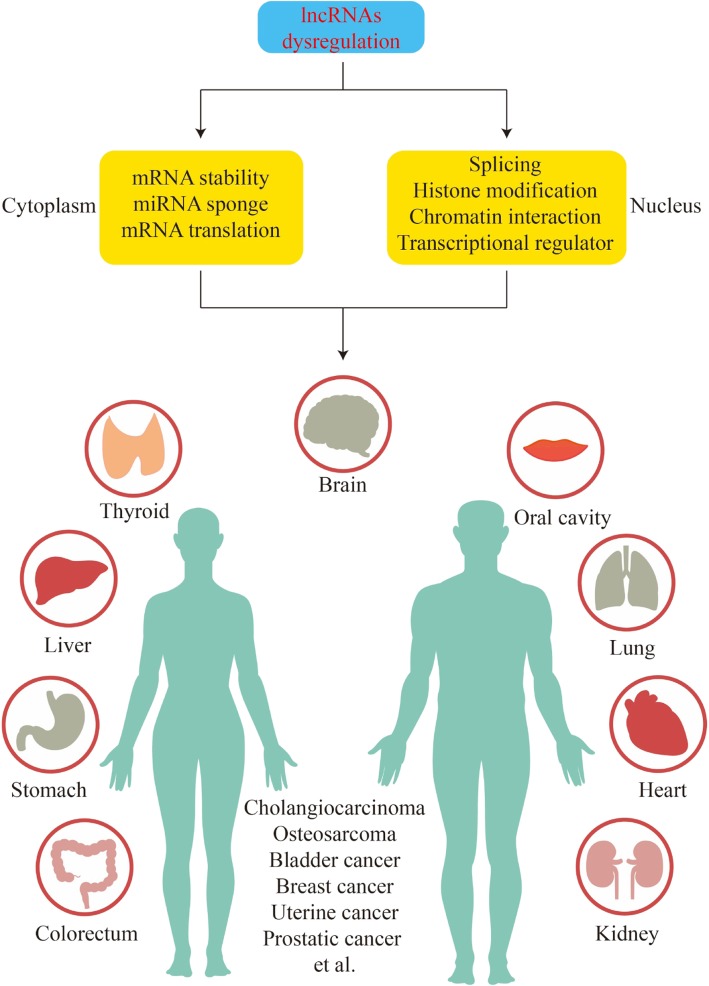
LncRNAs dysregulation is associated with a variety of diseases in humans. LncRNAs can affect human health through a variety of signaling pathways which can be divided into cytoplasmic signaling pathways and intranuclear signaling pathways. Cytoplasmic signaling pathways include mRNA stability, miRNA sponge and mRNA translation. Intranuclear signaling pathways include splicing, histone modification, chromatin interaction and transcriptional regulator
Fig. 4
Fig. 4
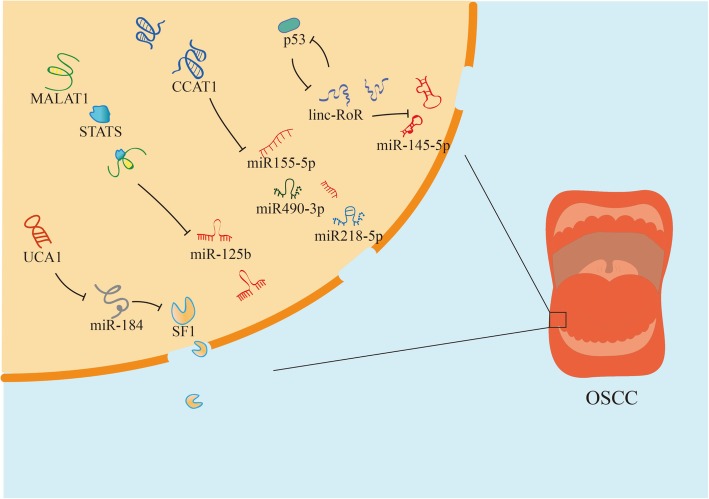
Overview of the role of lncRNAs with miRNAs in OSCC cells
Fig. 5
Fig. 5
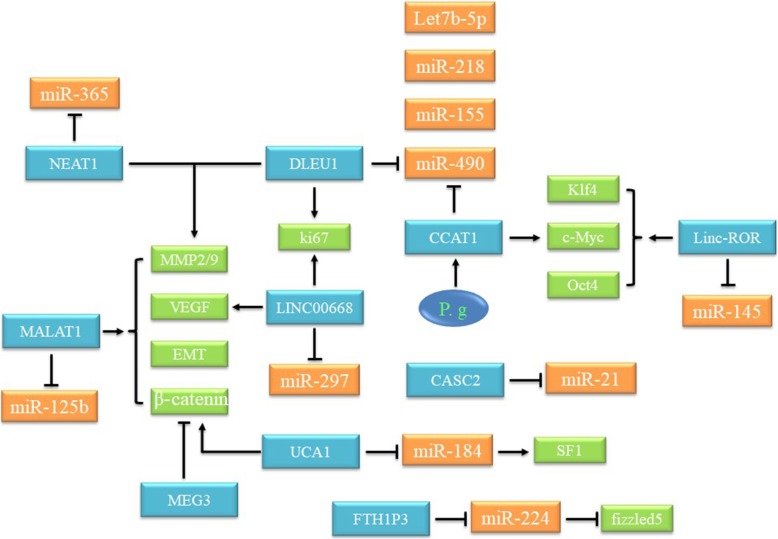
LncRNAs trigger OSCC through multiple regulatory signaling pathways. A variety of methods have been used to detect upregulation or downregulation of multiple lncRNAs in OSCC patients. These lncRNAs are affected by upstream regulatory factors or affect downstream factors to trigger carcinogenic or tumor suppressor signaling pathways

References

    1. Chi AC, Day TA, Neville BW. Oral cavity and oropharyngeal squamous cell carcinoma--an update. CA Cancer J Clin. 2015;65(5):401–421. doi: 10.3322/caac.21293. - DOI - PubMed
    1. Pannone G, Santoro A, Papagerakis S, Lo Muzio L, De Rosa G, Bufo P. The role of human papillomavirus in the pathogenesis of head & neck squamous cell carcinoma: an overview. Infect Agent Cancer. 2011;6(1):4. doi: 10.1186/1750-9378-6-4. - DOI - PMC - PubMed
    1. Sankunny M, Parikh RA, Lewis DW, Gooding WE, Saunders WS, Gollin SM. Targeted inhibition of ATR or CHEK1 reverses radioresistance in oral squamous cell carcinoma cells with distal chromosome arm 11q loss. Genes Chromosomes Cancer. 2014;53(2):129–143. doi: 10.1002/gcc.22125. - DOI - PMC - PubMed
    1. Mehrotra R, Yadav S. Oral squamous cell carcinoma: etiology, pathogenesis and prognostic value of genomic alterations. Indian J Cancer. 2006;43(2):60–66. doi: 10.4103/0019-509X.25886. - DOI - PubMed
    1. Patel SC, Carpenter WR, Tyree S, Couch ME, Weissler M, Hackman T, Hayes DN, Shores C, Chera BS. Increasing incidence of oral tongue squamous cell carcinoma in young white women, age 18 to 44 years. J Clin Oncol. 2011;29(11):1488–1494. doi: 10.1200/JCO.2010.31.7883. - DOI - PubMed

Publication types