Review
. 2019 May 7:10:861.
doi: 10.3389/fimmu.2019.00861. eCollection 2019.

Innate Lymphoid Cells in Mucosal Immunity

Affiliations
Review

Innate Lymphoid Cells in Mucosal Immunity

Santosh K Panda et al. Front Immunol. .

Abstract

Innate lymphoid cells (ILCs) are innate counterparts of T cells that contribute to immune responses by secreting effector cytokines and regulating the functions of other innate and adaptive immune cells. ILCs carry out some unique functions but share some tasks with T cells. ILCs are present in lymphoid and non-lymphoid organs and are particularly abundant at the mucosal barriers, where they are exposed to allergens, commensal microbes, and pathogens. The impact of ILCs in mucosal immune responses has been extensively investigated in the gastrointestinal and respiratory tracts, as well as in the oral cavity. Here we review the state-of-the-art knowledge of ILC functions in infections, allergy and autoimmune disorders of the mucosal barriers.

Keywords: COPD; IBD – Inflammatory bowel diseases; ILCs; NK cells; allergy and asthma; mucosal infections.


Figures

Figure 1
Figure 1
Role of ILCs in different mucosae. Different ILC subsets play beneficial and detrimental roles in different mucosae: protection against various infections, tolerance against innocuous antigens, induction of allergy, IBD, and cancer. NK cells and ILC1s block viral and intracellular bacterial infections by secreting IFN-γ. However, ILC1s promote COPD and IBD in respiratory and intestinal mucosa, respectively. ILC2s contribute to worm expulsion and tissue repair in both respiratory and intestinal mucosa during helminth infection. Further, these cells repair viral induced lung injury by secreting amphiregulin. On the other hand, ILC2s promote allergic inflammation in lung and nasal polyps. ILC3s play dual role in both respiratory and intestinal mucosa. These cells confer protection against extracellular bacterial infection by secreting IL-22 which induces production of anti-microbial peptides by epithelial cells. ILC3s block oral fungal infection in an IL-17-dependent manner. These cells also promote tolerance against commensal and dietary antigens through MHC-II mediated antigen presentation. However, inappropriate activation of ILC3s can play a detrimental role by instigating allergy in the respiratory mucosa, as well as IBD and cancer in the intestinal mucosa.
Figure 2
Figure 2
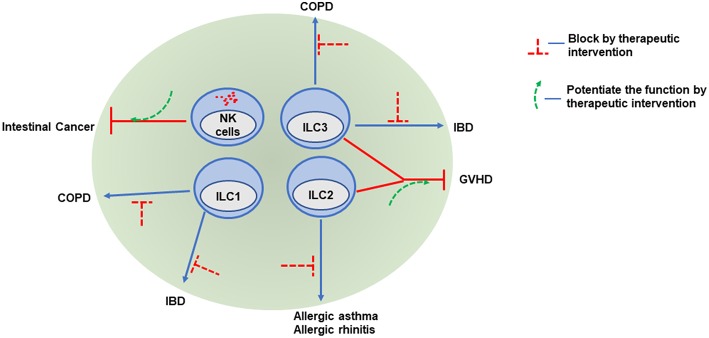
ILCs as potential therapeutic targets. Because of their various roles in promoting or attenuating pathogenesis, ILCs may be potential therapeutic target. Infiltration of NK cells into intestinal cancer is associated with better prognosis, therefore increasing NK cell infiltration and potentiating NK cell functions in tumors might be beneficial. Hyperactivation of both ILC1 and ILC3 promote COPD and IBD. Regulation of pathogenic cytokine production or antibody mediated depletion of these cells might be a potential treatment option. Similarly, antibodies targeting type-2 cytokines produced by ILC2 may be promising in the treatment of allergy and asthma patients. Both ILC2 and ILC3 ameliorate clinical symptoms and play protective roles in GVHD. Expansion of ILC2 and ILC3 numbers by therapeutic intervention might be helpful to control GVHD.

References

    1. Bando JK, Colonna M. Innate lymphoid cell function in the context of adaptive immunity. Nat Immunol. (2016) 17:783–9. 10.1038/ni.3484 - DOI - PMC - PubMed
    1. Mjosberg J, Spits H. Human innate lymphoid cells. J Allergy Clin Immunol. (2016) 138:1265–76. 10.1016/j.jaci.2016.09.009 - DOI - PubMed
    1. Ebbo M, Crinier A, Vely F, Vivier E. Innate lymphoid cells: major players in inflammatory diseases. Nat Rev Immunol. (2017) 17:665–78. 10.1038/nri.2017.86 - DOI - PubMed
    1. Vivier E, Artis D, Colonna M, Diefenbach A, Di Santo JP, Eberl G, et al. Innate lymphoid cells: 10 years on. Cell. (2018) 174:1054–66. 10.1016/j.cell.2018.07.017 - DOI - PubMed
    1. Fuchs A, Vermi W, Lee JS, Lonardi S, Gilfillan S, Newberry RD, et al. Intraepithelial type 1 innate lymphoid cells are a unique subset of IL-12- and IL-15-responsive IFN-gamma-producing cells. Immunity. (2013) 38:769–81. 10.1016/j.immuni.2013.02.010 - DOI - PMC - PubMed

Publication types

MeSH terms

LinkOut - more resources