Review
. 2019 May 7:10:426.
doi: 10.3389/fgene.2019.00426. eCollection 2019.

Long-Read Sequencing Emerging in Medical Genetics

Affiliations
Review

Long-Read Sequencing Emerging in Medical Genetics

Tuomo Mantere et al. Front Genet. .

Abstract

The wide implementation of next-generation sequencing (NGS) technologies has revolutionized the field of medical genetics. However, the short read lengths of currently used sequencing approaches pose a limitation for the identification of structural variants, sequencing repetitive regions, phasing of alleles and distinguishing highly homologous genomic regions. These limitations may significantly contribute to the diagnostic gap in patients with genetic disorders who have undergone standard NGS, like whole exome or even genome sequencing. Now, the emerging long-read sequencing (LRS) technologies may offer improvements in the characterization of genetic variation and regions that are difficult to assess with the prevailing NGS approaches. LRS has so far mainly been used to investigate genetic disorders with previously known or strongly suspected disease loci. While these targeted approaches already show the potential of LRS, it remains to be seen whether LRS technologies can soon enable true whole genome sequencing routinely. Ultimately, this could allow the de novo assembly of individual whole genomes used as a generic test for genetic disorders. In this article, we summarize the current LRS-based research on human genetic disorders and discuss the potential of these technologies to facilitate the next major advancements in medical genetics.

Keywords: long-read sequencing; medical genetics; next-generation sequencing; phasing; pseudogenes; structural variation; tandem repeat expansion.


Figures
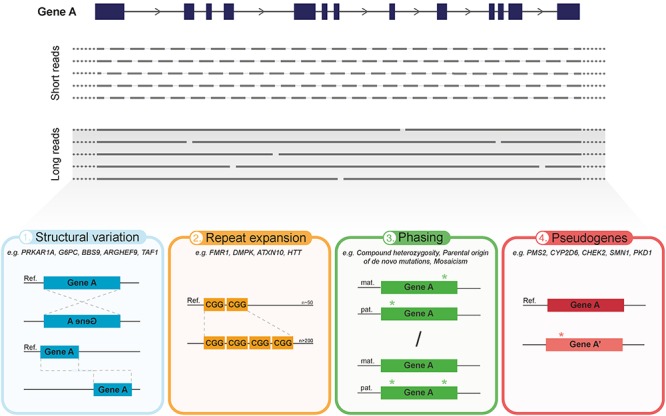
Figure 1
Figure 1
Overview of the main advantages of current long-read sequencing (LRS) approaches in medical genetics. The predominant difference between LRS and the conventional SR-NGS approaches is the significant increase in read length. In contrast to short reads (150–300 bp), LRS has the capacity to sequence on average over 10 kb in one single read, thereby requiring less reads to cover the same gene (illustrated in top panel). Hence, aside from reducing alignment and mapping errors, LRS holds various advantages over short-read approaches which can greatly impact medical genetics (bottom panel). (1) Improved detection and characterization of large structural variation (SV), due to, e.g., large inversions or translocations. (2) Capacity to directly, and with that more accurately, sequence over long tandem repeat expansions and extreme GC-rich regions. (3) Enhanced phasing, i.e., assignment of genetic variants to the homologous paternal or maternal chromosomes, to determine inheritance patterns, parental origin of de novo events, mosaicism, allele specific expression and disease risk haplotypes. (4) Improved discrimination of clinically relevant genes from their pseudogenes.
Figure 2
Figure 2
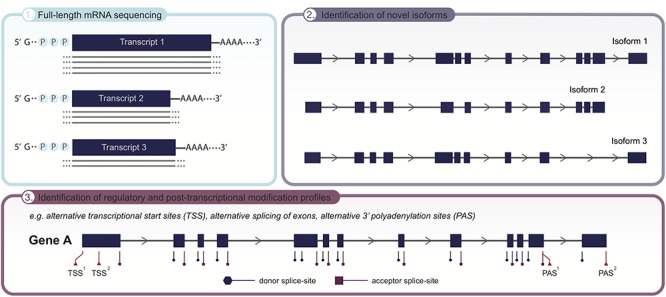
Applicability of long-read sequencing (LRS) to unveil the transcriptome landscape of cells and tissues. Given the significant improvements in read length, employing LRS on RNA level now allows for full-length isoform sequencing, covering the complete mRNA transcript in one single read (panel 1). As recent advances have demonstrated the isoform landscape to be more complex than initially thought, LRS holds the potential to identify novel isoforms (panel 2), as well as detect transcriptional and post-transcriptional modification sites, e.g., alternative transcriptional start sites (TSS), alternative splicing of exons and alternative transcription termination sites (3′polyadenylation sites; PAS), that underpin the emergence of different isoforms (panel 3). Collectively, uncovering the full isoform diversity within cells and tissues.

References

    1. Akey J., Jin L., Xiong M. (2001). Haplotypes vs single marker linkage disequilibrium tests: what do we gain? Eur. J. Hum. Genet. 9 291–300. 10.1038/sj.ejhg.5200619 - DOI - PubMed
    1. Alkan C., Coe B. P., Eichler E. E. (2011). Genome structural variation discovery and genotyping. Nat. Rev. Genet. 12 363–376. 10.1038/nrg2958 - DOI - PMC - PubMed
    1. Ameur A., Che H., Martin M., Bunikis I., Dahlberg J., Hoijer I., et al. (2018a). De novo assembly of two Swedish genomes reveals missing segments from the human GRCh38 reference and improves variant calling of population-scale sequencing data. Genes 9:E486. 10.3390/genes9100486 - DOI - PMC - PubMed
    1. Ameur A., Kloosterman W. P., Hestand M. S. (2018b). Single-molecule sequencing: towards clinical applications. Trends Biotechnol. 37 72–85. 10.1016/j.tibtech.2018.07.013 - DOI - PubMed
    1. Ammar R., Paton T. A., Torti D., Shlien A., Bader G. D. (2015). Long read nanopore sequencing for detection of HLA and CYP2D6 variants and haplotypes. F1000Res. 4:17. 10.12688/f1000research.6037.2 - DOI - PMC - PubMed