


The main will of the patients of a private Italian IVF clinic for their aneuploid/affected blastocysts would be donation to research: a currently forbidden choice
- PMID: 31134411
- PMCID: PMC6708053
- DOI: 10.1007/s10815-019-01465-2
The main will of the patients of a private Italian IVF clinic for their aneuploid/affected blastocysts would be donation to research: a currently forbidden choice
Abstract
Purpose: Surplus cryopreserved affected/aneuploid blastocysts may be obtained after in vitro fertilization (IVF) treatments with preimplantation genetic testing (PGT). These embryos are considered not suitable for transfer and may be discarded. Currently, in Italy, an embryo disposition decision (EDD) is not allowed and the frozen/vitrified blastocysts (even if affected/aneuploid) should be kept cryopreserved indefinitely. In this peculiar clinical, social, and legislative scenario, we aimed at assessing the attitudes of the patients towards the fate of these embryos, in case the local regulation would be changed and allow an EDD regarding the surplus affected/aneuploid embryos obtained after PGT.
Methods: A questionnaire with multiple answers was submitted to 832 patients who obtained affected/aneuploid embryos during a PGT cycle at our private IVF center. They were asked to choose between three putative options with related reasons: everlasting cryopreservation (only option currently available); discard or donate them to research.
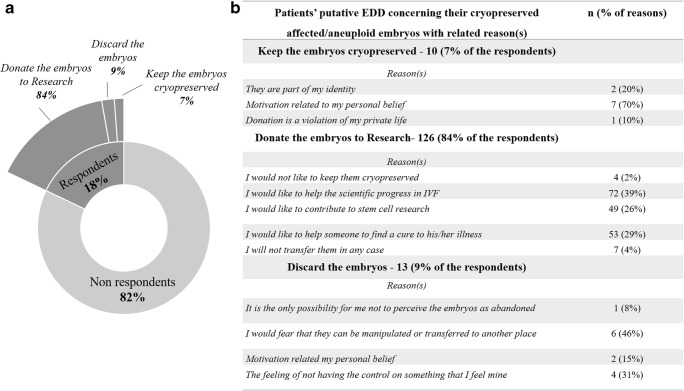
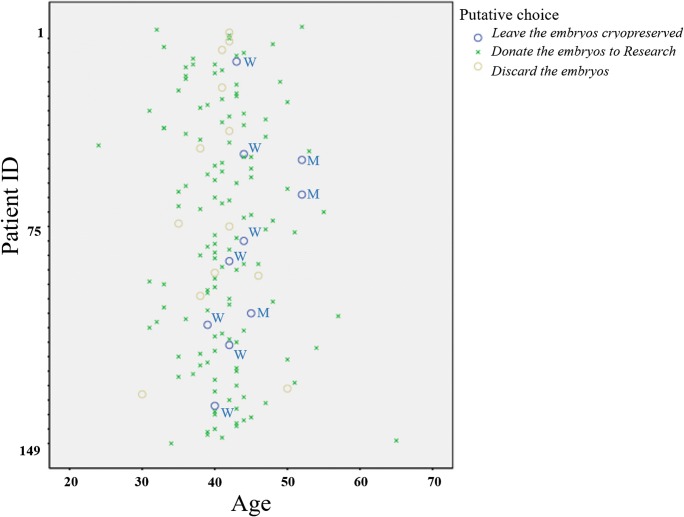
Results: Overall, 149 patients (18%; 85 women and 64 men) answered the questionnaire. Among them, 84% (n = 126) would choose to donate their affected/aneuploid blastocysts to research, 9% (n = 13) would discard them and only 7% (n = 10) would keep them cryopreserved indefinitely.
Conclusions: Donation of the affected/aneuploid blastocysts is the option chosen from most of the respondents (84%; 15% of the eligible patients). These patients are motivated from the altruistic will of incentivating the progress in IVF and/or stem cell research and supporting future couples to limit/solve their infertility/health issues.
Keywords: Affected embryos; Donation; Embryo disposition decision; Preimplantation genetic testing; Surplus embryos.
Figures
References
-
- Rienzi L, Gracia C, Maggiulli R, LaBarbera AR, Kaser DJ, Ubaldi FM, et al. Oocyte, embryo and blastocyst cryopreservation in ART: systematic review and meta-analysis comparing slow-freezing versus vitrification to produce evidence for the development of global guidance. Hum Reprod Update. 2017;23(2):139–155. - PMC - PubMed
-
- Lyerly AD, Steinhauser K, Voils C, Namey E, Alexander C, Bankowski B, Cook-Deegan R, Dodson WC, Gates E, Jungheim ES, McGovern P, Myers ER, Osborn B, Schlaff W, Sugarman J, Tulsky JA, Walmer D, Faden RR, Wallach E. Fertility patients' views about frozen embryo disposition: results of a multi-institutional U.S. survey. Fertil Steril. 2010;93(2):499–509. doi: 10.1016/j.fertnstert.2008.10.015. - DOI - PMC - PubMed
Publication types
MeSH terms
LinkOut - more resources
Full Text Sources
Medical
