


Genetic and environmental factors influencing the contents of essential oil compounds in Atractylodes lancea
- PMID: 31136627
- PMCID: PMC6538177
- DOI: 10.1371/journal.pone.0217522
Genetic and environmental factors influencing the contents of essential oil compounds in Atractylodes lancea
Abstract
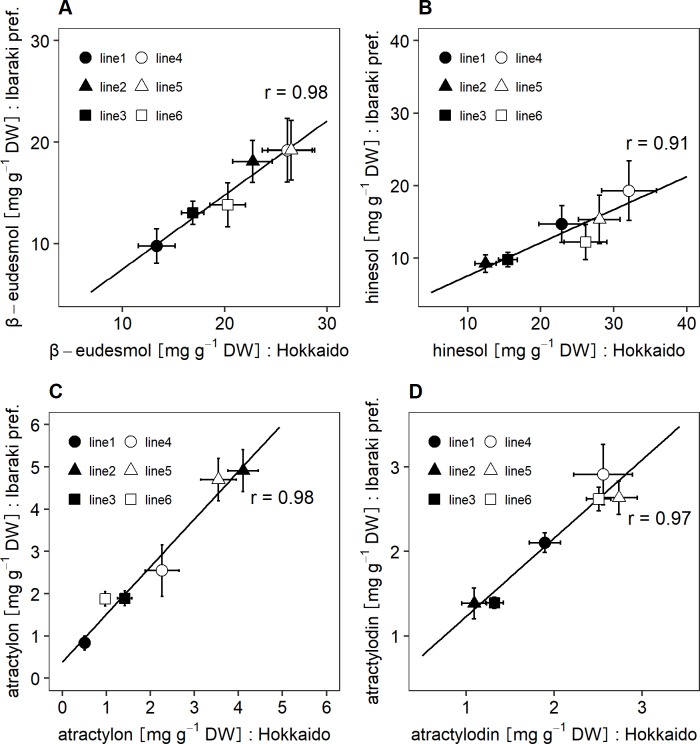
Rhizomes of Atractylodes lancea are used in traditional Japanese medicine (Kampo) and Chinese medicine to treat numerous diseases and disorders because they contain many pharmacologically active compounds. The major active compounds in A. lancea are essential oil compounds such as β-eudesmol, hinesol, atractylon, and atractylodin. The contents of the compounds in A. lancea exhibit high variability depending on their habitat. We cultivated clonal lines of A. lancea in different years (2016, 2017) and different locations (Hokkaido, Ibaraki) to investigate the influence of genetic and environmental factors on the contents of major compounds, namely, β-eudesmol, hinesol, atractylon, and atractylodin. Broad sense heritability of β-eudesmol, hinesol, atractylon, and atractylodin contents were 0.84, 0.77, 0.86, and 0.87, respectively. The effects of interannual variability on the contents of the compounds were lower than those of genotype. In addition, the cultivated environmental factors were assessed by different locations, and the correlations between Hokkaido and Ibaraki grown plants based on β-eudesmol, hinesol, atractylon, and atractylodin contents were 0.94, 0.94, 1.00, and 0.83, respectively. The results suggest that the contents of β-eudesmol, hinesol, atractylon, and atractylodin in A. lancea are largely influenced by genetic factors, and clonal propagation could be an effective strategy for obtaining populations with high contents of essential oil compounds. Furthermore, the contents of β-eudesmol, hinesol, atractylon, and atractylodin in A. lancea exhibited few correlations with rhizome yields. A. lancea cultivars with not only high contents of essential oil compounds but also high rhizome yield could be developed through selective breeding.
Conflict of interest statement
I have read the journal’s policy and the authors of this manuscript have the following competing interests: TT and BM are employees of Tsumura & Co. (https://www.tsumura.co.jp/english/). HE and RO are supervisors at the University of Tsukuba to which TT belongs. This does not alter our adherence to PLOS ONE policies on sharing data and materials.
Figures


References
-
- Shiba M, Kondo K, Miki E, Yamaji H, Morota T, Terabayashi S, et al. Identification of medicinal Atractylodes based on ITS sequences of nrDNA. Biol Pharm Bull. 2006; 29: 315–320. - PubMed
-
- Japanese Pharmacopoeia, Society of Japanese Pharmacopoeia, 17th ed. Tokyo; 2016: 1803
-
- Chinese Pharmacopoeia Commission. Chinese Pharmacopoeia (the first part). China Medical Science Press; 2015: 161.
-
- Mizukami H, Okabe Y, Kohda H, Hiraoka N. Identification of the crude drug Atractylodes rhizome (Byaku-jutsu) and Atractylodes lancea rhizome (So-jutsu) using chloroplast TrnK sequence as a molecular marker. Biol Pharm Bull. 2000;23: 589–594. - PubMed
-
- Kubo M, Nogami M, Nishimura M, Moriura T, Arichi S. Studies of crude drugs about its origin, process and quality. I. The preventive effects of chinese crude drug" Zhu" on experimental stomach ulcer and its pharmacological evaluation (1). Yakugaku Zasshi. 1983;103: 442–448. - PubMed
Publication types
MeSH terms
Substances
LinkOut - more resources
Full Text Sources
