


Evaluation of measurement error in 24-hour dietary recall for assessing sodium and potassium intake among US adults - National Health and Nutrition Examination Survey (NHANES), 2014
- PMID: 31136657
- PMCID: PMC6537943
- DOI: 10.1093/ajcn/nqz044
Evaluation of measurement error in 24-hour dietary recall for assessing sodium and potassium intake among US adults - National Health and Nutrition Examination Survey (NHANES), 2014
Abstract
Background: Understanding measurement error in sodium and potassium intake is essential for assessing population intake and studying associations with health outcomes.
Objective: The aim of this study was to compare sodium and potassium intake derived from 24-h dietary recall (24HDR) with intake derived from 24-h urinary excretion (24HUE).
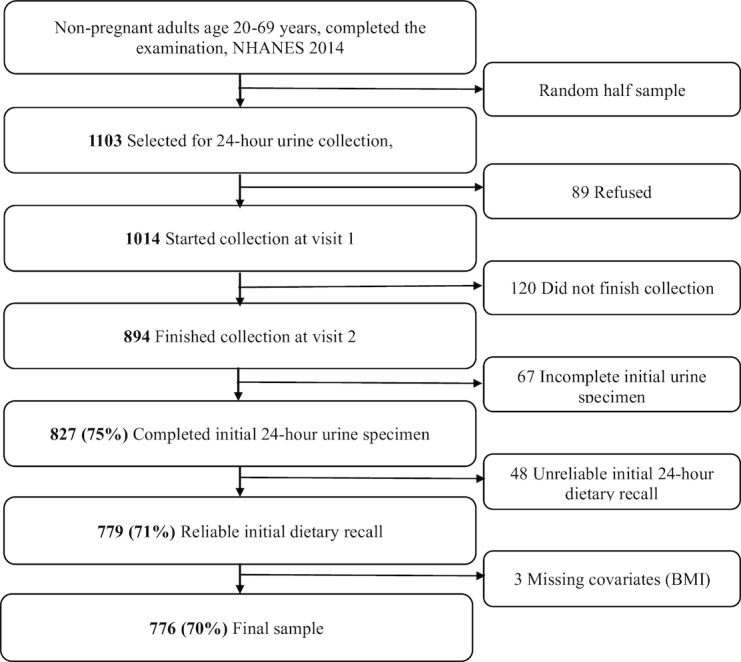
Design: Data were analyzed from 776 nonpregnant, noninstitutionalized US adults aged 20-69 y who completed 1-to-2 24HUE and 24HDR measures in the 2014 NHANES. A total of 1190 urine specimens and 1414 dietary recalls were analyzed. Mean bias was estimated as mean of the differences between individual mean 24HDR and 24HUE measurements. Correlations and attenuation factors were estimated using the Kipnis joint-mixed effects model accounting for within-person day-to-day variability in sodium excretion. The attenuation factor reflects the degree to which true associations between long-term intake (estimated using 24HUEs) and a hypothetical health outcome would be approximated using a single 24HDR: values near 1 indicate close approximation and near 0 indicate bias toward null. Estimates are reported for sodium, potassium, and the sodium: potassium (Na/K) ratio. Model parameters can be used to estimate correlations/attenuation factors when multiple 24HDRs are available.
Results: Overall, mean bias for sodium was -452 mg (95% CI: -646, -259), for potassium -315 mg (CI: -450, -179), and for the Na/K ratio -0.04 (CI: -0.15, 0.07, NS). Using 1 24HDR, the attenuation factor for sodium was 0.16 (CI: 0.09, 0.21), for potassium 0.25 (CI:0.16, 0.36), and for the Na/K ratio 0.20 (CI: 0.10, 0.25). The correlation for sodium was 0.27 (CI: 0.16, 0.37), for potassium 0.35 (CI: 0.26, 0.55), and for the Na/K ratio 0.27 (CI: 0.13, 0.32).
Conclusions: Compared with 24HUE, using 24HDR underestimates mean sodium and potassium intake but is unbiased for the Na/K ratio. Additionally, using 24HDR as a measure of exposure in observational studies attenuates the true associations of sodium and potassium intake with health outcomes.
Keywords: 24-h dietary recall; measurement error; potassium; sodium; urine.
Published by Oxford University Press on behalf of the American Society for Nutrition 2019.
Figures
References
-
- Whelton PK, Carey RM, Aronow WS, Casey DE Jr, Collins KJ, Dennison Himmelfarb C, DePalma SM, Gidding S, Jamerson KA, Jones DW et al.. 2017 ACC/AHA/AAPA/ABC/ACPM/AGS/APhA/ASH/ASPC/NMA/PCNA Guideline for the Prevention, Detection, Evaluation, and Management of High Blood Pressure in Adults: A Report of the American College of Cardiology/American Heart Association Task Force on Clinical Practice Guidelines. J Am Coll Cardiol. 2017;71:2199-2269:[]. - PubMed
-
- Mozaffarian D, Fahimi S, Singh GM, Micha R, Khatibzadeh S, Engell RE, Lim S, Danaei G, Ezzati M, Powles J. Global sodium consumption and death from cardiovascular causes. N Engl J Med. 2014;371(7):624–34. - PubMed
-
- Department of Health and Human Services, Department of Agriculture. Dietary guidelines for Americans 2015–2020. [Internet]. 8th ed 2015. Available from: http://health.gov/dietaryguidelines/2015/guidelines (Accessed 27 April 2018).
-
- Jackson SL, Cogswell ME, Zhao L, Terry AL, Wang C, Wright J, Coleman King SM, Bowman B, Chen T, Merritt R et al.. Association between urinary sodium and potassium excretion and blood pressure among adults in the United States National Health and Nutrition Examination Survey 2014. Circulation. 2018;137:237–46. - PMC - PubMed
Publication types
MeSH terms
Substances
LinkOut - more resources
Full Text Sources
Medical
Miscellaneous
