


Development of Liposomal Gemcitabine with High Drug Loading Capacity
- PMID: 31136710
- PMCID: PMC6662591
- DOI: 10.1021/acs.molpharmaceut.8b01284
Development of Liposomal Gemcitabine with High Drug Loading Capacity
Abstract
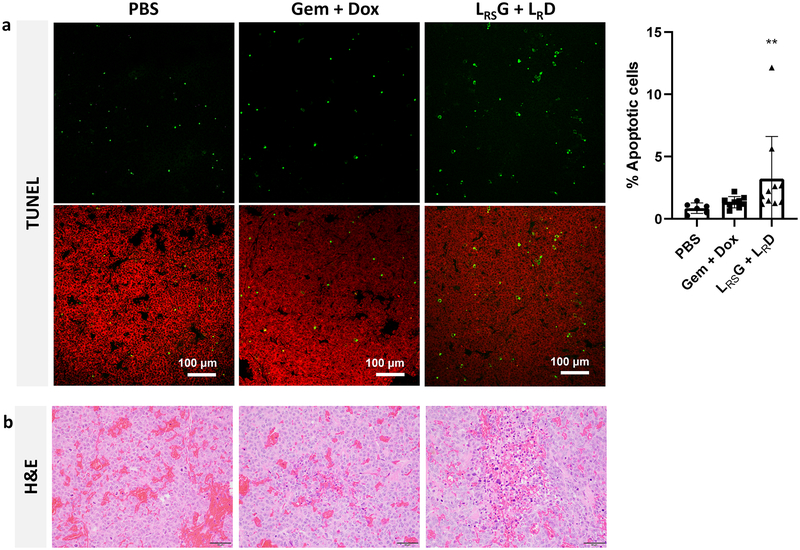
Liposomes are widely used for systemic delivery of chemotherapeutic agents to reduce their nonspecific side effects. Gemcitabine (Gem) makes a great candidate for liposomal encapsulation due to the short half-life and nonspecific side effects; however, it has been difficult to achieve liposomal Gem with high drug loading capacity. Remote loading, which uses a transmembrane pH gradient to induce an influx of drug and locks the drug in the core as a sulfate complex, does not serve Gem as efficiently as doxorubicin (Dox) due to the low p Ka value of Gem. Existing studies have attempted to improve Gem loading capacity in liposomes by employing lipophilic Gem derivatives or creating a high-concentration gradient for active loading into the hydrophilic cores (small volume loading). In this study, we combine the remote loading approach and small volume loading or hypertonic loading, a new approach to induce the influx of Gem into the preformed liposomes by high osmotic pressure, to achieve a Gem loading capacity of 9.4-10.3 wt % in contrast to 0.14-3.8 wt % of the conventional methods. Liposomal Gem showed a good stability during storage, sustained-release over 120 h in vitro, enhanced cellular uptake, and improved cytotoxicity as compared to free Gem. Liposomal Gem showed a synergistic effect with liposomal Dox on Huh7 hepatocellular carcinoma cells. A mixture of liposomal Gem and liposomal Dox delivered both drugs to the tumor more efficiently than a free drug mixture and showed a relatively good anti-tumor effect in a xenograft model of hepatocellular carcinoma. This study shows that bioactive liposomal Gem with high drug loading capacity can be produced by remote loading combined with additional approaches to increase drug influx into the liposomes.
Keywords: drug loading capacity; gemcitabine; hypertonic loading; liposomes; remote loading; small volume loading.
Figures


References
-
- Haran G; Cohen R; Bar LK and Barenholz Y, Transmembrane ammonium sulfate gradients in liposomes produce efficient and stable entrapment of amphipathic weak bases. Biochimica et Biophysica Acta (BBA) - Biomembranes 1993, 1151, 201–215. - PubMed
-
- Gubernator J, Active methods of drug loading into liposomes: recent strategies for stable drug entrapment and increasedin vivoactivity. Expert Opinion on Drug Delivery 2011, 8, 565–580. - PubMed
-
- Fritze A; Hens F; Kimpfler A; Schubert R and Peschka-Suss R, Remote loading of doxorubicin into liposomes driven by a transmembrane phosphate gradient. Biochim Biophys Acta 2006, 1758, 1633–40. - PubMed
-
- Barenholz Y, Doxil(R)--the first FDA-approved nano-drug: lessons learned. J Control Release 2012, 160, 117–34. - PubMed
-
- Barenholz Y, Liposome application: problems and prospects. Current Opinion in Colloid & Interface Science 2001, 6, 66–77.
Publication types
MeSH terms
Substances
Grants and funding
LinkOut - more resources
Full Text Sources
Medical
Research Materials
