. 2019 May 24;11(5):473.
doi: 10.3390/v11050473.

Transcriptome Response of Female Culicoides sonorensis Biting Midges (Diptera: Ceratopogonidae) to Early Infection with Epizootic Hemorrhagic Disease Virus (EHDV-2)

Affiliations

Transcriptome Response of Female Culicoides sonorensis Biting Midges (Diptera: Ceratopogonidae) to Early Infection with Epizootic Hemorrhagic Disease Virus (EHDV-2)

Dana Nayduch et al. Viruses. .

Abstract

Female Culicoides sonorensis biting midges are vectors of epizootic hemorrhagic disease virus (EHDV), which causes morbidity and mortality in wild and domesticated ruminants. The aims in this study were to identify key changes in female midge transcriptome profiles occurring during early infection with EHDV-2. Midges were fed either negative control bloodmeals or bloodmeals containing EHDV-2 and transcriptomes were acquired at 36 h through deep sequencing. Reads were de novo assembled into a transcriptome comprised of 18,754 unigenes. Overall, there were 2401 differentially expressed unigenes and ~60% were downregulated in response to the virus (953 up; 1448 down). Downstream Gene Ontology enrichment, KEGG pathway mapping, and manual analyses were used to identify the effect of virus ingestion at both the gene and pathway levels. Downregulated unigenes were predominantly assigned to pathways related to cell/tissue structure and integrity (actin cytoskeleton, adherens junction, focal adhesion, hippo signaling), calcium signaling, eye morphogenesis and axon guidance. Unigenes attributed to sensory functions (especially vision), behavior, learning and memory were largely downregulated. Upregulated unigenes included those coding for innate immune processes, olfaction and photoreceptor pigments. Our results suggest that midges respond to virus infection as soon as 36 h post-ingestion, and that EHDV-2 may have a significant phenotypic effect on sensory and neural tissues.

Keywords: Culicoides; arbovirus; differential expression; dissemination; epizootic hemorrhagic disease virus; innate immune; midge; vector; visual perception.


Conflict of interest statement

The authors declare no conflict of interest.

Figures
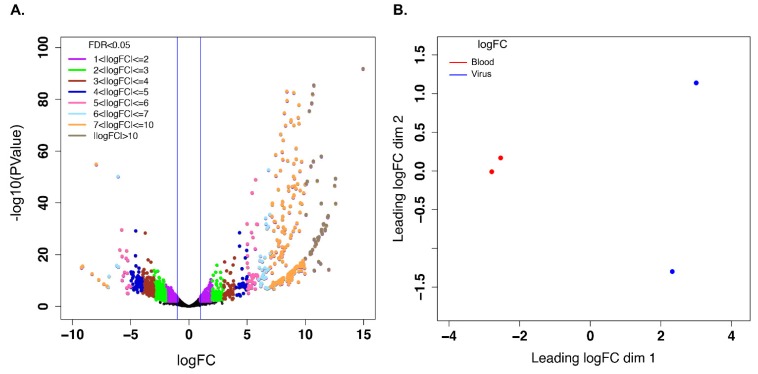
Figure 1
Figure 1
Visualization of differential gene expression analysis using edgeR. (A) Represents the volcano graph derived by plotting the log of the FDR-adjusted p value as a function of Log2 of the fold change (“logFC”) for each transcript in EHDV-fed midges vs. controls. (B) Represents the multidimensional scaling plot of the relationship matrix which is derived from Log2 fold change of the differentially-expressed unigenes across the sample groups showing separation of controls vs. EHDV-fed groups.
Figure 2
Figure 2
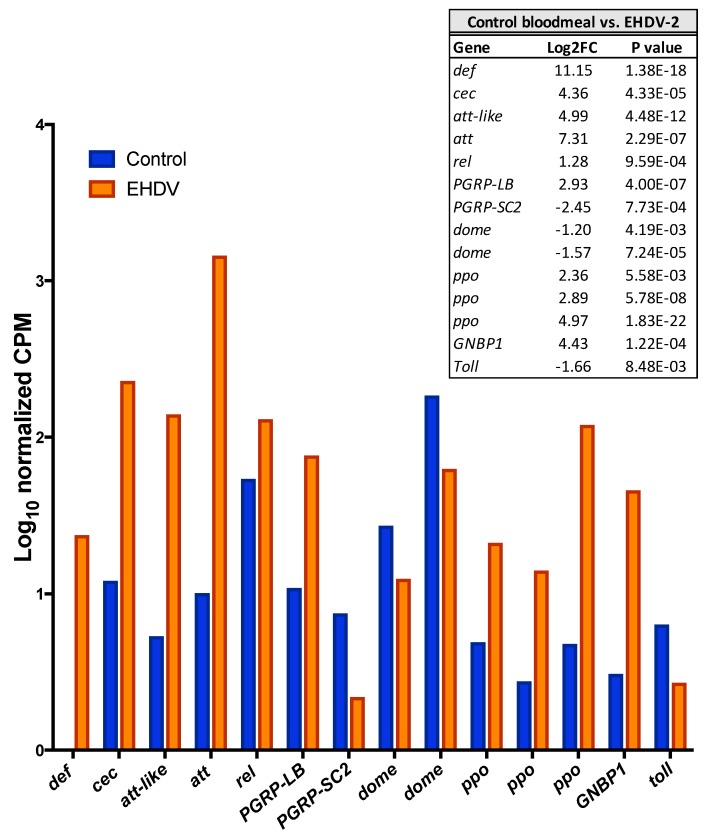
Innate immune genes that were differentially-expressed after EHDV-2 infection in the midge. Control midges were fed blood with sterile virus media and EHDV-2 midges were fed blood with virus in media (n = 15 per replicate, 2 replicates). Data were captured at 36 h post-ingestion for whole midges. 10-log CPM (Counts Per Million mapped reads) represents relative expression across conditions (normalized for two replicates). All unigenes shown were differentially expressed between the two conditions (p < 0.05). Log2FC and actual p values are shown in inset table with further details between the two conditions available in Table S2. def, defensin (m.9997); cec, cecropin (m.10000); att-like, attacin-like (m.3410), att, attacin (m.7821), rel, relish (m.58438), PGRP-LB, peptidoglycan recognition protein LB (v.751); PGRP-SC2, peptidoglycan recognition protein SC2 (m.9236); dome, dome cytokine receptor (paralogs: m.63662; m.64065); ppo, prophenoloxidase (paralogs: m.21464, m.5965, m.41748); GNBP1, Beta-1,3-glucan-binding protein-1 (m.20067); toll, toll receptor (m.9915).
Figure 3
Figure 3
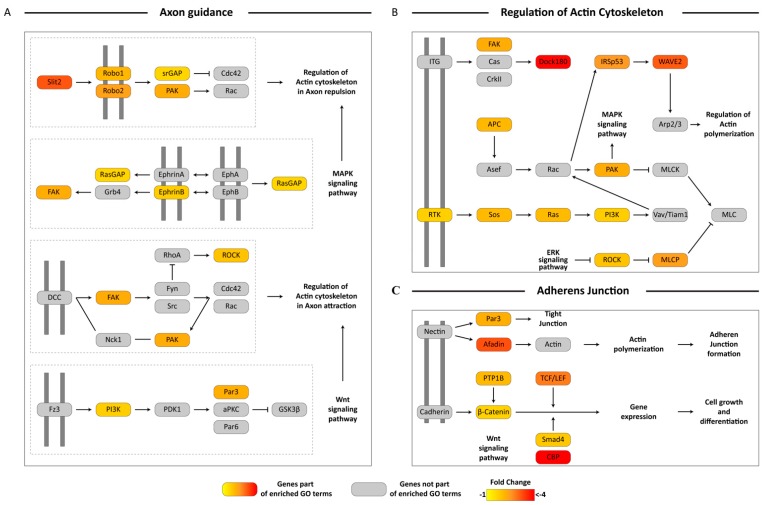
Pathway visualization using downregulated differentially-expressed unigenes in Axon guidance, Regulation of actin cytoskeleton and Adherens junction. Transcripts from enriched Gene Ontology (GO) terms from the downregulated unigene set were mapped on to KEGG Axon guidance pathway (A), Regulation of actin cytoskeleton (B) and Adherens junction (C) pathways and visualized manually. Boxes in color represent protein coding genes that were present within the enriched GO terms. The gradient of the color represents their fold change. Grey boxes represent protein coding genes not present in the enriched GO terms. Dotted lines represent individual modules within the parent pathway. Pathway components present on double grey lines represent cell membrane receptors. Log2FC differences between the two conditions can be referenced in Table S2.
Figure 4
Figure 4
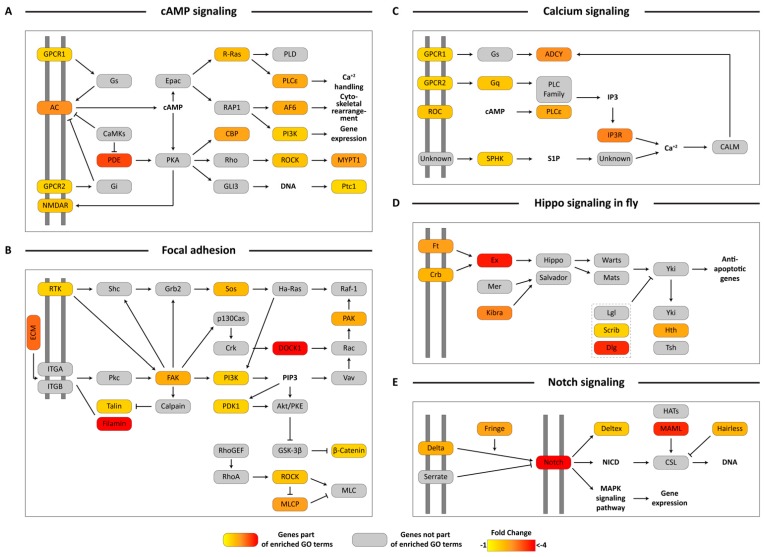
Pathway visualization using downregulated differentially-expressed unigenes in cAMP signaling, Focal adhesion, Calcium signaling, Hippo signaling in fly and Notch signaling. Transcripts from enriched Gene Ontology (GO) terms from the downregulated unigene set were mapped on to KEGG cAMP signaling (A), Focal adhesion (B), Calcium signaling (C), Hippo signaling in fly (D) and Notch signaling (E) pathways and visualized manually. Boxes in color represent protein coding genes that were present within the enriched GO terms. The gradient of the color represents their fold change. Grey boxes represent protein coding genes not present in the enriched GO terms. Pathway components present on double grey lines represent cell membrane receptors. Log2FC differences between the two conditions can be referenced in Table S2.
Figure 5
Figure 5
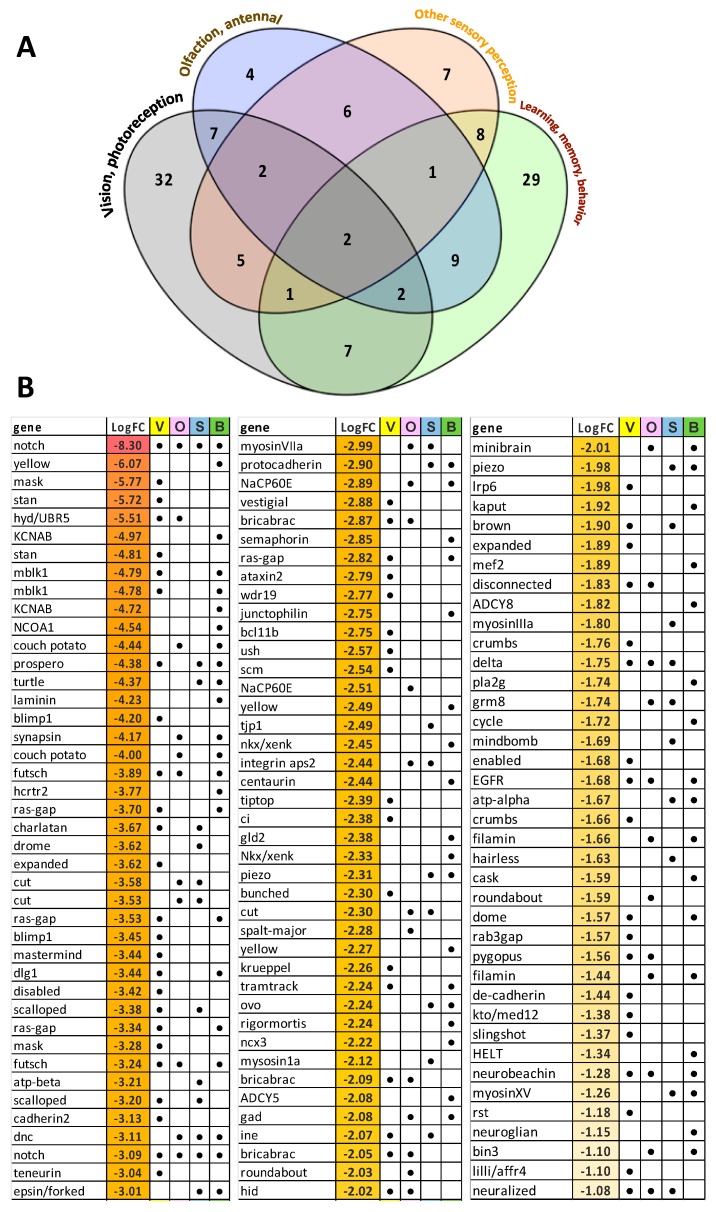
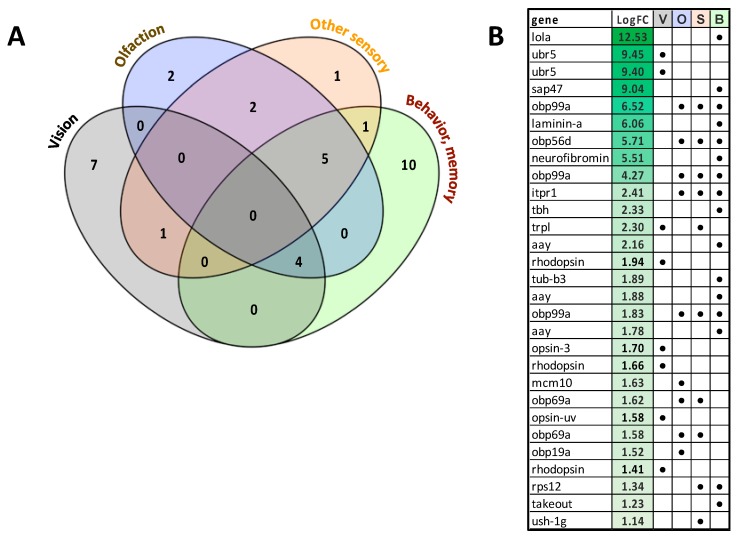
Unigenes associated with sensory processes, behavior, learning and memory that were significantly downregulated in EHDV-2 infected midges. Differentially-expressed unigenes were manually inspected, catalogued and categorized to present sets associated with sensory processes (vision, olfaction, other) and brain functions (learning, memory, behaviors). (A) 122 unigenes were downregulated with EHDV-2 infection: 62 associated with vision, 35 associated with olfaction, 32 other sensory functions (e.g., gustatory, touch), 59 brain functions. (B) Log2FC in expression of unigenes associated with vision (V), olfaction (O), other sensory (S) and brain functions (B) are given. As both panels indicate, many of these unigenes have overlapping functions. Further details including functional roles for each unigene can be found in Supplementary Table S8.
Figure 6
Figure 6
Unigenes associated with sensory processes, behavior, learning and memory that were significantly upregulated in EHDV-2 infected midges. Differentially-expressed unigenes were manually inspected, catalogued and categorized to present sets associated with sensory processes (vision, olfaction, other) and brain functions (learning, memory, behaviors). (A) Of the 29 unigenes that were upregulated with EHDV-2 infection: 8 associated with vision, 9 associated with olfaction, 10 associated with other sensory functions (e.g., gustatory, touch), and 16 to brain, memory and/or learning. (B) Log2-FC in expression of unigenes associated with vision (V), olfaction (O), other sensory (S) and brain functions (B) are given. As both panels indicate, many of these unigenes have overlapping functions. Further details including functional roles for each unigene can be found in Supplementary Table S8.

References

    1. Ruder M.G., Lysyk T.J., Stallknecht D.E., Foil L.D., Johnson D.J., Chase C.C., Dargatz D.A., Gibbs E.P.J. Transmission and epidemiology of bluetongue and epizootic hemorrhagic disease in North America: Current perspectives, research gaps, and future directions. Vector-Borne Zoonotic Dis. 2015;15:348–363. doi: 10.1089/vbz.2014.1703. - DOI - PubMed
    1. Ruder M.G., Johnson D., Ostlund E., Allison A.B., Kienzle C., Phillips J.E., Poulson R.L., Stallknecht D.E. The first 10 years (2006–15) of epizootic hemorrhagic disease virus serotype 6 in the USA. J. Wildl. Dis. 2017;53:901–905. doi: 10.7589/2016-12-284. - DOI - PubMed
    1. Beringer J., Hansen L.P., Stallknecht D.E. An epizootic of hemorrhagic disease in white-tailed deer in Missouri. J. Wildl. Dis. 2000;36:588–591. doi: 10.7589/0090-3558-36.3.588. - DOI - PubMed
    1. Stevens G., McCluskey B., King A., O’Hearn E., Mayr G. Review of the 2012 epizootic hemorrhagic disease outbreak in domestic ruminants in the United States. PLoS ONE. 2015;10:e0133359. doi: 10.1371/journal.pone.0133359. - DOI - PMC - PubMed
    1. Gaydos J.K., Crum J.M., Davidson W.R., Cross S.S., Owen S.F., Stallknecht D.E. Epizootiology of an epizootic hemorrhagic disease outbreak in West Virginia. J. Wildl. Dis. 2004;40:383–393. doi: 10.7589/0090-3558-40.3.383. - DOI - PubMed

Publication types