Review
. 2019 May 24;24(10):2001.
doi: 10.3390/molecules24102001.

Hydroxytyrosol, Tyrosol and Derivatives and Their Potential Effects on Human Health

Affiliations
Review

Hydroxytyrosol, Tyrosol and Derivatives and Their Potential Effects on Human Health

Ana Karković Marković et al. Molecules. .

Abstract

The Mediterranean diet and olive oil as its quintessential part are almost synonymous with a healthy way of eating and living nowadays. This kind of diet has been highly appreciated and is widely recognized for being associated with many favorable effects, such as reduced incidence of different chronic diseases and prolonged longevity. Although olive oil polyphenols present a minor fraction in the composition of olive oil, they seem to be of great importance when it comes to the health benefits, and interest in their biological and potential therapeutic effects is huge. There is a growing body of in vitro and in vivo studies, as well as intervention-based clinical trials, revealing new aspects of already known and many new, previously unknown activities and health effects of these compounds. This review summarizes recent findings regarding biological activities, metabolism and bioavailability of the major olive oil phenolic compounds-hydroxytyrosol, tyrosol, oleuropein, oleocanthal and oleacein-the most important being their antiatherogenic, cardioprotective, anticancer, neuroprotective and endocrine effects. The evidence presented in the review concludes that these phenolic compounds have great pharmacological potential, however, further studies are still required.

Keywords: bioavailability; biological activities; hydroxytyrosol; metabolism; oleacein; oleocanthal; oleuropein; tyrosol.


Conflict of interest statement

The authors declare no conflict of interest.

Figures

Scheme 1
Scheme 1
Mechanism of free radical scavenging by HTyr.
Figure 1
Figure 1
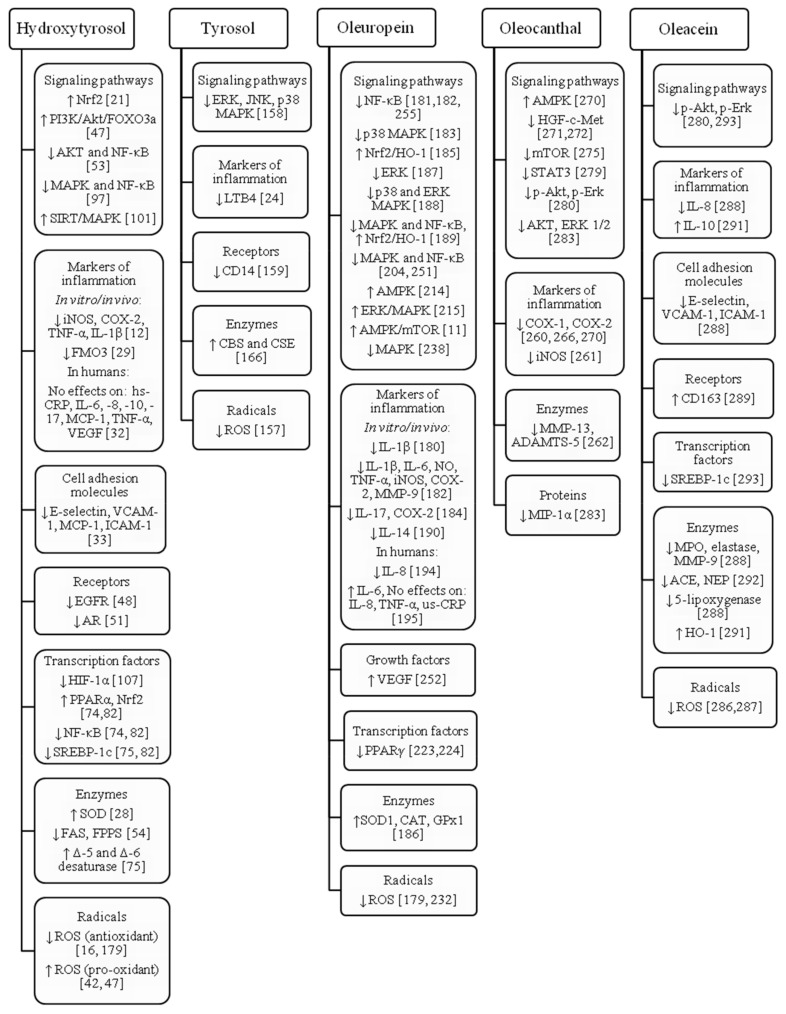
Signaling pathways and targeted molecules affected by hydroxytyrosol, tyrosol, oleuropein, oleocanthal and oleacein. ACE: angiotensin converting enzyme; ADAMTS: a disintegrin and metalloproteinase with thrombospondin motifs (aggrecanase); Akt: Protein kinase B; AMPK: adenosine monophosphate-activated protein kinase; AR: androgen receptor; CAT: catalase; CBS: cystathionine β-synthase; CD: cluster of differentiation; COX: cyclooxygenase; CSE: cystathionine γ-lyase; EGFR: epidermal growth factor receptor; Erk: extracellular regulated mitogen activated protein kinase; FAS: fatty acid synthase; FMO3: flavin containing monooxygenase 3; FPPS: farnesyl diphosphate synthase; GPx1: glutathione peroxidase 1; HGF/c-Met: hepatocyte growth factor/tyrosine-protein kinase Met; HIF-1α: hypoxia-inducible factor-1; HO-1: hem oxygenase 1; hs-CRP: high-sensitive C-reactive protein; ICAM-1: intracellular cell adhesion molecule 1; IL: interleukin; iNOS: inducible nitric oxide syntase; JNK: c-Jun N-terminal kinase; LTB4: leukotriene B4; MAPK: mitogen activated protein kinase; MCP-1: monocyte chemoattractant protein 1; MIP-1α: macrophage inflammatory protein 1α; MMP: matrix metalloproteinase; MPO: myeloperoxidase; mTOR: mammalian target of rapamycin; NEP: neutral endopeptidase; NF-κB: nuclear factor kappa B; NO: nitrogen oxide; Nrf2: nuclear factor E2-related factor 2; p-Akt: phosphorylated Akt; p-Erk: phosphorylated Erk; PI3K/Akt/FOXO3a: phosphoinositide 3-kinase/Akt/Forkhead box O3; PPAR: peroxisome proliferator-activated receptor; ROS: reactive oxygen species; SIRT: sirtuin; SOD: superoxide dismutase; SREBP-1c: sterol regulatory element binding protein 1c; STAT3: signal transducer and activator of transcription 3; TNF-α: tumor necrosis factor-α; VCAM-1: vascular cell adhesion molecule 1; VEGF: vascular endothelial growth factor.
Scheme 2
Scheme 2
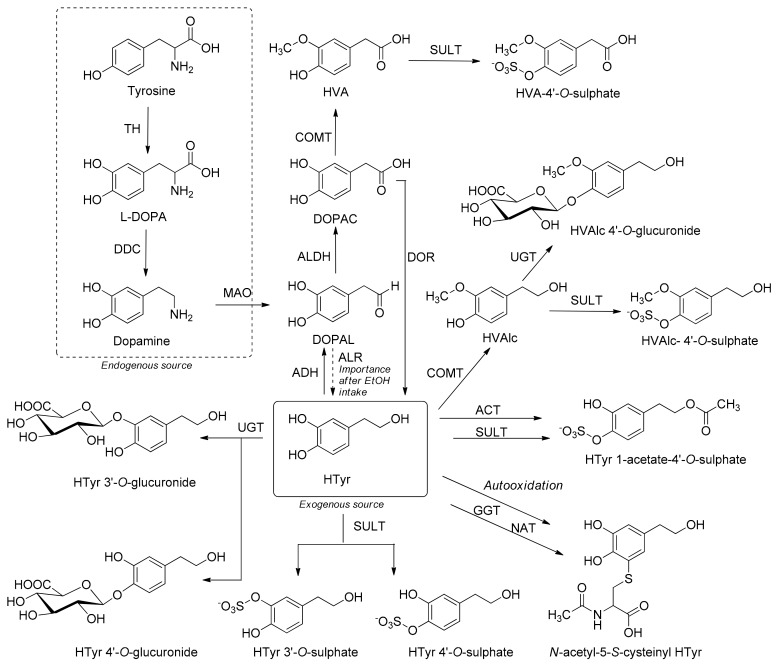
Metabolic pathways of endogenous and exogenous HTyr. HVAlc: homovanillic alcohol; HVA: homovanillic acid; EtOH: ethanol; TH: tyrosine hydroxylase; DDC: dopa decarboxylase; MAO: monoaminoxidase; ALDH: aldehyde dehydrogenase; ALR: aldehyde/aldosa reductase; ADH: alcohol dehydrogenase; DOR: DOPAC reductase; COMT: catechol-O-methyltransferase; UGT: uridine 5′-diphosphoglucuronosyl transferases; SULT: sulphotransferase; ACT: O-acetyltransferase; GGT: γ-glutamyl transpeptidase; NAT: N-acetyl transferase.
Scheme 3
Scheme 3
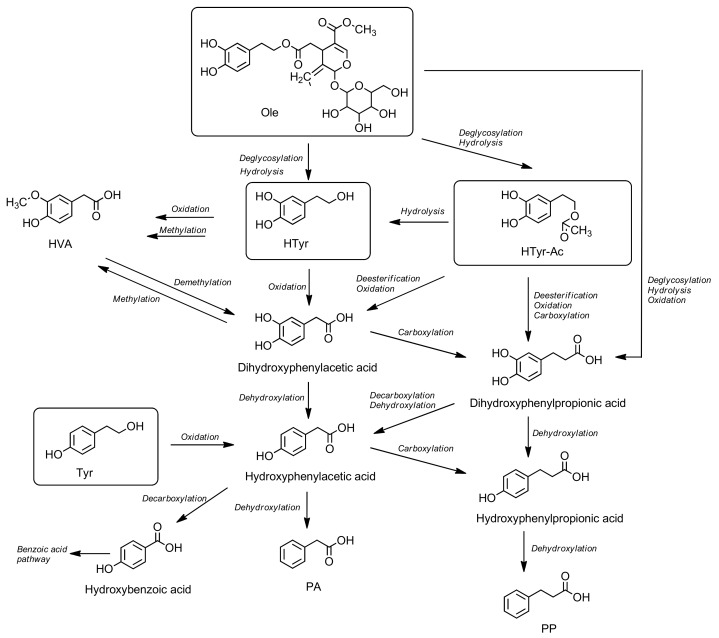
Proposed colonic pathway of hydroxytyrosol (HTyr), tyrosol (Tyr), hydroxytyrosol acetate (HTyr-Ac) and oleuropein (Ole). HVA: homovanillic acid; PA: phenylacetic acid; PP: phenylpropionic acid.
Scheme 4
Scheme 4
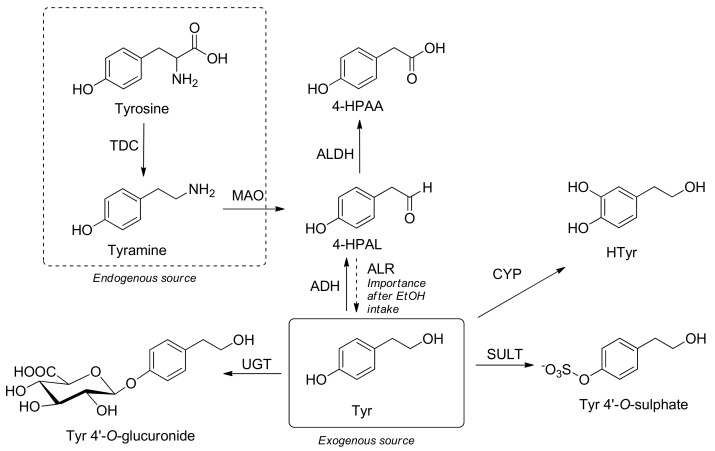
Metabolic pathways of endogenous and exogenous tyrosol (Tyr): Htyr: hydroxytyrosol; 4-HPAA: 4-hydroxyphenylacetic acid; 4-HPAL: 4-hydroxyphenylacetaldehyde; EtOH: ethanol; TDC: tyrosine decarboxylase; MAO: monoaminoxidase; ALDH: aldehyde dehydrogenase; ALR: aldehyde/aldosa reductase; ADH: alcohol dehydrogenase; CYP: cytochrome P450; UGT: uridine 5′-diphosphoglucuronosyl transferases; SULT: sulphotransferase.
Scheme 5
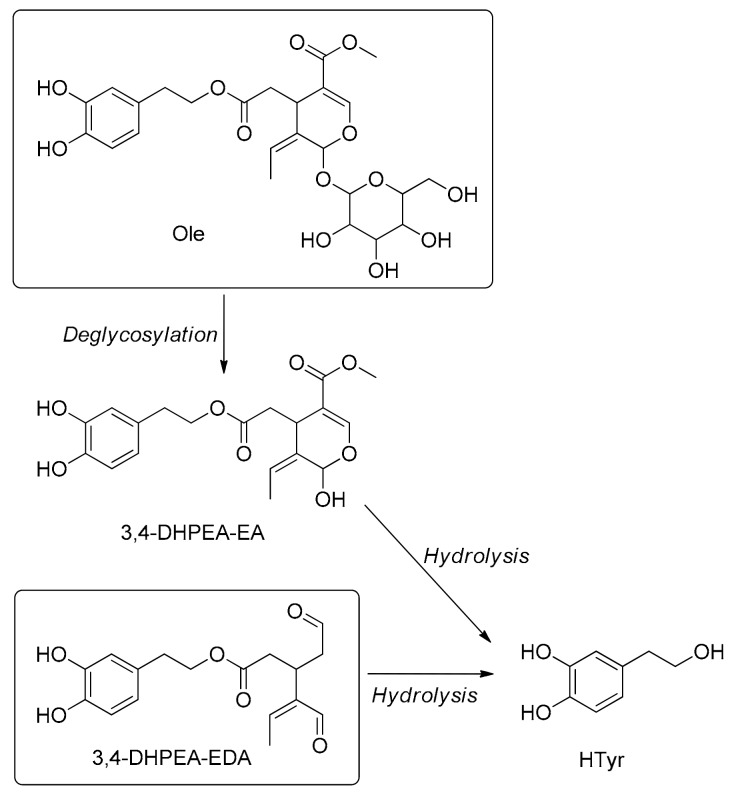
Scheme 5
Metabolic pathways of oleuropein (Ole) and oleacein (3,4-DHPEA-EDA). 3,4-DHPEA-EA: oleuropein aglycone monoaldehyde. The catabolism of the Ole produces both PA and PP families of catabolites [46,144,145] (Scheme III).

References

    1. López-Miranda J., Pérez-Jiménez F., Ros E., De Caterina R., Badimón L., Covas M.I., Escrich E., Ordovás J.M., Soriguer F., Abiá R., et al. Olive oil and health: Summary of the II international conference on olive oil and health consensus report, Jaén and Córdoba (Spain) 2008. Nutr. Metab. Cardiovasc. Dis. 2010;20:284–294. doi: 10.1016/j.numecd.2009.12.007. - DOI - PubMed
    1. Estruch R., Ros E., Salas-Salvadó J., Covas M.-I., Corella D., Arós F., Gómez-Gracia E., Ruiz-Gutiérrez V., Fiol M., Lapetra J., et al. Primary Prevention of Cardiovascular Disease with a Mediterranean Diet Supplemented with Extra-Virgin Olive Oil or Nuts. N. Engl. J. Med. 2018;378:e34. doi: 10.1056/NEJMoa1800389. - DOI - PubMed
    1. Sofi F., Macchi C., Abbate R., Gensini G.F., Casini A. Mediterranean diet and health status: An updated meta-analysis and a proposal for a literature-based adherence score. Public Health Nutr. 2014;17:2769–2782. doi: 10.1017/S1368980013003169. - DOI - PMC - PubMed
    1. Covas M.-I., de la Torre R., Fitó M. Virgin olive oil: A key food for cardiovascular risk protection. Br. J. Nutr. 2015;113:S19–S28. doi: 10.1017/S0007114515000136. - DOI - PubMed
    1. Psaltopoulou T., Kosti R.I., Haidopoulos D., Dimopoulos M., Panagiotakos D.B. Olive oil intake is inversely related to cancer prevalence: A systematic review and a meta-analysis of 13800 patients and 23340 controls in 19 observational studies. Lipids Health Dis. 2011;10:127–143. doi: 10.1186/1476-511X-10-127. - DOI - PMC - PubMed

MeSH terms

LinkOut - more resources