. 2019 May 27;11(5):1187.
doi: 10.3390/nu11051187.

Developmental Vitamin D Deficiency Produces Behavioral Phenotypes of Relevance to Autism in an Animal Model

Affiliations

Developmental Vitamin D Deficiency Produces Behavioral Phenotypes of Relevance to Autism in an Animal Model

Asad Ali et al. Nutrients. .

Abstract

Emerging evidence suggests that gestational or developmental vitamin D (DVD) deficiency is associated with an increased risk of autism spectrum disorder (ASD). ASD is a neurodevelopmental disorder characterized by impairments in social interaction, lack of verbal and non-verbal communications, stereotyped repetitive behaviors and hyper-activities. There are several other clinical features that are commonly comorbid with ASD, including olfactory impairments, anxiety and delays in motor development. Here we investigate these features in an animal model related to ASD-the DVD-deficient rat. Compared to controls, both DVD-deficient male and female pups show altered ultrasonic vocalizations and stereotyped repetitive behavior. Further, the DVD-deficient animals had delayed motor development and impaired motor control. Adolescent DVD-deficient animals had impaired reciprocal social interaction, while as adults, these animals were hyperactive. The DVD-deficient model is associated with a range of behavioral features of interest to ASD.

Keywords: Vitamin D; animal model; autism spectrum disorder; behavior; brain development; ultrasonic vocalizations.


Conflict of interest statement

The authors declare no conflict of interest.

Figures
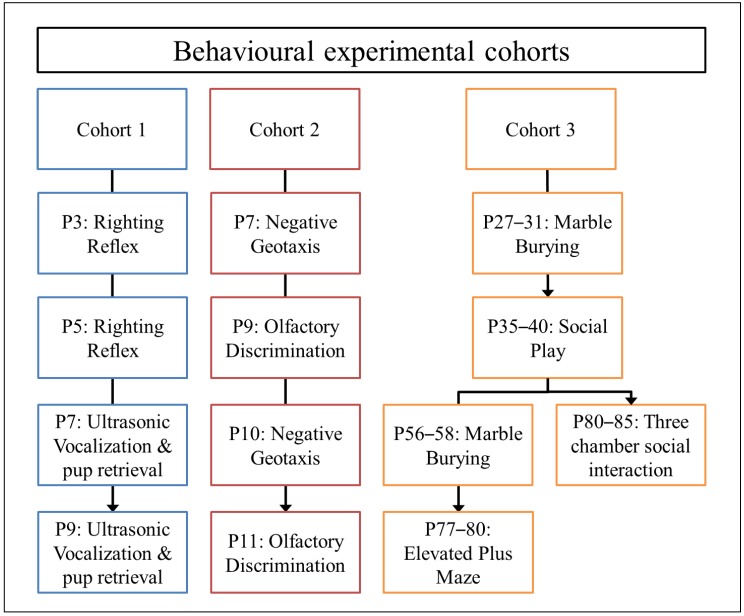
Figure 1
Figure 1
Three separate cohorts were used to assess behaviors in neonates, adolescent and adult rats. Animals were repeated tested at different ages to both assess developmental trajectories and long-term behavioral changes, P = postnatal day.
Figure 2
Figure 2
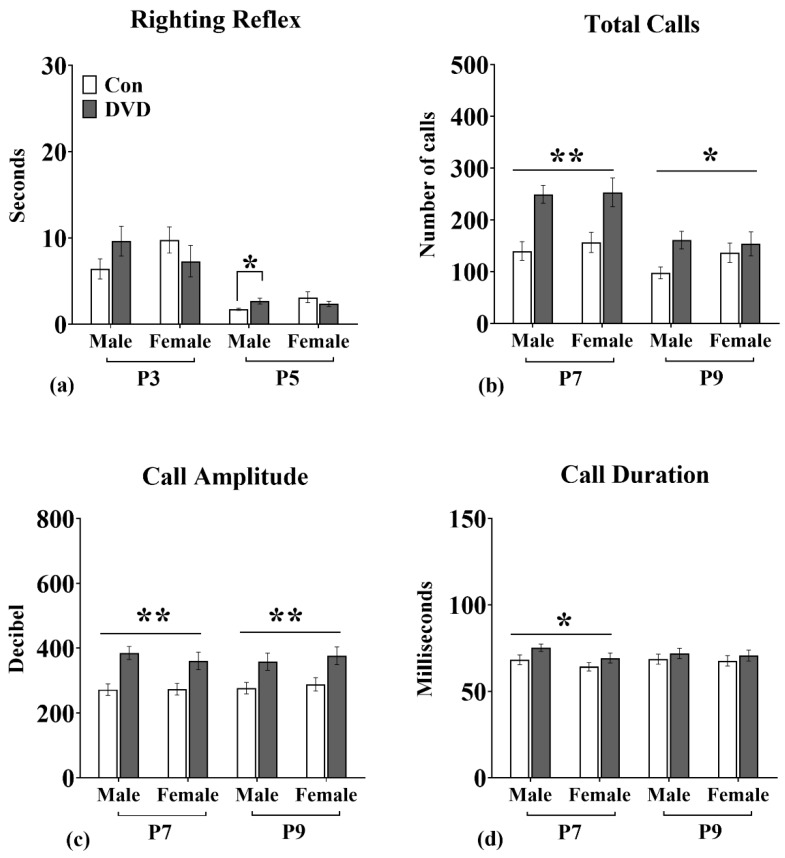
(a) The righting reflex was tested at P3 and P5. There was no effect of developmental vitamin D (DVD)-deficiency on the righting reflex at P3. However, DVD-deficient males showed a delayed latency to right at P5 with no difference in female pups. DVD males n = 49, control males n = 48, DVD females n = 29 and control females n = 43. Data shown is mean time taken by pups to right in seconds. Ultrasonic vocalizations were recorded at P7 and P9. (b) Both DVD-deficient male and female pups emitted significantly greater number and (c) louder calls at P7 and P9 compared with control pups. (d) DVD-deficient pups also emitted long calls at P7 with no difference in call duration at P9. DVD males n = 49, control males n = 48, DVD females n = 29 and control females n = 43. Error bars show SEM, * p < 0.05 and ** p < 0.0001, P = postnatal day.
Figure 3
Figure 3
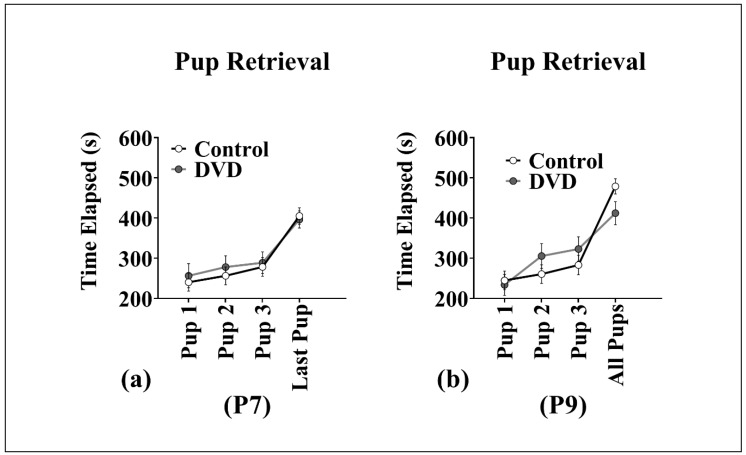
Pup retrieval assay (Cohort 1). Pup retrieval behavior in vitamin D deficient and control dams at P7 and P9. (a) There was no effect of vitamin D deficient diet on the dam’s latency to retrieve pups at P7 and (b) P9. Data reported as latency to retrieve the first, second, third and last pup in seconds. DVD-deficient dams n = 7, control dams n = 8 and error bars show SEM, P = postnatal day.
Figure 4
Figure 4
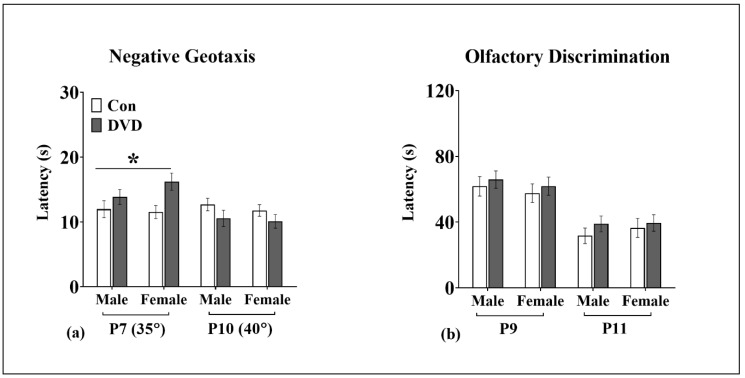
Negative geotaxis and olfactory discrimination (Cohort 2). (a) Negative geotaxis was tested P7 and P10. Both DVD-deficient male and female pups had a delayed latency to attain negative geotaxis compared to controls at P7 with no difference among the diet groups at P10. DVD males n = 42, control males n = 29, DVD females n = 34 and control females n = 30. Data shown is mean time taken by pups to complete a 180° turn in seconds. (b) Olfactory discrimination was tested at P9 and P11. There was no effect of DVD-deficiency on olfactory discrimination in both male and female pups at both testing days. DVD males n = 50, control males n = 44, DVD females n = 63 and control females n = 43. Data shown is mean latency to reach the home bedding side measured in seconds. Error bars show SEM, * p < 0.05, P = postnatal day.
Figure 5
Figure 5
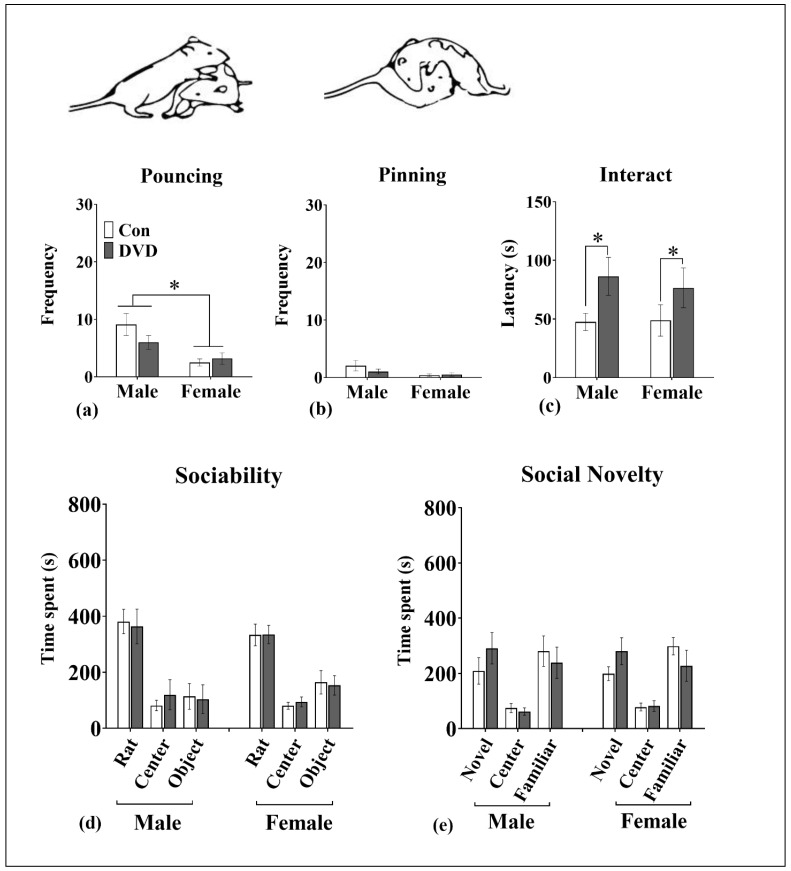
Social play and three chamber social interaction assay (Cohort 3). DVD-deficiency did not affect frequency of (a) pouncing and (b) pinning. However, DVD-deficiency significantly enhanced (c) latency to start interaction in both male and female rats. Male pairs n = 24, control male pairs n = 24, DVD female pairs n = 24 and control female pairs n = 22. In the three-chambered assay, (d) DVD-deficiency does not affect sociability or (e) preference for social novelty. In the sociability phase, experimental rats spent more amount of time in the chamber containing novel rat compared with the novel object. There was also no effect of maternal diet or sex on preference for the rat over object. Social novelty could not be explored as there was no preference displayed for the novel compared to the familiar rat in the control animals. DVD males n = 12, control males n = 12, DVD females n = 12 and control females n = 12. Error bars show SEM and * p < 0.05.
Figure 6
Figure 6
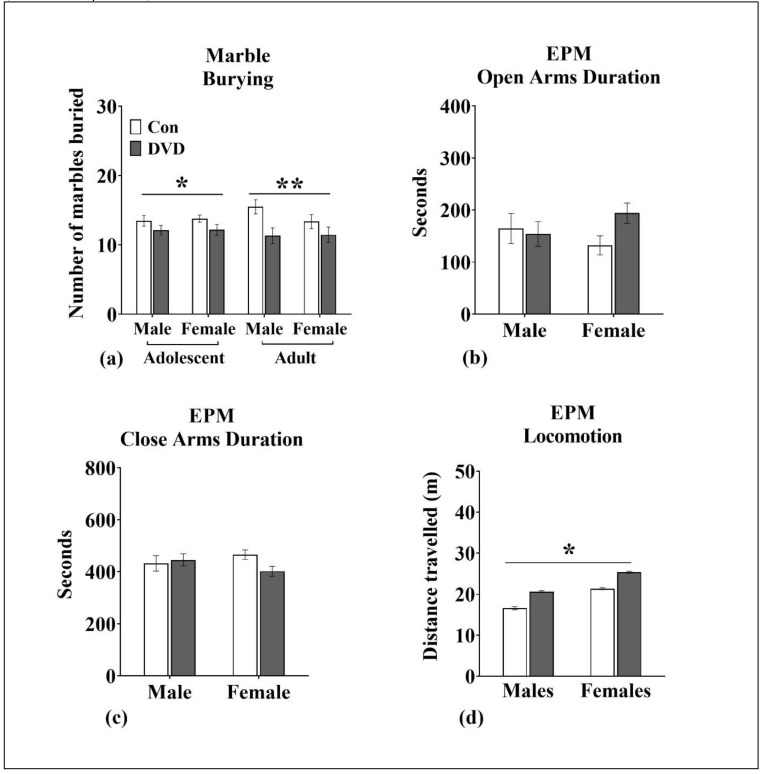
Marble burying and elevated plus maze assay (Cohort 3). (a) DVD-deficient rats from both sexes buried significantly fewer marbles than control rats as both adolescents and adults. DVD males n = 48, control males n = 47, DVD females n = 48 and control females n = 44. Results show the mean number of marble buried in 30 min of session. In the elevated plus maze. (b) DVD-deficiency does not affect the time spent in open arms or (c) closed arms. (d) Both DVD-deficient male and female rats travelled significantly more than control rats. DVD males n = 24, control males n = 16, DVD females n = 26 and control females n = 28. Error bars show SEM, * p < 0.05 and ** p < 0.01, EPM = elevated plus maze.

References

    1. Volkmar F., Chawarska K., Klin A. Autism in infancy and early childhood. Ann. Rev. Psychol. 2005;56:315–336. doi: 10.1146/annurev.psych.56.091103.070159. - DOI - PubMed
    1. American Psychiatric Association . Diagnostic and Statistical Manual of Mental Disorders. American Psychiatric Association; Washington, DC, USA: 2013. - DOI
    1. Provost B., Lopez B.R., Heimerl S. A comparison of motor delays in young children: Autism spectrum disorder, developmental delay, and developmental concerns. J. Autism Dev. Disord. 2007;37:321–328. doi: 10.1007/s10803-006-0170-6. - DOI - PubMed
    1. Lloyd M., MacDonald M., Lord C. Motor Skills of Toddlers with Autism Spectrum Disorders. Autism Int. J. Res. Pract. 2013;17:133–146. doi: 10.1177/1362361311402230. - DOI - PMC - PubMed
    1. Tonacci A., Billeci L., Tartarisco G., Ruta L., Muratori F., Pioggia G., Gangemi S. Olfaction in autism spectrum disorders: A systematic review. Child Neuropsychol. 2017;23:1–25. doi: 10.1080/09297049.2015.1081678. - DOI - PubMed

MeSH terms