. 2019 May 28;12(1):269.
doi: 10.1186/s13071-019-3520-x.

Ellagic acid microspheres restrict the growth of Babesia and Theileria in vitro and Babesia microti in vivo

Affiliations

Ellagic acid microspheres restrict the growth of Babesia and Theileria in vitro and Babesia microti in vivo

Amani Magdy Beshbishy et al. Parasit Vectors. .

Abstract

Background: There are no effective vaccines against Babesia and Theileria parasites; therefore, therapy depends heavily on antiprotozoal drugs. Treatment options for piroplasmosis are limited; thus, the need for new antiprotozoal agents is becoming increasingly urgent. Ellagic acid (EA) is a polyphenol found in various plant products and has antioxidant, antibacterial and effective antimalarial activity in vitro and in vivo without toxicity. The present study documents the efficacy of EA and EA-loaded nanoparticles (EA-NPs) on the growth of Babesia and Theileria.

Methods: In this study, the inhibitory effect of EA, β-cyclodextrin ellagic acid (β-CD EA) and antisolvent precipitation with a syringe pump prepared ellagic acid (APSP EA) was evaluated on four Babesia species and Theileria equi in vitro, and on the multiplication of B. microti in mice. The cytotoxicity assay was tested on Madin-Darby bovine kidney (MDBK), mouse embryonic fibroblast (NIH/3T3) and human foreskin fibroblast (HFF) cell lines.

Results: The half-maximal inhibitory concentration (IC50) values of EA and β-CD EA on B. bovis, B. bigemina, B. divergens, B. caballi and T. equi were 9.58 ± 1.47, 7.87 ± 5.8, 5.41 ± 2.8, 3.29 ± 0.42 and 7.46 ± 0.6 µM and 8.8 ± 0.53, 18.9 ± 0.025, 11 ± 0.37, 4.4 ± 0.6 and 9.1 ± 1.72 µM, respectively. The IC50 values of APSP EA on B. bovis, B. bigemina, B. divergens, B. caballi and T. equi were 4.2 ± 0.42, 9.6 ± 0.6, 2.6 ± 1.47, 0.92 ± 5.8 and 7.3 ± 0.54 µM, respectively. A toxicity assay showed that EA, β-CD EA and APSP EA affected the viability of cells with a half-maximal effective concentration (EC50) higher than 800 µM. In the experiments on mice, APSP EA at a concentration of 70 mg/kg reduced the peak parasitemia of B. microti by 68.1%. Furthermore, the APSP EA-atovaquone (AQ) combination showed a higher chemotherapeutic effect than that of APSP EA monotherapy.

Conclusions: To our knowledge, this is the first study to demonstrate the in vitro and in vivo antibabesial action of EA-NPs and thus supports the use of nanoparticles as an alternative antiparasitic agent.

Keywords: APSP EA; Babesia; Ellagic acid; Nanoparticles; Theileria; β-cyclodextrin ellagic acid.


Conflict of interest statement

The authors declare that they have no competing interests.

Figures
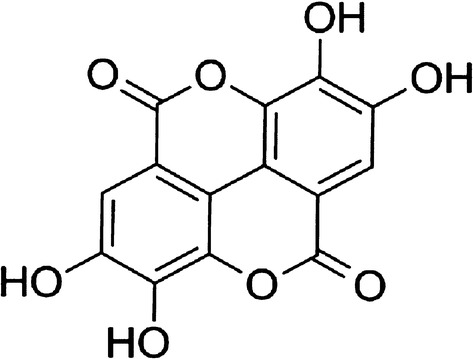
Fig. 1
Fig. 1
Chemical structure of ellagic acid
Fig. 2
Fig. 2
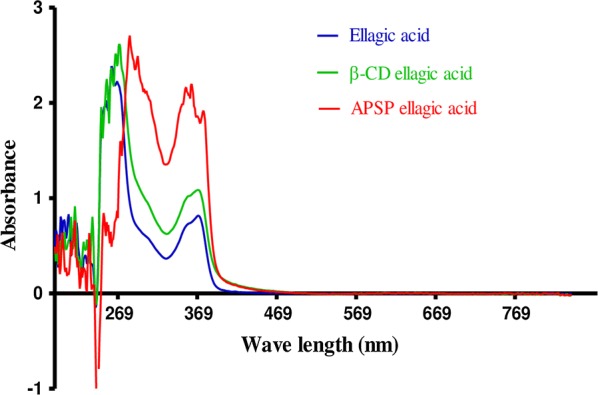
UV/Vis absorbance spectra of nanoparticles (150–800 nm)
Fig. 3
Fig. 3
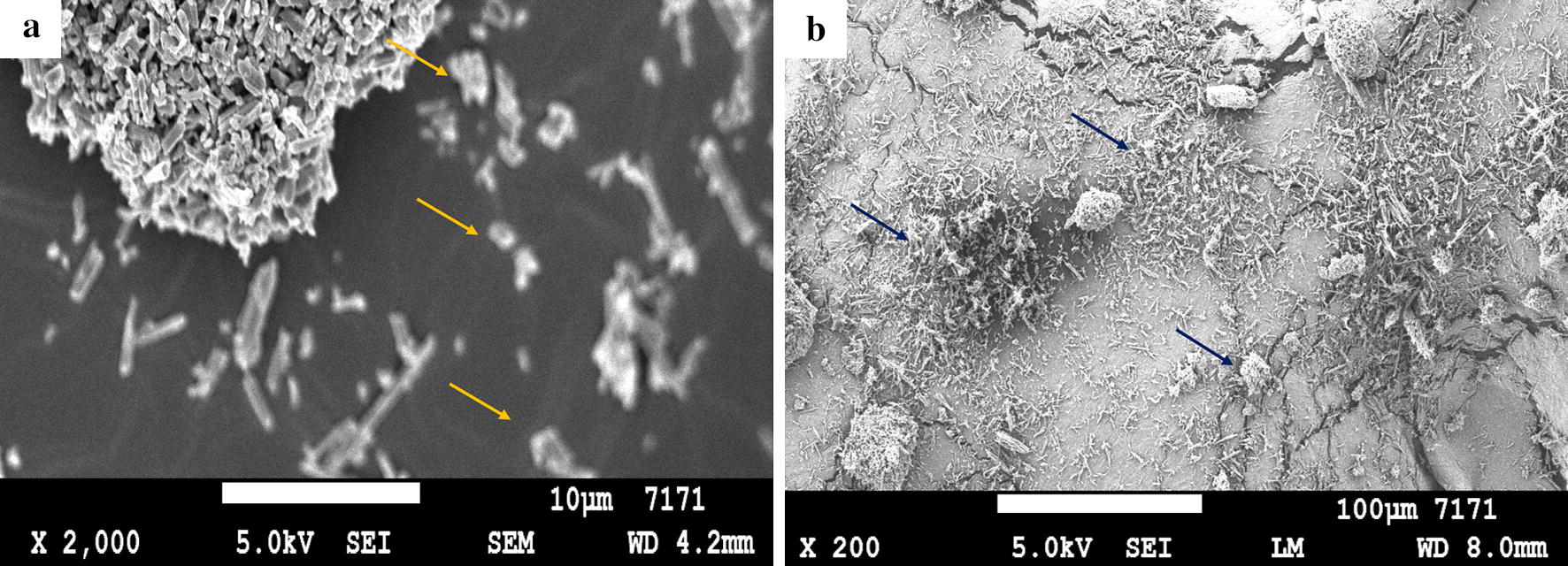
a, b Scanning electron microscope (SEM) image of APSP EA nanoparticles. The arrows show the needle-shaped or rod-like crystal structure of APSP EA nanoparticles. Scale-bars: a, 10 µm; b, 100 µm
Fig. 4
Fig. 4
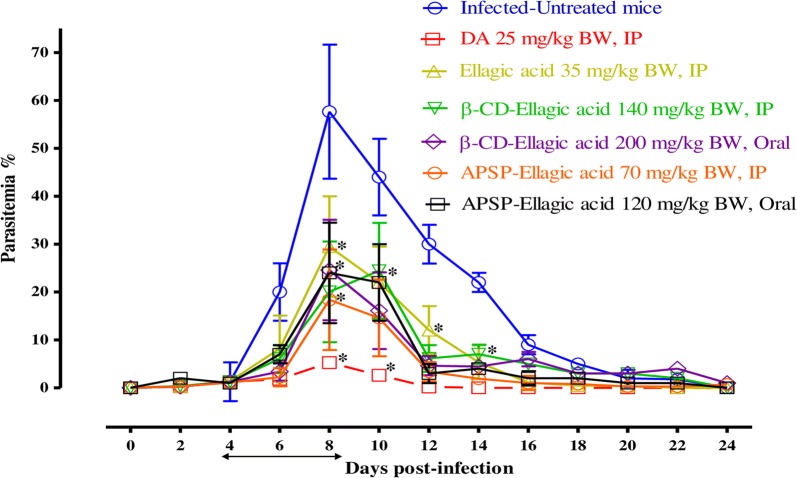
Growth inhibition of EA, β-CD EA and APSP EA on B. microti in vivo. Graph showing the inhibitory effects of DA-IP, EA-IP, β-CD EA-IP, β-CD EA-oral, APSP EA-IP and APSP EA-oral treatment compared to the untreated group. The values plotted indicate the mean ± standard deviation for two separate experiments. Asterisks (*) indicate statistically significant differences (P < 0.05) based on the unpaired t-test analysis. The arrow indicates 5 consecutive days of treatment. Parasitemia was calculated by counting infected RBCs among 5000 RBCs using Giemsa-stained thin blood smears. Abbreviations: DA, diminazene aceturate; EA, ellagic acid; β-CD EA, β-cyclodextrin ellagic acid; APSP EA, antisolvent precipitation with syringe pump prepared ellagic acid; IP, intraperitoneal; RBCs, red blood cells
Fig. 5
Fig. 5
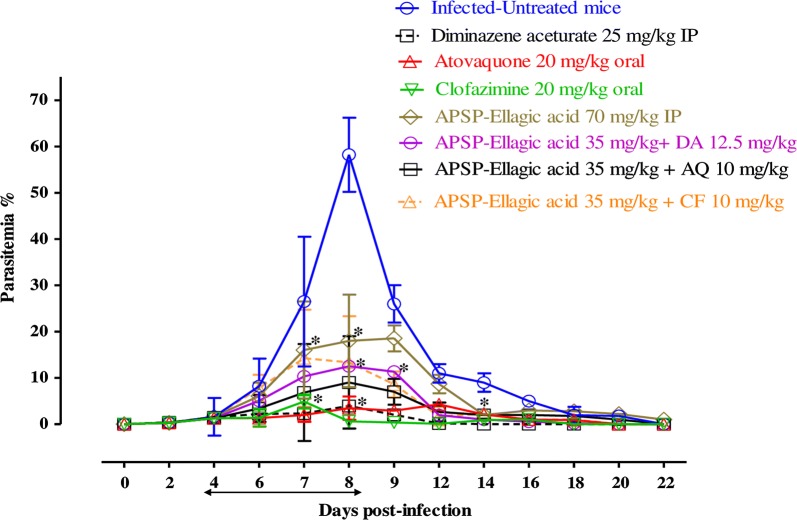
Growth inhibition of APSP-ellagic acid on B. microti in vivo. Graph showing the inhibitory effects of DA-IP, AQ-oral, CF-oral, APSP EA-IP, APSP EA-DA, APSP EA-AQ and APSP EA-CF treatment as compared to the untreated group. The values plotted indicate the mean ± standard deviation for two separate experiments. Asterisks (*) indicate statistically significant differences (P < 0.05) based on the unpaired t-test analysis. The arrow indicates 5 consecutive days of treatment. Parasitemia was calculated by counting infected RBCs among 5000 RBCs using Giemsa-stained thin blood smears. Abbreviations: DA, diminazene aceturate; AQ, atovaquone; CF, clofazimine; EA, ellagic acid; APSP EA, antisolvent precipitation with syringe pump prepared ellagic acid; IP, intraperitoneal; RBCs, red blood cells
Fig. 6
Fig. 6
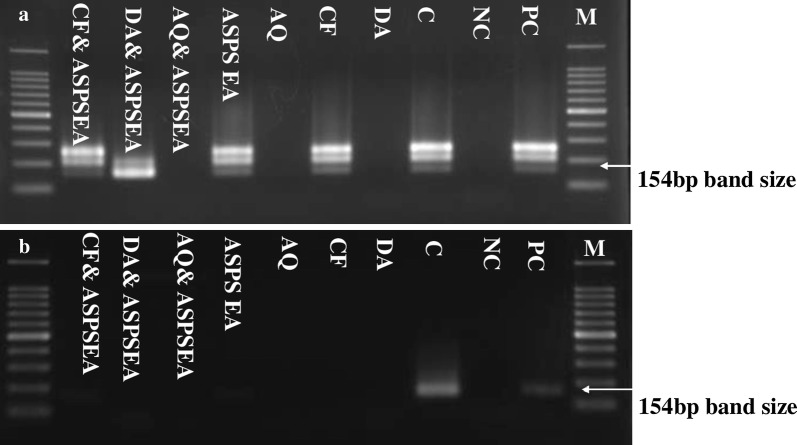
Molecular detection of parasite DNA in the blood of treated groups. Images a, b show the molecular detection of parasites in the blood of treated groups. Double distilled water (DDW) was used as a negative control. The arrow shows the expected band length of 154 bp for positive cases of B. microti. Abbreviations: PC, positive control; NC, negative control; M, marker; C, B. microti DNA; DA, diminazene aceturate; AQ, atovaquone; CF, clofazimine; EA, ellagic acid; APSP EA, antisolvent precipitation with syringe pump prepared ellagic acid; β-CD EA, β-cyclodextrin ellagic acid

References

    1. Hunfeld KP, Hildebrandt A, Gray JS. Babesiosis: recent insights into an ancient disease. Int J Parasitol. 2008;38:1219–1237. doi: 10.1016/j.ijpara.2008.03.001. - DOI - PubMed
    1. Baldissera MD, Grando TH, Souza CF, Cossetin LF, Sagrillo MR, Atia Nascimento K, et al. Nerolidol nanospheres increases its trypanocidal efficacy against Trypanosoma evansi: new approach against diminazene aceturate resistance and toxicity. Exp Parasitol. 2016;166:144–149. doi: 10.1016/j.exppara.2016.04.015. - DOI - PubMed
    1. da Silva Oliveira GL, de Freitas RM. Diminazene aceturate—an antiparasitic drug of antiquity: advances in pharmacology & therapeutics. Pharmacol Res. 2015;102:138–157. doi: 10.1016/j.phrs.2015.10.005. - DOI - PubMed
    1. Krause PJ, Lepore T, Sikand VK, Gadbaw J, Burke G, Telford SR, et al. Atovaquone and azithromycin for the treatment of babesiosis. N Engl J Med. 2000;343:1454–1458. doi: 10.1056/NEJM200011163432004. - DOI - PubMed
    1. Guler JL, White IJ, Phillips MA, Rathod PK. Atovaquone tolerance in Plasmodium falciparum parasites selected for high-level resistance to a dihydroorotate dehydrogenase inhibitor. Antimicrob Agents Chemother. 2015;59:686–689. doi: 10.1128/AAC.02347-14. - DOI - PMC - PubMed

MeSH terms

LinkOut - more resources