


Biological treatment of ankylosing spondylitis: a nationwide study of treatment trajectories on a patient level in clinical practice
- PMID: 31138285
- PMCID: PMC6540538
- DOI: 10.1186/s13075-019-1908-9
Biological treatment of ankylosing spondylitis: a nationwide study of treatment trajectories on a patient level in clinical practice
Abstract
Background: There is substantial evidence that patients with ankylosing spondylitis (AS) have high response rates to tumour necrosis factor inhibitors (TNFi), a low likelihood of successful treatment termination, but yet a limited drug retention. Whereas several reports have assessed drug retention rates for TNFi in AS, there are few, if any, studies investigating the actual treatment trajectories on a patient level, including subsequent therapy changes and dose reductions, of individual patients. The aim of this study was to describe 5-year treatment trajectories in patients with ankylosing spondylitis (AS) starting a first TNFi.
Methods: Bio-naïve patients with AS starting a TNFi in 2006-2015 were identified in the nationwide Swedish Rheumatology Quality register and followed until 31 December 2015. All changes in their anti-rheumatic treatment during follow-up were recorded. To further increase precision, these data were complimented by information on the amount of prescribed subcutaneous TNFi collected from pharmacies during each year, retrieved from the Swedish Prescribed Drug Register.
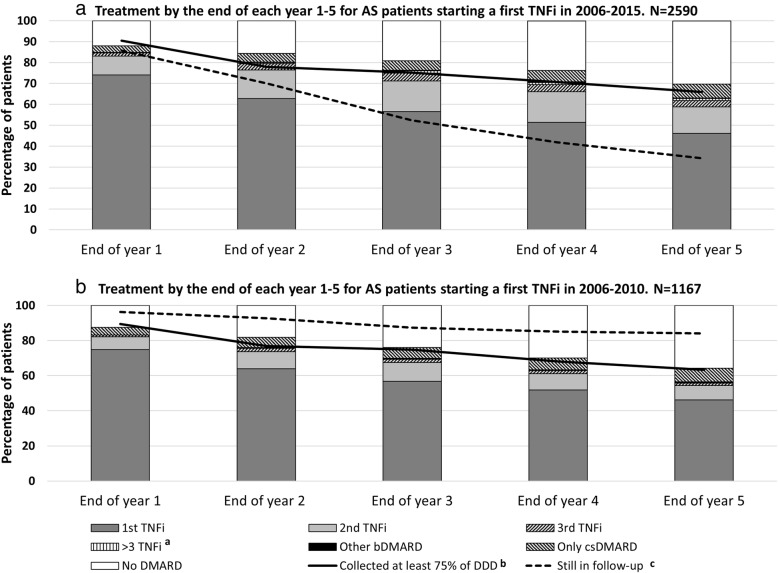
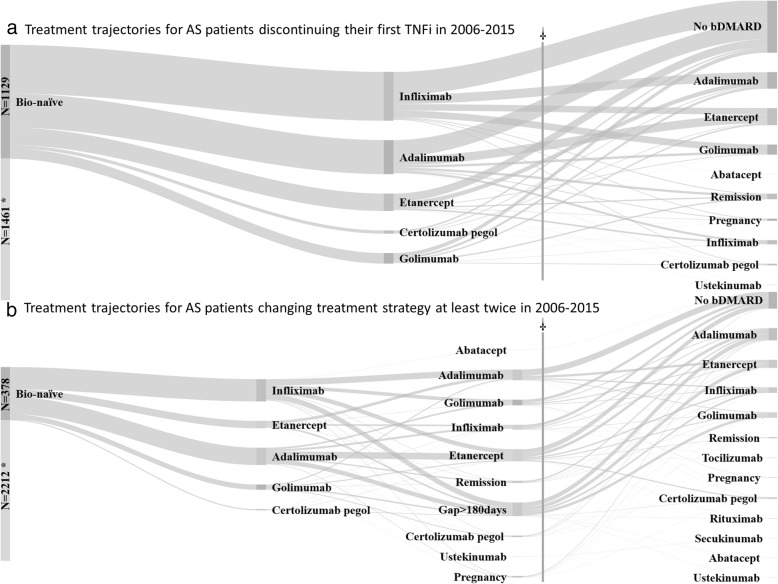
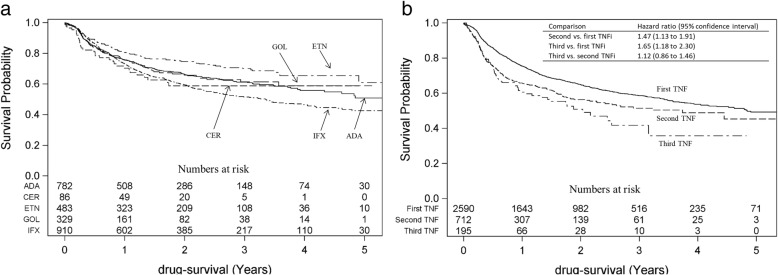
Results: Two thousand five hundred ninety patients started a first TNFi 2006-2015, and after 1 year, 74% remained on their first TNFi. However, after 5 years, this figure was only 46%, although at that time 63% were still on treatment with any biologic, while 30% had no anti-rheumatic treatment at all. After discontinuing the first TNFi, 46% switched directly to a second TNFi, but the drug retention for the second and third TNFi grew successively shorter compared to that for the first TNFi. In contrast, patients remaining on treatment with their first subcutaneous TNFi gradually reduced the dose, so that during the fifth year of treatment only 66% had collected ≥ 75% of the defined daily doses for that year.
Conclusion: Less than half of patients with AS will remain on their first TNFi after 5 years, but most are still on a biologic. While patients remaining on treatment with their first TNFi appear to be able to reduce the dose over time, a large proportion cycle through several biologics, and 1/3 have no anti-rheumatic treatment after 5 years. This indicates the importance of thorough follow-up programs as well as a need for alternative therapeutic options.
Keywords: Ankylosing spondylitis; Observational; Treatment; Tumour necrosis factor inhibitor.
Conflict of interest statement
UL, SW, IQ and TO declare that they have no competing interests. JA has entered into agreements with Abbvie, BMS, Lilly, Merck, Pfizer, Roche, Samsung Bioepis, and UCB, mainly for safety monitoring via the Swedish ARTIS system (see below), and received a travel reimbursement from Novartis. Karolinska Institutet has received remuneration for JA’s participation in meetings arranged by Pfizer and by Lilly.
Figures
References
-
- European Medicines Agency. Available from: http://www.ema.europa.eu/ema/. Accessed August 2018.
-
- van der Heijde D, Deodhar A, Braun J, Mack M, Hsu B, Gathany TA, et al. The effect of golimumab therapy on disease activity and health-related quality of life in patients with ankylosing spondylitis: 2-year results of the GO-RAISE trial. J Rheumatol. 2014;41:6. doi: 10.3899/jrheum.131003. - DOI - PubMed
-
- Landewe R, Braun J, Deodhar A, Dougados M, Maksymowych WP, Mease PJ, et al. Efficacy of certolizumab pegol on signs and symptoms of axial spondyloarthritis including ankylosing spondylitis: 24-week results of a double-blind randomised placebo-controlled phase 3 study. Ann Rheum Dis. 2014;73:1. doi: 10.1136/annrheumdis-2013-204231. - DOI - PMC - PubMed
MeSH terms
Substances
Grants and funding
LinkOut - more resources
Full Text Sources
Medical
Research Materials
