. 2019 May 22;5(5):831-841.
doi: 10.1021/acscentsci.9b00114. Epub 2019 May 1.

Graphite-Conjugated Acids Reveal a Molecular Framework for Proton-Coupled Electron Transfer at Electrode Surfaces

Affiliations

Graphite-Conjugated Acids Reveal a Molecular Framework for Proton-Coupled Electron Transfer at Electrode Surfaces

Megan N Jackson et al. ACS Cent Sci. .

Abstract

Proton-coupled electron-transfer (PCET) steps play a key role in energy conversion reactions. Molecular PCET reactions are well-described by "square schemes" in which the overall thermochemistry of the reaction is broken into its constituent proton-transfer and electron-transfer components. Although this description has been essential for understanding molecular PCET, no such framework exists for PCET reactions that take place at electrode surfaces. Herein, we develop a molecular square scheme framework for interfacial PCET by investigating the electrochemistry of molecularly well-defined acid/base sites conjugated to graphitic electrodes. Using cyclic voltammetry, we first demonstrate that, irrespective of the redox properties of the corresponding molecular analogue, proton transfer to graphite-conjugated acid/base sites is coupled to electron transfer. We then show that the thermochemistry of surface PCET events can be described by the pK a of the molecular analogue and the potential of zero free charge (zero-field reduction potential) of the electrode. This work provides a general framework for analyzing and predicting the thermochemistry of interfacial PCET reactions.


Conflict of interest statement

The authors declare the following competing financial interest(s): M.N.J. and Y.S. are inventors on patent application 15/236,963, submitted by the Massachusetts Institute of Technology, that covers the graphite-conjugated materials described in this work.

Figures
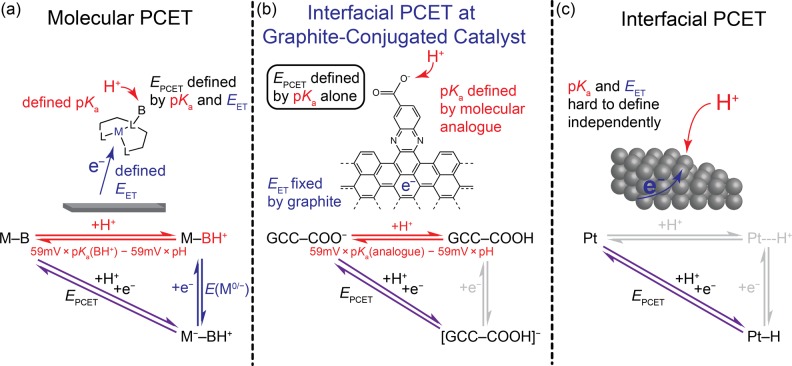
Figure 1
Figure 1
(a) Partial square scheme for the molecular proton-coupled electron-transfer (PCET) reaction M–B + H+ + e → M–BH+. The horizontal leg represents the thermochemistry of the proton-transfer step, determined by the pKa of the proton acceptor and the pH of the solution. The vertical leg represents the thermochemistry of the electron-transfer step, determined by the reduction potential of the protonated molecule, M–BH+, in the absence of proton transfer. The diagonal represents the thermochemistry of the overall reaction, which is the sum of the two legs. (b) Partial square scheme for PCET at a GCC–COOH site. The pKa in the horizontal leg is taken as that of a molecular phenazine analogue, and the vertical leg is grayed out because the parameter defining it was unknown prior to this work. (c) Partial square scheme for a PCET reaction to form a bond at a Pt surface. The horizontal and vertical legs of the scheme defining these legs were unknown prior to this work.
Scheme 1
Scheme 1. Synthesis of GCCs
Figure 2
Figure 2
Cyclic voltammogram (100 mV s–1) of GCC-phenazine recorded in 0.1 M NaOH.
Figure 3
Figure 3
Cyclic voltammograms (100 mV s–1) recorded in 0.1 M NaOH of (a) GCC-phen-COOH and (b) quinoxaline-6-carboxylate.
Figure 4
Figure 4
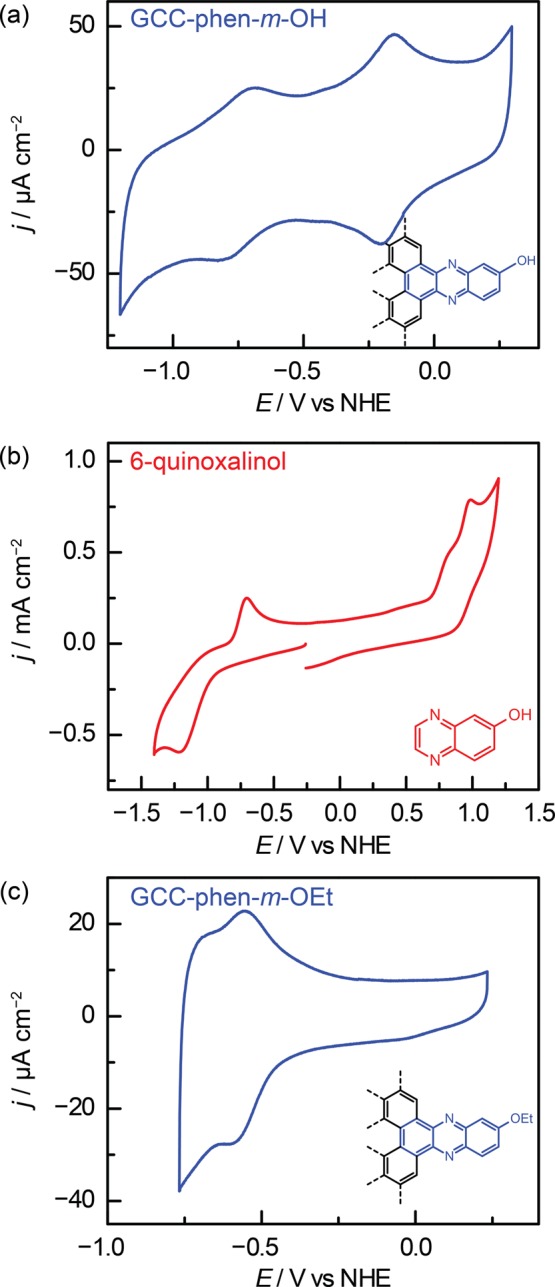
Cyclic voltammograms (100 mV s–1) recorded in 0.1 M NaOH of (a) GCC-phen-m-OH, (b) 6-quinoxalinol, and (c) GCC-phen-m-OEt.
Figure 5
Figure 5
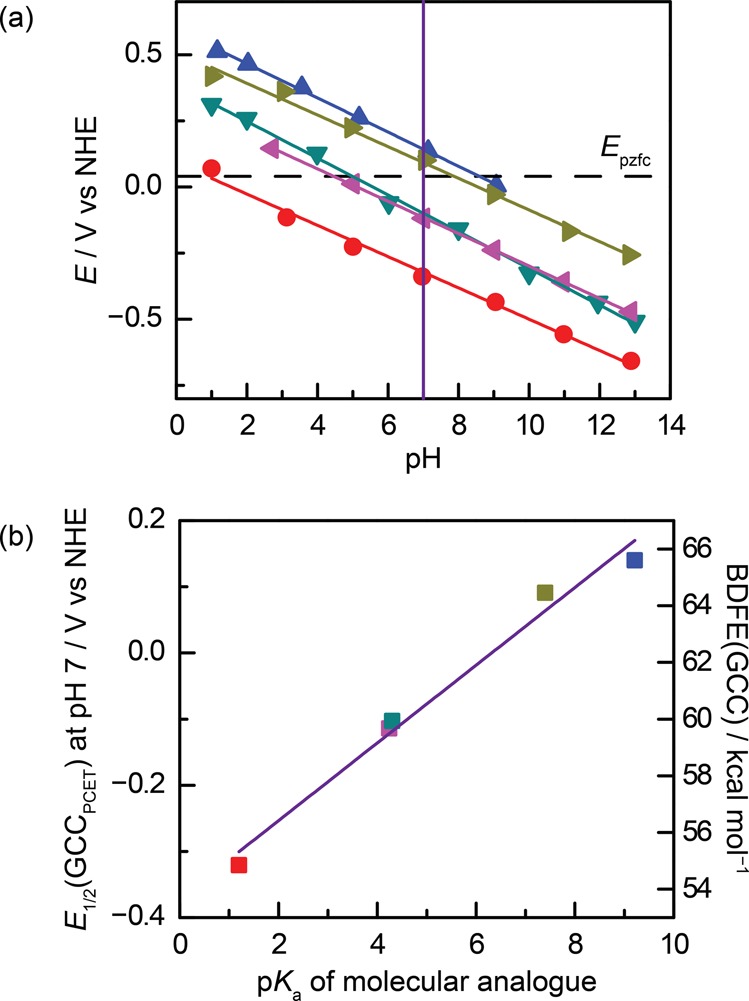
(a) Pourbaix diagram showing pH-dependence of interfacial proton-coupled electron-transfer (PCET) waves for GCC-phenazine (red), GCC-phen-NH2 (purple), GCC-phen-COOH (dark green), GCC-phen-m-OH (olive green), and GCC-phen-o-OH (blue). The purple vertical line shows the interpolated data points from which panel b was constructed. The dotted line shows the computed potential of zero free charge (EPZFC), which is discussed in greater detail below. (b) Plot of the potential of the PCET wave for each GCC at pH 7 vs the pKa of the corresponding acidic site on a molecular phenazine analogue. Values of the pKa for molecular analogues were taken from the literature for phenazine, phenazine-2-carboxylic acid, phenazin-2-amine, phenazin-2-ol, and phenazin-1-ol.
Figure 6
Figure 6
Putative interfacial free energy diagrams for GCC-phen-COOH when the pH of the solution is less than the pKa of the surface COOH in the absence of an external field. In each panel, the gray denotes the filled band states of the electrode, the purple denotes the unfilled band states, and the dotted horizontal black line between the filled and unfilled states denotes the Fermi level of the electrode, EF. The approximate edge of the electrical double layer, EDL, is denoted by a vertical dotted black line, and the free energy required to bind a proton to a surface COO in the absence of an electric field is shown with a vertical blue bar labeled Δμ. The electrostatic potential of the metal, ψM, and solution, ψsoln, are in red, and the difference between them, Δψ, is indicated by a vertical red bar. The electrostatic potential profile across the EDL is indicated by a dotted red line in each diagram. Across all four diagrams, the electrochemical potential required to protonate the surface COO site, E(GCCPCET), and the potential of zero free charge, EPZFC, are denoted by dotted gray lines. The four panels correspond to the situations in which (a) EF < E(GCCPCET), (b) EF = EPZFC, (c) EF = E(GCCPCET), and (d) EF > E(GCCPCET). In each case, varying EF changes the magnitude of the electrostatic potential, which consequently alters the driving force for proton transfer across the double layer to or from the surface COO.
Scheme 2
Scheme 2. Partial Square Scheme for Interfacial Proton-Coupled Electron Transfer (PCET) at GCC-phen-COOH as an Example Reaction
Our model partitions the potential for PCET (diagonal leg) into a horizontal leg, defined as the difference between the 0-field pKa of the surface site and the pH of the solution, and a vertical leg, defined as the potential of zero free charge, EPZFC, of the electrode.

References

    1. Reece S. Y.; Nocera D. G. Proton-Coupled Electron Transfer in Biology: Results from Synergistic Studies in Natural and Model Systems. Annu. Rev. Biochem. 2009, 78 (1), 673–699. 10.1146/annurev.biochem.78.080207.092132. - DOI - PMC - PubMed
    1. Hammes-Schiffer S.; Iordanova N. Theoretical Studies of Proton-Coupled Electron Transfer Reactions. Biochim. Biophys. Acta, Bioenerg. 2004, 1655 (1–3), 29–36. 10.1016/j.bbabio.2003.07.009. - DOI - PubMed
    1. Roubelakis M. M.; Bediako D. K.; Dogutan D. K.; Nocera D. G. Proton-Coupled Electron Transfer Kinetics for the Hydrogen Evolution Reaction of Hangman Porphyrins. Energy Environ. Sci. 2012, 5 (7), 7737–7740. 10.1039/c2ee21123h. - DOI
    1. Rountree E. S.; Dempsey J. L. Reactivity of Proton Sources with a Nickel Hydride Complex in Acetonitrile: Implications for the Study of Fuel-Forming Catalysts. Inorg. Chem. 2016, 55 (10), 5079–5087. 10.1021/acs.inorgchem.6b00885. - DOI - PubMed
    1. Rountree E. S.; Martin D. J.; McCarthy B. D.; Dempsey J. L. Linear Free Energy Relationships in the Hydrogen Evolution Reaction: Kinetic Analysis of a Cobaloxime Catalyst. ACS Catal. 2016, 6 (5), 3326–3335. 10.1021/acscatal.6b00667. - DOI